
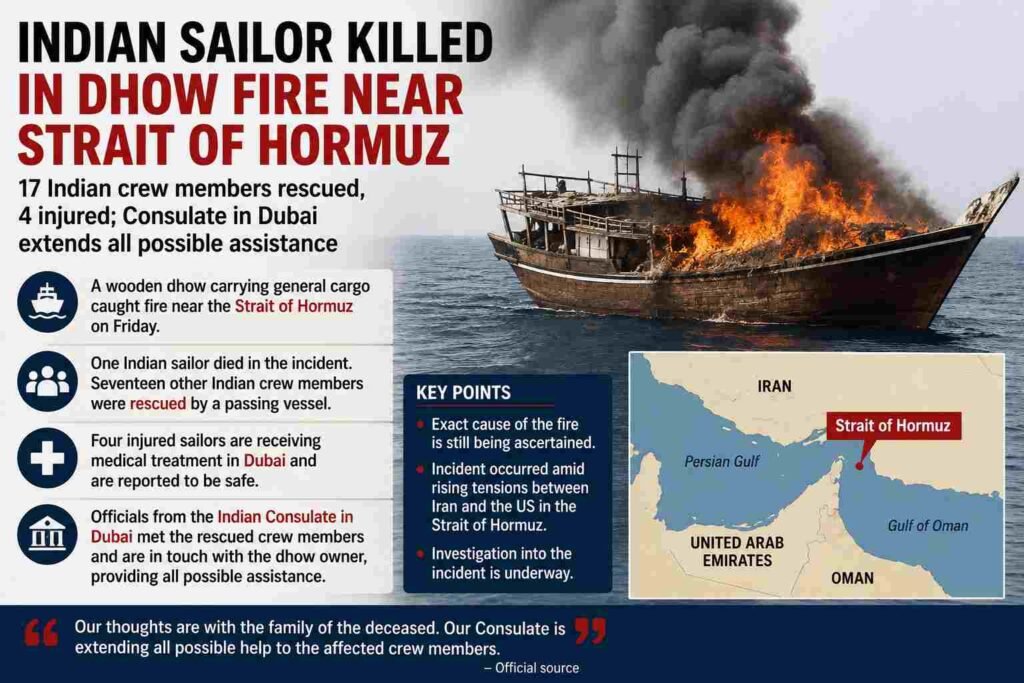
An Indian sailor has died and several others were injured after a wooden cargo vessel caught fire near the strategically critical Strait of Hormuz, highlighting both the human cost of maritime incidents and the risks associated with operating in one of the world’s most sensitive shipping corridors.
According to official sources, the incident occurred on Friday when a traditional wooden dhow, carrying general cargo, suddenly caught fire while navigating waters close to the narrow passage that connects the Persian Gulf to the Arabian Sea. The exact cause of the blaze remains under investigation, with authorities yet to determine whether it was triggered by mechanical failure, human error, or external factors.
There were 18 Indian crew members on board at the time of the incident. While one sailor succumbed to the fire, 17 others were successfully rescued in a timely operation carried out by a passing vessel in the vicinity. The swift response is believed to have prevented a far more devastating outcome, given the flammable nature of wooden dhows and the speed at which onboard fires can escalate.
Four of the rescued sailors sustained burn injuries and were immediately transported to medical facilities in Dubai, where they are currently undergoing treatment. Officials have confirmed that the injured are in stable condition and receiving appropriate medical care.
The Indian Consulate in Dubai has taken charge of providing assistance to the affected crew members. Consular officials met the survivors soon after the incident, ensuring access to medical support, accommodation, and necessary documentation. The consulate is also in close coordination with the dhow’s owner to facilitate further support and eventual repatriation procedures if required.
This maritime tragedy comes at a time of heightened geopolitical tensions in the region, particularly involving Iran and the United States, with the Strait of Hormuz often at the centre of strategic concerns. While there is no immediate indication that the fire was linked to any security-related developments, the incident underscores the vulnerability of civilian vessels operating in high-risk zones.
The Strait of Hormuz is one of the busiest and most crucial oil transit chokepoints in the world, with a significant portion of global energy supplies passing through it daily. Any disruption—whether due to geopolitical tensions or accidents—can have far-reaching economic and security implications.
For Indian seafarers, who form a substantial part of the global maritime workforce, such incidents also raise broader concerns about safety standards, emergency preparedness, and the need for stronger international coordination to protect crews operating in volatile regions.
As investigations continue, authorities are expected to examine the vessel’s condition, safety compliance, and onboard firefighting mechanisms. The focus will also remain on ensuring accountability, preventing future occurrences, and reinforcing maritime safety protocols in sensitive international waters.
The loss of life serves as a stark reminder of the inherent dangers faced by seafarers, whose work often goes unnoticed despite being vital to global trade and connectivity.
AI generated Image