
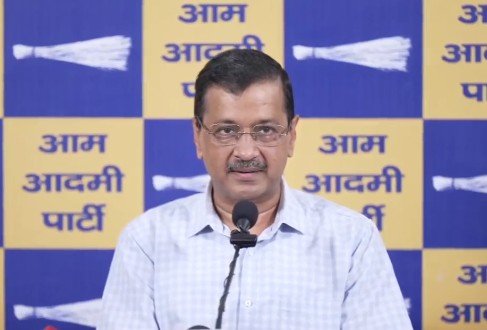
A fresh political confrontation has emerged between the Aam Aadmi Party (AAP) and the Bharatiya Janata Party (BJP), with AAP national convener Arvind Kejriwal launching a sharp critique of Prime Minister Narendra Modi and the Centre’s recent actions in Punjab. In a strongly worded statement, Kejriwal accused the central government of targeting the state through investigative agencies, particularly the Enforcement Directorate (ED), and framed the developments within a broader historical and political narrative.
Drawing a controversial comparison, Kejriwal likened the Prime Minister’s approach to that of Mughal emperor Aurangzeb, invoking the legacy of resistance associated with Punjab’s Sikh Gurus. He suggested that Punjab, with its history rooted in sacrifice and defiance, would stand firm against what he described as “oppression” by the Centre. The remarks, shared via social media, were positioned as both a political message and an appeal to regional identity and historical memory.
The AAP leader’s comments come against the backdrop of a series of ED searches in Punjab, which have recently targeted several individuals linked to political and business circles. Kejriwal alleged that these actions reflect a pattern of politically motivated intervention rather than purely investigative intent. He argued that the frequency of such raids has increased following electoral developments in other states, particularly after the West Bengal Assembly elections, suggesting a strategic shift in focus towards Punjab.
In his remarks, Kejriwal also revisited the farmers’ protests, asserting that Punjab had previously resisted central policies and would continue to do so. He claimed that the current situation represents a broader challenge to the state, not limited to individual leaders or parties. According to him, issues such as water sharing, institutional autonomy, and financial allocations have contributed to a sense of grievance within Punjab, which is now being compounded by enforcement actions.
The AAP chief further cited specific instances to support his claims, referring to past ED operations involving prominent figures. He suggested that such actions were followed by political realignments in some cases, implying that investigative pressure was being used as a tool to influence affiliations. These assertions, however, remain part of the ongoing political debate, with no official confirmation linking enforcement actions to political outcomes.
The BJP has not formally responded to Kejriwal’s latest remarks, but the party has consistently maintained that central agencies operate independently and that their actions are guided by evidence and due process. Government sources have, in the past, rejected allegations of political misuse of institutions, emphasising that anti-corruption efforts must not be viewed through a partisan lens.
The exchange highlights the intensifying political climate in Punjab, where governance, federal relations, and electoral positioning are increasingly intersecting. As investigative actions continue and political rhetoric sharpens, the developments are likely to shape the narrative in the state in the months ahead, particularly with evolving electoral considerations and shifting alliances.
At its core, the controversy underscores a deeper contest over institutional credibility, political accountability, and the balance of power between the Centre and the states—an issue that continues to resonate across India’s federal framework.