
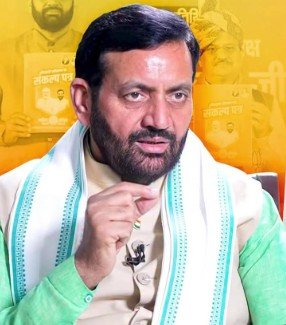
Haryana Chief Minister Nayab Singh Saini has unveiled an ambitious roadmap to transform irrigation practices across the state, placing water conservation and modern farming technology at the centre of Haryana’s long-term agricultural strategy. In a major policy push under the Haryana Vision-2047 framework, the Chief Minister has directed the Irrigation and Water Resources Department to implement large-scale micro-irrigation systems and community-based water storage infrastructure aimed at ensuring that irrigation water reaches every farm while reducing groundwater dependence.
Chairing a high-level review meeting at the Haryana Civil Secretariat in Chandigarh, the Chief Minister stressed that the future of Indian agriculture would depend not merely on expanding cultivation but on managing limited water resources with scientific precision. Referring to Prime Minister Narendra Modi’s “Per Drop More Crop” vision, Saini said Haryana must move beyond traditional irrigation methods and adopt global best practices followed by water-scarce developed nations such as Israel.
At the heart of the new strategy is a plan to encourage groups of farmers to jointly construct irrigation tanks for agricultural clusters of 10 acres or more. These tanks will be filled with canal water through pipeline-based systems and linked directly to micro-irrigation networks including drip and sprinkler technologies. The Haryana government will provide up to 85 percent subsidy for the construction of these collective tanks, making the initiative financially accessible to farmers.
The government believes the model could significantly reduce excessive groundwater extraction and dependence on tube wells, while also lowering electricity consumption associated with traditional irrigation methods. According to officials, solar panels will also be installed over these community tanks, enabling energy-efficient irrigation systems that can provide farmers with flexible access to water whenever needed.
The Chief Minister said the first phase of implementation would begin in nine districts considered vulnerable to water stress and groundwater depletion. These include Bhiwani, Charkhi Dadri, Gurugram, Mahendragarh, Nuh, Rewari, Hisar, Jhajjar and Sirsa. Officials have been instructed to organise farmer groups and begin planning tank-based irrigation infrastructure on priority basis.
Saini emphasised that the government’s objective was not only to conserve water but also to reduce the financial burden on farmers. He said once the new irrigation system becomes operational, farmers would no longer need to spend large amounts on digging borewells or installing tube wells. Instead, canal-fed micro-irrigation systems would ensure reliable and cost-effective water supply directly to fields.
The Chief Minister also underlined the need to discourage the practice of flood irrigation, where large quantities of water are released openly into fields, leading to enormous wastage. By shifting towards precision irrigation systems, Haryana hopes to irrigate larger agricultural areas using significantly less water.
In a notable move, the government has decided to begin micro-irrigation implementation this year itself in water-intensive crops such as sugarcane and cotton. Officials were also asked to explore state-wide tenders for converting entire villages to micro-irrigation systems by the end of the current year. The plan may involve partnerships with modern agri-technology and smart irrigation companies capable of delivering digitally managed irrigation solutions.
The meeting also focused on long-term water management and canal modernisation. The Chief Minister directed the Irrigation Department to prepare a detailed plan for repairing and reconstructing ageing canal networks across Haryana to prevent leakage and water loss. Monthly monitoring mechanisms will now be introduced to track how much water is being saved and how many farmers are benefiting from the reforms.
Another major aspect of the meeting was skill development. Additional Chief Secretary Anurag Agarwal informed the Chief Minister that Haryana currently faces a shortage of technically trained manpower in the micro-irrigation sector. In response, Saini directed that a new micro-irrigation trade be introduced in all Industrial Training Institutes (ITIs) across the state from this year onwards. The government believes this step will create employment opportunities for youth while simultaneously building a skilled workforce capable of supporting Haryana’s irrigation modernisation programme.
The Chief Minister also called for closer coordination between the Agriculture and Irrigation Departments to educate farmers about water-efficient farming practices. He said awareness campaigns must explain to farmers that modern irrigation systems can reduce costs, improve productivity and protect groundwater reserves for future generations.
In addition, the government is now exploring wider use of treated sewage water for agricultural irrigation. Officials were instructed to examine how recycled water from sewage treatment plants could be safely integrated into irrigation networks to reduce pressure on freshwater resources.
Political observers view the initiative as one of Haryana’s most ambitious water-management reforms in recent years. With climate change, declining groundwater tables and rising agricultural demand placing increasing pressure on water resources, the state government appears to be positioning micro-irrigation and precision farming as key pillars of Haryana’s agricultural future.
The announcement also reflects a broader shift in Indian agriculture policy, where sustainability, technology and resource efficiency are gradually becoming as important as production itself. For Haryana — a state that has long been at the centre of India’s food security system — the success of such reforms could shape not only the future of farming in the region but also offer a model for water-stressed states across the country.