
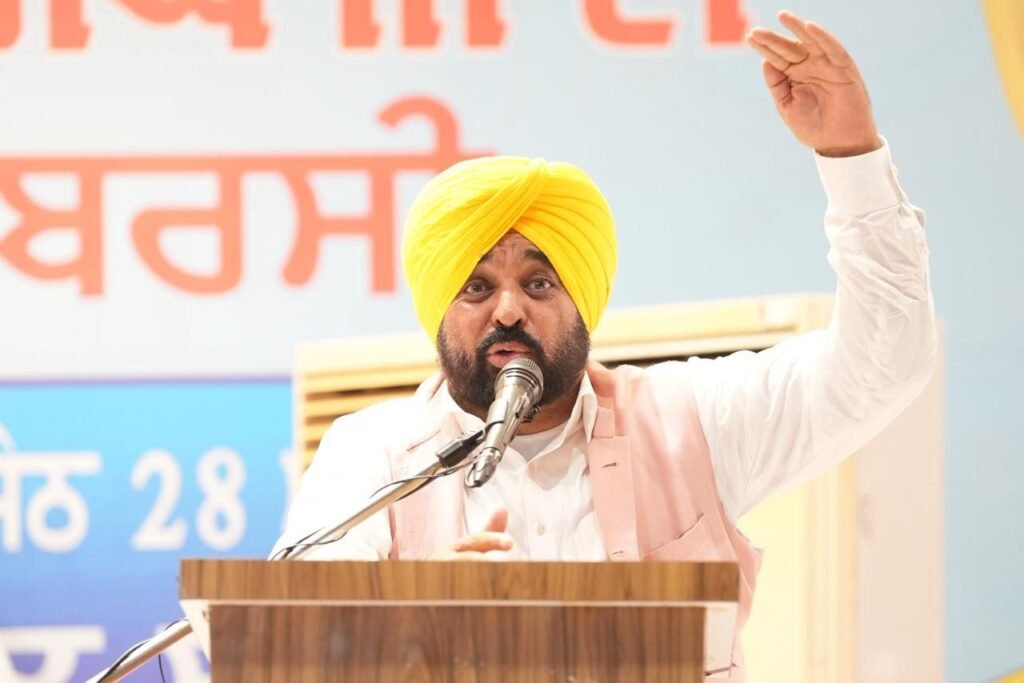
Punjab Chief Minister Bhagwant Singh Mann used the platform of a major religious and social gathering at Seechewal village to present what he described as a blueprint for a prosperous, environmentally sustainable and socially united Punjab, linking the state’s future to investments in education, healthcare, sports infrastructure, irrigation and environmental conservation.
The occasion was the 38th Salana Barsi Samagam of Sant Baba Avtar Singh Ji, a revered spiritual figure remembered for his contribution to Sikh religious and social life. The event drew a large gathering of devotees, community leaders and public representatives. During the programme, the Chief Minister, accompanied by Rajya Sabha Member of Parliament Sant Balbir Singh Seechewal, inaugurated a newly developed astroturf at the Sant Avtar Singh Memorial Hockey Stadium, a project symbolising the state government’s broader emphasis on strengthening sports infrastructure in rural Punjab.
Addressing the gathering, Mann sought to blend themes of development, spirituality and social cohesion. He described Punjab as a land enriched not only by fertile soil but also by a long tradition of tolerance, brotherhood and communal harmony. According to the Chief Minister, the state’s history and cultural identity are deeply shaped by the teachings of Sikh Gurus, saints and social reformers who advocated compassion, equality and mutual respect.
He cautioned against attempts to create divisions among communities, arguing that Punjab’s strength lies in its social unity. Without naming specific political opponents, Mann suggested that forces seeking to exploit religious and social differences for political gain pose a threat to the state’s peace and stability. He maintained that Punjabis have historically celebrated festivals and traditions together and have repeatedly rejected efforts to divide society along communal lines.
A significant portion of the Chief Minister’s address focused on environmental restoration, an issue closely associated with the work of Sant Balbir Singh Seechewal, whose environmental campaigns have gained national recognition. Referring to the Sikh teaching “Pawan Guru, Pani Pita, Mata Dharat Mahat,” Mann emphasised the spiritual responsibility of protecting air, water and land. He argued that environmental conservation must become a collective mission, particularly at a time when concerns over groundwater depletion, pollution and ecological degradation continue to affect large parts of Punjab.
The Chief Minister highlighted what he described as tangible progress in water conservation and irrigation management. According to him, the state government has significantly expanded canal-based irrigation systems, enabling the release of approximately 21,000 cusecs of water to agricultural fields. He claimed that this volume is comparable to the supply capacity of two Bhakra canals and has helped reduce dependence on groundwater extraction.
Mann further stated that extensive investments in irrigation infrastructure, including nearly 14,000 kilometres of pipelines and watercourses, have improved water distribution to farmers across the state. The creation of recharge structures along canals and rivers, he said, has contributed to a measurable rise in groundwater levels, with some regions recording increases of between two and four metres.
The Chief Minister also pointed to the transformation of Seechewal itself as an example of environmental renewal. He noted that areas once characterised by sandy terrain and limited vegetation have gradually evolved into green landscapes through sustained community-led efforts involving tree plantation and ecological restoration. Thousands of trees and diverse plant species now flourish in the region, serving as both an environmental asset and a symbol of collective action.
Alongside environmental issues, Mann highlighted the government’s focus on education and healthcare, sectors that remain central to the Aam Aadmi Party’s governance narrative. He said Punjab has undertaken major reforms in government schools, expanded Schools of Eminence, strengthened higher education infrastructure and facilitated international training opportunities for teachers. These initiatives, he argued, are intended to equip young Punjabis with skills needed to compete in a rapidly changing global economy.
Healthcare reforms also featured prominently in the Chief Minister’s address. He pointed to the expansion of Aam Aadmi Clinics across the state, describing them as a key component of efforts to make healthcare more accessible. According to government figures cited by Mann, nearly 1,000 clinics are now operational and have provided medical services and free medicines to millions of residents.
The Chief Minister further outlined several welfare initiatives aimed at improving social security and economic inclusion. Among them is the Mawan Dhiyan Satkar Yojana, under which eligible women are expected to receive direct financial assistance. Mann described the scheme as an effort to strengthen women’s financial independence and social dignity, while also acknowledging the broader role women play in supporting families and communities.
Another major initiative highlighted during the event was the Mukh Mantri Sehat Yojana, a health insurance programme intended to provide substantial financial protection for families requiring medical treatment. Mann said health cards are being distributed across Punjab, with millions of beneficiaries already enrolled under the scheme.
The Chief Minister also devoted part of his address to the issue of sacrilege and the protection of religious sanctity. He referred to incidents that have generated deep concern within Sikh communities and reiterated the government’s commitment to enforcing stricter legal provisions aimed at preventing acts of desecration. Mann described recent legislative measures as a response to longstanding demands from religious leaders and community organisations seeking stronger safeguards.
The gathering also served as an occasion to honour the legacy of Sant Baba Avtar Singh Ji, whose life and work continue to influence religious and social initiatives across Punjab. Mann paid tribute to the spiritual leader’s contribution to promoting Sikh values, community service and social harmony, describing him as a figure whose teachings transcended geographical boundaries and inspired countless people.
Political observers note that the event reflected the government’s broader strategy of connecting development initiatives with Punjab’s cultural and spiritual heritage. By highlighting achievements in infrastructure, environmental conservation, education and healthcare within a religious and community setting, the Chief Minister sought to present an integrated vision of governance rooted in both modern development and traditional values.
As Punjab continues to confront challenges ranging from groundwater depletion and agricultural sustainability to economic diversification and social cohesion, the message delivered at Seechewal was one of optimism and transformation. Whether through environmental restoration, expanded public services or investments in youth and sports, the government’s narrative is increasingly centred on the promise of rebuilding what Mann repeatedly described as a vibrant, progressive and inclusive “Rangla Punjab.”
The inauguration of the new hockey astroturf, though symbolic in scale compared to the broader policy announcements, captured the essence of that message: a state seeking to balance its rich heritage with aspirations for a more prosperous future.