Saptrishi Soni
In a politically significant move reflecting the delicate balance between governance and religious authority in Punjab, Chief Minister Bhagwant Mann has confirmed that all Sikh ministers and legislators of the ruling Aam Aadmi Party (AAP) will appear before the Akal Takht on June 29 in response to summons issued over the state’s recently enacted anti-sacrilege legislation.
The decision follows a closed-door strategy meeting held in Amritsar, attended by Chief Minister Mann, AAP national convener Arvind Kejriwal and the party’s Sikh legislators. The meeting was convened to formulate the government’s response after the Akal Takht, the highest temporal authority of the Sikh community, raised objections to the manner in which the legislation was introduced and enacted.
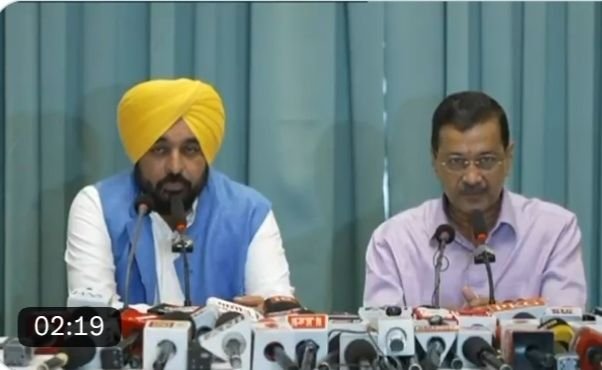
Addressing a press conference after the meeting, Bhagwant Mann said the party respects the authority and dignity of the Akal Takht and that its representatives would appear before the institution with humility. He said all Sikh MLAs and Cabinet ministers would present their position in writing and would carefully listen to the observations and suggestions made by the Sikh clergy.
The controversy centres on the Jaagat Jot Sri Guru Granth Sahib Satkar (Amendment) Act, 2026, a law introduced by the Punjab Government with the stated objective of strengthening legal safeguards against acts of sacrilege involving Sri Guru Granth Sahib and other revered religious scriptures.
While the government has defended the legislation as a sincere attempt to address long-standing public demand for stricter punishment in sacrilege cases, the Akal Takht and the Shiromani Gurdwara Parbandhak Committee (SGPC) have expressed serious reservations over the process adopted by the state. The religious bodies argue that legislation dealing with matters directly connected to Sikh faith and religious traditions should have been preceded by wider consultations with the Sikh Panth and representative religious institutions.
The issue has evolved into one of the most sensitive political and religious debates in Punjab in recent years, with questions extending beyond the legal provisions of the Act to the broader relationship between elected governments and Sikh religious institutions.
During his interaction with the media, Mann rejected allegations that his government had attempted to undermine or challenge the authority of the Akal Takht. He maintained that the state government holds the highest respect for Sikh institutions but also has a constitutional responsibility to legislate in matters relating to law and order and public interest.
The Chief Minister also criticised what he described as attempts by political parties to exploit religious issues for electoral gains. Without naming specific parties, he alleged that religion should not become a tool for political confrontation and appealed for a distinction between genuine religious concerns and partisan politics.
The presence of Arvind Kejriwal alongside Bhagwant Mann at the press conference underscored the importance the AAP leadership has attached to the issue. Party leaders indicated that the appearance before the Akal Takht should not be viewed as a confrontation but as an opportunity to present the government’s position while demonstrating respect for Sikh religious sentiments.
Political observers believe the development carries implications well beyond the immediate controversy. Punjab has historically witnessed a close intersection between politics and religious institutions, and any disagreement involving the Akal Takht often assumes statewide significance. The manner in which the AAP government responds is expected to influence both public perception and the state’s evolving political discourse.
Opposition parties, including the Shiromani Akali Dal and the Congress, have accused the government of introducing the legislation without adequate consultation with Sikh religious authorities. They contend that the issue is not limited to the contents of the law but also concerns the process through which it was enacted.
The Punjab Government, however, maintains that the legislation was framed with the sole objective of protecting the sanctity of holy scriptures and strengthening legal deterrence against sacrilege. Government leaders have repeatedly stated that there was no intention to interfere with religious institutions or diminish their authority.
The appearance of AAP’s Sikh legislators and ministers before the Akal Takht on June 29 is expected to be closely watched across Punjab. It is likely to determine not only the future course of the controversy surrounding the anti-sacrilege law but also the evolving relationship between the elected government and one of Sikhism’s most influential religious institutions.
With political sensitivities running high and religious sentiments deeply involved, the proceedings before the Akal Takht are expected to have significant implications for Punjab’s political landscape in the weeks ahead.