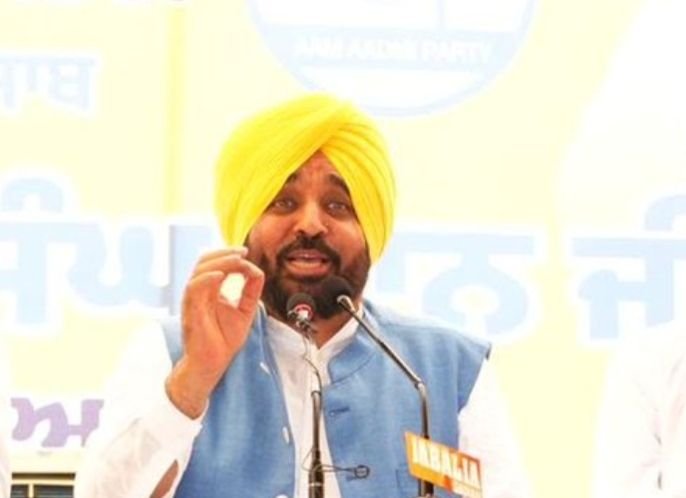
Saptrishi Soni: Punjab Chief Minister Bhagwant Mann has mounted a robust defence against allegations that he has questioned the authority of the Akal Takht, asserting that his government holds the highest temporal seat of the Sikhs in the utmost respect while accusing opposition parties of attempting to transform a legislative disagreement into a political and religious campaign against him.
The remarks came after a high-level meeting of Aam Aadmi Party (AAP) legislators in Amritsar, attended by party national convener Arvind Kejriwal, to finalise the government’s response to the Akal Takht’s summons over the Jaagat Jot Sri Guru Granth Sahib Satkar (Amendment) Act, 2026. The legislation, intended by the Punjab Government to strengthen legal safeguards against sacrilege, has drawn objections from the Akal Takht and the Shiromani Gurdwara Parbandhak Committee (SGPC), which contend that the Sikh Panth was not adequately consulted before the law was enacted.
Addressing reporters after the meeting, Mann clarified that he had not personally been summoned by the Akal Takht. Instead, Sikh ministers and legislators belonging to the ruling party would appear before the religious institution on June 29 to explain the government’s position. Punjab Assembly Speaker Kultar Singh Sandhwan is also expected to participate in the proceedings.
The Chief Minister said the government would respectfully place its views before the Akal Takht and carefully consider every suggestion or observation made by the Sikh clergy and the SGPC. He indicated that any recommendations emerging from the deliberations would be discussed within the government before further decisions are taken.
Seeking to dispel perceptions that his government is in confrontation with Sikh religious institutions, Mann stressed that he could never contemplate challenging the authority of the Akal Takht. He recalled that on an earlier occasion, when summoned by the institution, he had even skipped an official engagement involving the President of India to appear before the Akal Takht, describing that decision as evidence of his deep respect for Sikh religious authority.
One of the controversies surrounding the current dispute relates to a video circulated on social media, which critics have cited while questioning the Chief Minister’s conduct. Mann dismissed the video as fabricated, alleging that it featured an individual wearing a mask resembling him. He said he would submit the recording, along with his written explanation, before the Akal Takht so that the institution could independently assess the matter.
While reiterating his reverence for the Akal Takht, Mann also raised concerns about what he described as the increasing politicisation of certain religious appointments. Without naming individuals, he remarked that when political appointees occupying religious positions begin taking decisions perceived as favouring particular political interests, questions naturally arise in public discourse. His comments reflected the government’s attempt to distinguish between respect for Sikh institutions and criticism of individuals associated with their functioning.
The Chief Minister further alleged that a coordinated political campaign was being waged against him by opposition parties. He accused the Congress, the Shiromani Akali Dal and the Bharatiya Janata Party of joining hands to portray the controversy as a religious confrontation in order to weaken the AAP government’s standing among Sikh voters.
According to Mann, the installation of hoardings outside several gurdwaras calling for his social boycott demonstrates that political opponents are attempting to influence public opinion through religious symbolism. He questioned why similar campaigns were not undertaken when Shiromani Akali Dal leader Sukhbir Singh Badal had previously been declared “tankhaiya” by Sikh religious authorities, suggesting that the present campaign reflects selective political targeting rather than a consistent religious standard.
Despite the controversy, Mann maintained that public support for his government remains intact. Referring to his recent public outreach programmes, he said thousands of people continue to attend his meetings and honour him with traditional Sikh ceremonies, arguing that public participation reflects confidence in his leadership despite the ongoing criticism.
Political analysts believe the controversy has assumed significance because it sits at the intersection of governance, religion and electoral politics. Punjab has historically witnessed a close relationship between political authority and Sikh religious institutions, making disagreements involving the Akal Takht particularly sensitive. Any perception that a political leader is at odds with the institution can influence public opinion, especially among sections of the Sikh electorate.
For opposition parties, the issue presents an opportunity to question the AAP government’s handling of religious matters and to challenge its credibility on an issue deeply connected to Sikh identity. Analysts note, however, that whether such criticism translates into political gains will depend on how the public interprets the government’s intentions, the proceedings before the Akal Takht and the eventual resolution of the dispute.
The Chief Minister also responded to questions regarding the Maharashtra Government’s decision to repeal legislation governing the management of Sachkhand Sri Hazur Sahib at Nanded. Mann argued that governments should refrain from interfering in the internal affairs of the Sikh community, reinforcing his position that religious institutions should function independently while maintaining constructive engagement with elected governments.
As Punjab prepares for the June 29 proceedings before the Akal Takht, the dispute is increasingly being viewed as more than a disagreement over a single law. It has evolved into a broader debate about legislative authority, religious consultation and the complex relationship between constitutional governance and Sikh institutions.
The outcome of the proceedings is expected to shape not only the future of the anti-sacrilege legislation but also the political narrative surrounding the Mann government. Whether the dialogue leads to reconciliation or prolongs the controversy, the episode is likely to remain one of the defining issues in Punjab’s political discourse in the months ahead.