
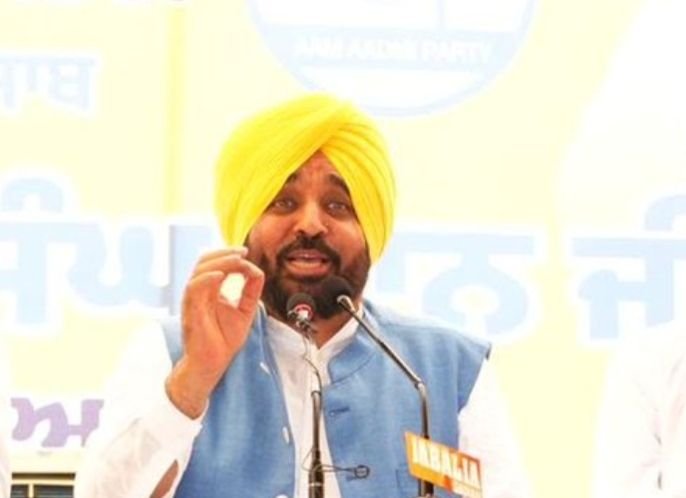
The Bhagwant Mann Report Card: Between Big Promises, Bold Welfare and the Voters’ Final Verdict
Four Years After AAP’s Historic Victory, Punjab’s Biggest Political Question Is No Longer ‘Why Change?’—It Is ‘Has the Change Delivered?’
Saptrishi Soni:
Chandigarh: When the Aam Aadmi Party (AAP) swept the 2022 Punjab Assembly elections with an unprecedented majority, it was more than an electoral victory. It marked a political reset. Voters rejected the traditional dominance of the Congress and the Shiromani Akali Dal (SAD), placing extraordinary expectations on Chief Minister Bhagwant Mann and the AAP government.
Now, with the 2027 Assembly election approaching, Punjab is entering a new political phase. The debate has shifted from campaign promises to governance outcomes. The central question confronting the electorate is whether the Mann government has delivered enough to justify a second consecutive mandate.
The Government’s Case: “Politics of Work”
Chief Minister Bhagwant Mann argues that his government has fulfilled the commitments it made before the 2022 election. Marking four years in office, he released a report card highlighting free electricity for eligible domestic consumers, daytime power supply for agriculture, expansion of Aam Aadmi Clinics, cashless healthcare initiatives, government recruitment, canal irrigation improvements and education reforms. The government also points to infrastructure projects and efforts to simplify public services as evidence of administrative change.
AAP leaders contend that Punjab has moved away from patronage politics towards service delivery. They argue that reforms in schools, health services and citizen-facing administration represent structural changes that will have a lasting impact beyond one electoral cycle.
Welfare Has Strengthened the Government’s Narrative
Among the government’s strongest political assets are its welfare programmes. Free electricity for eligible households, continued support for public healthcare through Aam Aadmi Clinics and cashless treatment under the Mukh Mantri Sehat Yojna have become central to AAP’s campaign messaging. The government has also highlighted regularisation of employees, recruitment drives and investments in school infrastructure.
Political analysts note that welfare schemes have become an increasingly important factor in state elections across India. The challenge for the government will be convincing voters that these programmes are fiscally sustainable while also delivering broader economic growth.
The Opposition’s Counter-Narrative
The Congress, BJP and Shiromani Akali Dal acknowledge that the government has implemented several welfare measures, but they argue that these alone cannot define governance. Opposition leaders have questioned the administration’s handling of law and order, fiscal management, industrial investment, employment generation and the continuing challenge of narcotics. Congress leader Partap Singh Bajwa has described the government’s performance as falling short of its promises, while BJP leaders have intensified criticism over security incidents and administrative functioning.
These criticisms form the basis of what is likely to become the opposition’s principal election message: that Punjab now requires stronger economic management and institutional reforms alongside welfare programmes.
Law and Order: The Issue That Refuses to Disappear
Among the issues likely to dominate the election campaign, law and order may prove one of the most closely scrutinised. The Mann government has repeatedly highlighted anti-drug operations, action against organised crime and anti-drone measures along the international border, presenting them as evidence of a tougher policing strategy.
At the same time, opposition parties continue to cite incidents of violence and attacks on police infrastructure to argue that public safety remains a significant concern.
For voters, the question may not be whether the government has taken action, but whether those measures have produced visible improvements in daily life.
Employment and Investment: The Next Political Test
Punjab’s young population is expected to place employment among the defining issues of the 2027 election. The government says it has created government jobs and facilitated wider employment opportunities, while opposition parties argue that attracting sustained private investment and strengthening manufacturing remain essential for long-term growth.
Economists point out that Punjab’s future economic performance will depend not only on public recruitment but also on industrial expansion, entrepreneurship and investment in emerging sectors.
Bhagwant Mann’s Political Style
One of the Chief Minister’s distinguishing political characteristics has been his emphasis on direct engagement with citizens. Through programmes such as Mann Milni and frequent public interactions, he has sought to maintain a visible connection with the electorate even as criticism of the government has intensified. Political observers describe this as an effort to reinforce accessibility and responsiveness during a politically demanding phase of his tenure.
What Will Decide 2027?
History suggests that Punjab’s electorate rarely votes on a single issue. Governments are generally assessed across multiple dimensions: governance, leadership, economic opportunity, agriculture, public services and credibility.
The AAP government enters the election with the advantage of incumbency and a record it believes demonstrates significant delivery. The opposition enters with the opportunity to argue that important challenges remain unresolved.
Ultimately, the verdict will belong to Punjab’s voters—not to political parties or analysts. The coming campaign is likely to be decided less by rhetoric than by a comparison of competing claims, measurable outcomes and the confidence each party inspires about the state’s future.
Editor’s Note: This article is part of the Punjab Decides 2027 series. It combines verified reporting with clearly identified political analysis. It does not predict electoral outcomes and distinguishes factual developments from editorial assessment.