Saptrishi Soni
With the 2027 Punjab Assembly election drawing closer, the state’s political landscape is once again being shaped by one of its most emotive and politically consequential issues — the sacrilege (Beadbi) cases that have dominated public discourse for nearly a decade.
The latest development, with the Special Investigation Team (SIT) issuing a notice to Shiromani Akali Dal president Sukhbir Singh Badal for questioning, has revived a debate that has repeatedly influenced Punjab’s electoral politics. The move comes amid renewed scrutiny of events surrounding the sacrilege investigations and subsequent police action against protesters, placing the issue firmly back at the centre of the state’s political narrative.

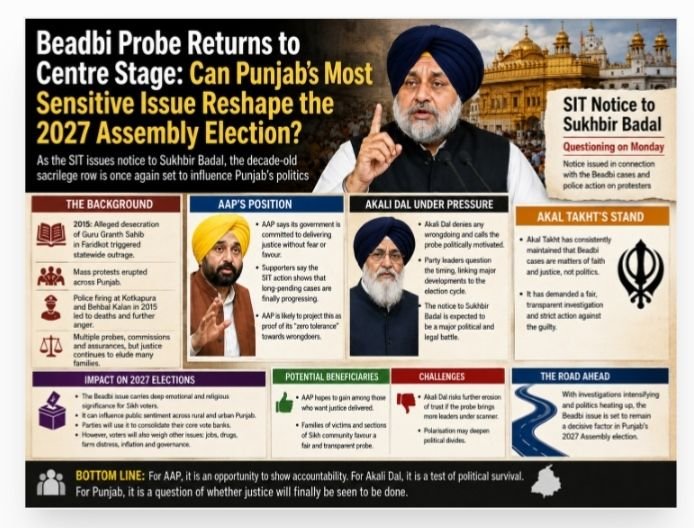
The background: Why the Beadbi issue matters
The controversy dates back to 2015, when incidents involving the alleged desecration of Sikh religious scriptures triggered widespread anger across Punjab. The subsequent protests, police firing at Kotkapura and Behbal Kalan, and years of investigations transformed the issue from a criminal inquiry into one of the state’s defining political controversies.
For many Sikh organisations, justice in the sacrilege cases remains an unfinished promise. The issue has continued to influence public opinion across both rural and urban Punjab, cutting across traditional political loyalties.
AAP seeks to reinforce its governance narrative
For the ruling Aam Aadmi Party, the renewed pace of the investigation offers an opportunity to demonstrate that long-pending cases are moving forward under its administration.
Since coming to power, the Mann government has repeatedly maintained that those responsible for the sacrilege incidents and any alleged lapses in their handling should be brought before the law through due legal process. The latest SIT action is likely to be projected by the party as evidence that the investigation is progressing without political interference.
Supporters of the government argue that many families affected by the events have waited years for accountability and that any fresh legal developments should be viewed through the prism of justice rather than electoral politics.
Akali Dal faces renewed political pressure
For the Shiromani Akali Dal, however, the investigation has reopened one of the most politically damaging chapters in its recent history.
The party has consistently denied wrongdoing and has alleged that successive governments have used the Beadbi issue as a political weapon. Party leaders have questioned the timing of investigative developments, arguing that major actions often coincide with politically significant periods.
The latest notice to Sukhbir Singh Badal is therefore expected to become both a legal and political battle as the party attempts to defend its record while countering allegations that continue to shadow its leadership.
Akal Takht’s position and the wider Sikh discourse
The Akal Takht has repeatedly maintained that the sacrilege cases are fundamentally matters of religious faith and justice rather than electoral politics. Sikh religious institutions have consistently demanded that investigations reach their logical conclusion and that those found guilty be held accountable in accordance with the law.
At the same time, political parties often interpret developments surrounding the issue through their own electoral lens, adding another layer of complexity to an already sensitive matter.
An election issue beyond party lines
Political observers note that the Beadbi issue has remained emotionally charged because it is closely linked with religious sentiment rather than conventional political ideology.
Unlike many election issues centred on development, employment or welfare, sacrilege carries a moral and emotional dimension that can influence voter perceptions across communities. Whether this translates into electoral gains for any particular party will depend not only on investigative developments but also on public confidence in the credibility and fairness of the legal process.
The road to 2027
As campaigning gradually gathers momentum, Punjab’s political contest appears increasingly likely to revolve around multiple themes — governance, law and order, unemployment, drugs, agriculture and religious accountability.
The latest SIT action has ensured that the sacrilege issue will once again feature prominently in political debates. For the ruling AAP, it presents an opportunity to argue that accountability is finally advancing. For the Akali Dal, it represents another test of its political resilience as it seeks to rebuild its support base.
Ultimately, however, the electoral impact may depend less on political rhetoric and more on whether the investigation is widely seen by the public as independent, transparent and capable of delivering credible justice. In a state where faith and politics have often intersected, the Beadbi issue continues to carry significance far beyond the courtroom, making it one of the defining factors to watch as Punjab moves towards the 2027 Assembly election.