
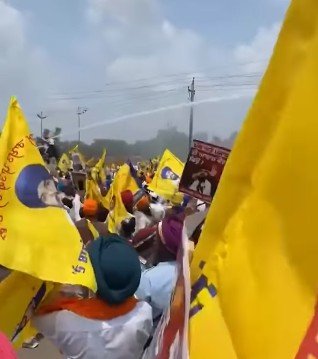
The political and legal fallout from the dramatic protest seeking the release of Khadoor Sahib MP Amritpal Singh intensified on Thursday after Chandigarh Police registered a criminal case against 15 identified leaders associated with Akali Dal (Waris Punjab De), besides thousands of unidentified protesters, following violent clashes during a march towards Punjab Chief Minister Bhagwant Singh Mann’s official residence. The development has once again brought the issue of Amritpal Singh’s continued detention into the centre of Punjab’s political discourse while raising fresh questions over law and order, democratic protest and the growing mobilisation around Sikh political issues.
The protest, organised by Akali Dal (Waris Punjab De), witnessed thousands of supporters assembling near Chandigarh with the stated objective of demanding the immediate release of jailed MP Amritpal Singh and other Sikh detainees. The demonstrators attempted to march towards the Punjab Chief Minister’s residence despite prohibitory orders imposed in the Union Territory, leading to a tense confrontation with security personnel.
As the procession advanced, police erected multiple barricades at strategic locations to prevent protesters from entering high-security zones. However, according to the police, a large section of demonstrators breached the barricades and attempted to force their way through, resulting in clashes with security personnel. Water cannons were deployed to disperse the crowd after repeated warnings reportedly failed to stop the march. Dramatic visuals of protesters climbing onto police vehicles and pushing through barricades quickly spread across social media, drawing nationwide attention to the confrontation.
Following the incident, Chandigarh Police registered an FIR naming Dakha MLA Manpreet Singh Ayali along with fourteen other leaders linked to Akali Dal (Waris Punjab De). The case also includes approximately 2,500 to 3,000 unidentified protesters who allegedly participated in the confrontation. Police have invoked multiple provisions of the Bharatiya Nyaya Sanhita, alleging obstruction of public servants, assault on police personnel, violation of lawful prohibitory orders and damage to government property.
According to the FIR, police officers repeatedly informed the protesters that prohibitory orders under Section 163 of the Bharatiya Nagarik Suraksha Sanhita were in force and advised them to shift their demonstration to the designated protest venue. Investigators have alleged that several leaders encouraged the gathering to move ahead despite repeated warnings, leading to the breach of barricades and physical confrontation with security personnel. Police also claimed that several officers sustained injuries during the clashes, while a water cannon vehicle was allegedly damaged by protesters.
The protest itself reflects the continuing political significance of Amritpal Singh’s detention in Punjab. Amritpal, who won the Lok Sabha election from Khadoor Sahib while in detention, has remained a highly polarising political figure. His supporters argue that his continued incarceration has denied the constituency effective parliamentary representation and have repeatedly demanded his immediate release. They also maintain that several Sikh prisoners who have completed their sentences should be released without further delay.
The latest confrontation is likely to add another layer of complexity to Punjab’s already evolving political landscape. With the 2027 Assembly elections gradually entering political calculations, Panthic organisations are attempting to consolidate support by mobilising around religious and political issues that resonate with sections of the Sikh electorate. Political analysts believe that Amritpal Singh’s detention continues to influence discussions on Sikh identity, civil liberties and Centre-State relations in Punjab.
The incident also places the Aam Aadmi Party government under renewed political pressure. While the Chandigarh Police function under the Union Territory administration, the protest was directed towards the Punjab Chief Minister’s residence, making the issue politically sensitive for both the Punjab Government and the Central Government. Opposition parties are expected to use the developments to sharpen their political narrative in the coming months.
Security agencies are now examining CCTV footage and video recordings to identify additional participants involved in the clashes. More arrests cannot be ruled out as investigators continue to examine evidence related to the alleged violence, damage to public property and attacks on police personnel.
Even as legal proceedings move forward, the episode has once again demonstrated how Punjab’s political landscape remains deeply influenced by issues that combine religion, identity and electoral politics. The coming weeks are likely to determine whether the confrontation remains confined to legal proceedings or develops into a wider political movement centred on the demand for the release of Amritpal Singh and other Sikh detainees.
This is a web generated news report.