
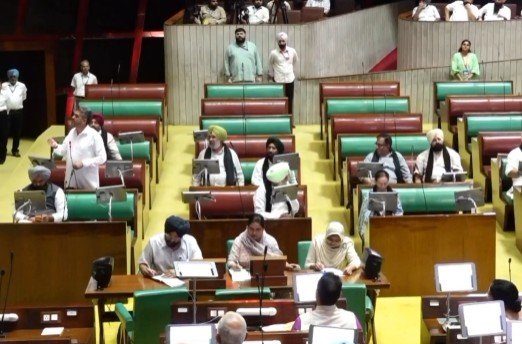
Religion and politics once again converged inside the Punjab Vidhan Sabha as the Bhagwant Singh Mann government faced intense debate over its proposed anti-sacrilege legislation, a subject that has shaped Punjab’s political discourse for nearly a decade. While the ruling Aam Aadmi Party projected the proposed legislation as a decisive step to protect the religious sentiments of all communities, the Opposition questioned both its legal framework and the government’s handling of one of the state’s most sensitive issues.
The discussion quickly evolved beyond the proposed legislation itself, reflecting the larger political contest that is steadily gathering pace ahead of the 2027 Assembly elections. Every major political party sought to position itself as the strongest defender of Punjab’s religious harmony while simultaneously questioning the credibility of its rivals.
Presenting the government’s position, members of the treasury benches argued that incidents of sacrilege have repeatedly disturbed Punjab’s social fabric over the past decade and that successive governments had failed to provide either timely justice or a credible legal mechanism capable of preventing such offences. According to the government, the proposed legislation aims to create a stronger legal framework that would deter deliberate acts of sacrilege while ensuring swift investigation and prosecution.
Government legislators maintained that the initiative reflects the sentiments of millions of Punjabis who have consistently demanded stronger legal safeguards against acts that hurt religious beliefs. They argued that maintaining communal harmony requires not only political commitment but also legislation capable of addressing offences that have repeatedly generated social unrest across the state.
However, the Opposition questioned whether the legislation had been drafted after sufficient legal consultation. Congress members sought greater clarity on several provisions, arguing that any law dealing with religious issues must be constitutionally robust to withstand judicial scrutiny. They insisted that legislation of such importance should emerge from wider consultation involving legal experts, constitutional authorities and representatives of different religious organisations.
Shiromani Akali Dal members, while reiterating their longstanding demand for stringent punishment in sacrilege cases, also criticised the government for what they described as inadequate consultation with Sikh religious institutions before introducing the proposal. Party leaders argued that legislation concerning faith should be framed only after building the broadest possible consensus.
The Assembly proceedings witnessed repeated exchanges between treasury and opposition members as both sides attempted to claim ownership of the issue. Government legislators accused previous administrations of allowing investigations into earlier sacrilege incidents to remain inconclusive, arguing that prolonged delays had weakened public confidence in the justice delivery system. Opposition leaders responded by alleging that the government was attempting to derive political advantage from an emotionally sensitive issue without adequately addressing legal complexities.
The debate demonstrated how sacrilege continues to remain one of Punjab’s most politically sensitive subjects. Since the series of sacrilege incidents reported in 2015, the issue has consistently influenced electoral politics, public discourse and legislative priorities. Successive governments have promised decisive action, but demands for faster investigations and stronger punishment have continued to resonate across the state.
Political observers believe the Mann government’s decision to move ahead with fresh legislation is intended not only to strengthen the legal framework but also to demonstrate political resolve on an issue that carries significant emotional importance among voters. At the same time, the Opposition appears determined to ensure that any shortcomings in the proposed law become part of the broader political debate before the next Assembly election.
The discussion also highlighted an important reality of Punjab politics: issues relating to religion rarely remain confined to legal interpretation alone. They quickly acquire political significance because of the deep emotional connect they have with the people of the state. Consequently, every political party is attempting to strike a careful balance between respecting religious sentiments and ensuring that legislation remains consistent with constitutional principles.
As the proposed law moves through the legislative process, further debate and possible amendments are expected. The government maintains that its objective is to protect the dignity of all religions and prevent future incidents capable of disturbing peace and harmony. The Opposition, while supporting strict punishment for sacrilege, continues to demand wider consultation and greater legal clarity before the legislation is finally enacted.
With Punjab gradually entering election mode, the debate over sacrilege legislation is likely to remain a major political issue, influencing both legislative discussions and public opinion in the months ahead.
This is a web generated news report.