
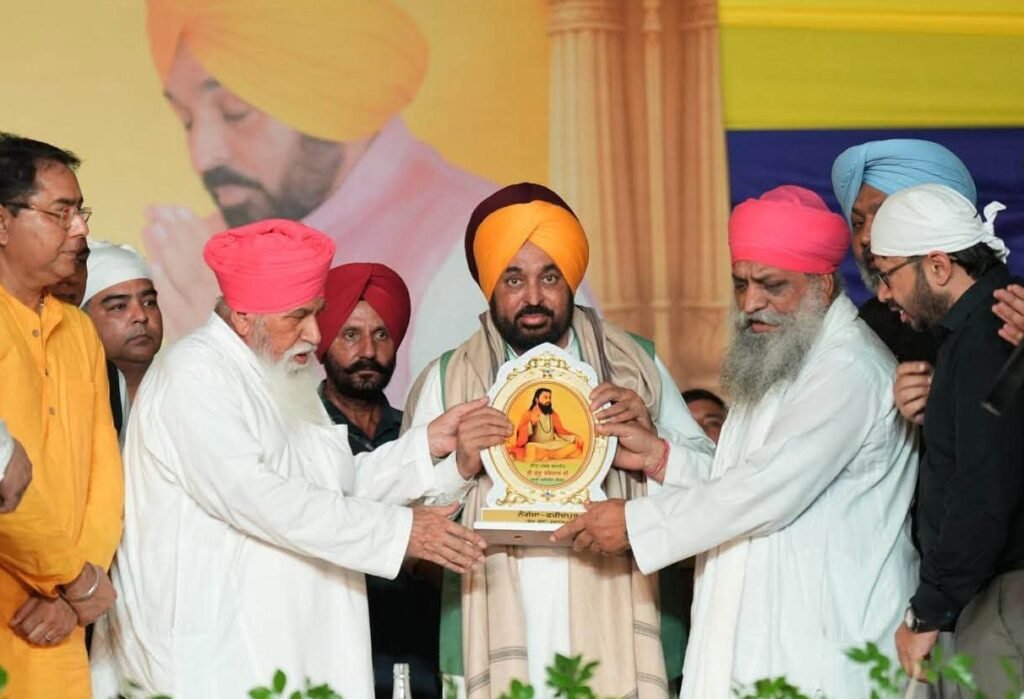
Saptrishi Soni: Religious outreach is once again becoming an important element of Punjab’s political landscape, with the Bhagwant Mann government continuing its focus on pilgrimage-related welfare programmes while Opposition parties seek to establish their own connections with religious and community institutions ahead of the 2027 Assembly election.
The government’s Mukh Mantri Tirath Yatra has become a visible component of its welfare strategy. The programme provides free travel for eligible residents to important religious destinations and is being presented by AAP as an initiative intended to make pilgrimage accessible to ordinary families regardless of their financial circumstances.
The political significance of the programme goes beyond its administrative structure. Punjab’s political culture has historically been closely connected with religious institutions, community identity and social organisations. Any government operating in the state therefore has to manage the delicate relationship between welfare, faith and politics.
AAP has attempted to present the pilgrimage programme primarily as a public-service initiative. Its political messaging focuses on accessibility and the idea that ordinary citizens should be able to visit important religious sites without bearing the full cost of travel.
The Opposition, however, is likely to scrutinise such programmes as the 2027 election approaches. Congress, BJP and the Akali Dal each have their own political traditions and constituencies connected to Punjab’s religious and social landscape.
For AAP, the challenge is to ensure that religious outreach does not overshadow its wider governance narrative. The government has simultaneously been highlighting employment, education, healthcare, industrial investment and financial assistance for women.
The broader political environment makes this balance especially important. Punjab’s voters have repeatedly demonstrated that religious identity is significant but not necessarily sufficient on its own to determine electoral choices. Governance, jobs, agriculture, public services and economic opportunity remain major concerns.
The Opposition is therefore unlikely to allow AAP to define the political conversation exclusively through welfare or religious outreach. Congress is expanding its organisational campaign, BJP is trying to enlarge its presence in the state, and the Akali Dal continues to seek space in Punjab’s traditional political ecosystem.
The emergence of religious outreach as an electoral issue also reflects the wider competition for political legitimacy in Punjab. Parties are increasingly attempting to demonstrate that they understand the state’s social and cultural concerns while simultaneously offering solutions to economic and administrative problems.
For the Mann government, the political advantage of the pilgrimage programme lies in its direct connection with beneficiaries. Unlike long-term infrastructure projects, a welfare journey creates an immediate experience for participants. That can make such initiatives highly visible at the grassroots.
Yet the government will also have to demonstrate that its welfare programmes remain financially manageable. Punjab’s fiscal challenges are substantial, and Opposition parties are expected to ask whether expanding welfare commitments can be sustained alongside investment in infrastructure, employment and public services.
The question of political communication will therefore become increasingly important. AAP will want voters to see its welfare schemes as evidence of inclusive governance. Opposition parties will seek to portray them as electoral populism unless accompanied by stronger economic outcomes.
The next phase of Punjab politics is consequently likely to combine welfare, religion, development and identity rather than revolve around a single issue.
The Mukh Mantri Tirath Yatra is one example of this changing political landscape. It reflects the government’s attempt to combine public welfare with cultural and religious outreach at a time when every major party is preparing for a highly competitive 2027 contest.
The final verdict, however, will depend on whether voters believe such initiatives are improving their lives and whether the government can persuade them that its wider governance record deserves another mandate.
This is a web generated news report.