Saptrishi Soni
Ferozepur : Punjab Chief Minister Bhagwant Singh Mann used the state-level Independence Day celebrations in Ferozepur to combine a message of patriotism with a wider political narrative centred on Punjab’s development, social harmony and its contribution to the country.
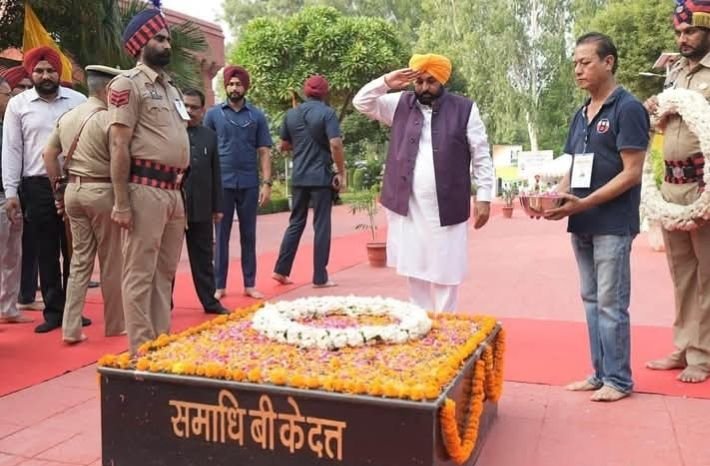
Mann unfurled the national flag at the state-level function in Ferozepur on Saturday and paid tribute to the freedom fighters whose sacrifices are deeply associated with Punjab. The choice of Ferozepur was significant. Located close to the international border and home to the National Martyrs Memorial at Hussainiwala, the district carries a powerful association with India’s freedom struggle and the sacrifices of Bhagat Singh, Sukhdev and Rajguru.
The Chief Minister’s appearance at Hussainiwala and the subsequent Independence Day address came at a politically important time, with Punjab already beginning to move towards the 2027 Assembly election.
Mann’s message was built around the idea that Punjab’s historical contribution to India must be matched by development and social stability in the present. His government has increasingly attempted to present education, healthcare, employment, rural development and welfare schemes as the core of its political record.
The Chief Minister has also repeatedly emphasised the need to protect Punjab’s traditional social and communal harmony. That theme is particularly important in a state where religious identity, the legacy of the separatist period and the political influence of Sikh institutions remain important elements of public discourse.
The Independence Day platform therefore provided Mann with an opportunity to make a broader argument: that Punjab’s political future should be shaped by development and unity rather than confrontation and division.
The Chief Minister has been presenting several government initiatives as evidence of change under the Aam Aadmi Party administration. These include improvements in government schools, Aam Aadmi Clinics, employment programmes, rural infrastructure and welfare measures.
The government’s education narrative is particularly prominent. Mann has argued that government schools have produced significantly better results in competitive examinations and that the state has invested in modernising public education.
The government is also using its anti-drug campaign as a major governance issue. More than 21,850 teachers across 12 districts are being trained to identify early signs of drug abuse and mental-health problems among students, reflecting an attempt to take the campaign beyond policing and into schools and communities.
The political challenge for the Mann government will be whether these initiatives can translate into a convincing electoral narrative by 2027.
Punjab’s opposition parties are likely to question the government’s record on unemployment, drug abuse, law and order, fiscal pressures and the delivery of promises. The Congress, BJP and Shiromani Akali Dal will each seek to frame the election around different issues and constituencies.
For AAP, however, the strategy is increasingly clear. The party wants the election to be fought on governance and welfare rather than allowing the opposition to define the political debate entirely around religious or identity issues.
Ferozepur was an appropriate location for that strategy. The district combines Punjab’s agricultural economy, border-security concerns, rural communities and a powerful connection with the freedom movement.
Mann’s Independence Day appearance consequently carried significance beyond the ceremonial programme. It offered the Chief Minister an opportunity to position his government as one that is attempting to connect Punjab’s historic legacy with a modern development agenda.
The coming months will show whether that message gains traction among voters. The 2027 election is likely to be a highly competitive contest involving AAP, Congress, BJP, SAD and other political forces.
For now, Mann’s Ferozepur message suggests that AAP intends to enter that contest by highlighting governance, welfare, education, employment and Punjab’s social unity — while presenting itself as a political alternative to what it describes as the traditional politics of the past