
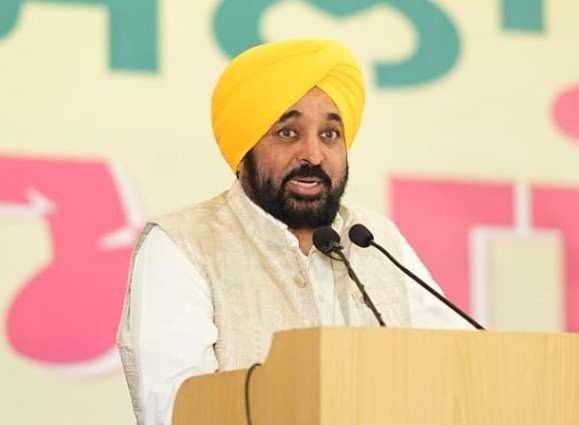
Dhuri — Punjab Chief Minister Bhagwant Singh Mann used the vibrant cultural setting of ‘Teeyan Da Mela’ in Dhuri on Tuesday to place women’s empowerment at the centre of his government’s broader vision for a progressive and culturally rooted Punjab.
Addressing a large gathering at Saffron Palms in Dhuri, the Chief Minister said Punjab’s daughters were no longer to be viewed through the lens of dependence or vulnerability, but as confident and capable contributors to the state’s development.
“Today, our daughters are proving their mettle in every field,” he said, describing women as an increasingly powerful force in Punjab’s progress.
The event, attended by the Chief Minister along with his wife Dr Gurpreet Kaur Mann, combined the celebration of Punjab’s traditional Teej festivities with a political and social message centred on women’s dignity, economic independence and participation in public life.
Mann said that meaningful development would remain incomplete without the full participation of women in governance, the economy and decision-making. He argued that empowering women was not simply a welfare objective, but an essential part of building a stronger Punjab.
A major part of his address focused on the government’s Mawan-Dheeyan Satkar Yojna. According to the Chief Minister, more than 75 lakh women have been registered under the scheme, with eligible beneficiaries receiving financial assistance ranging from ₹1,000 to ₹1,500 per month.
He said that by August 1, 2026, ₹2,274.42 crore had been transferred directly to the bank accounts of eligible women beneficiaries. Mann added that women who were yet to register should complete the process so that they too could avail themselves of the scheme’s benefits.
The Chief Minister presented the initiative as part of a wider effort to improve women’s economic independence and reduce financial pressure on households.
The government has also sought to strengthen women’s livelihoods through self-help groups. Mann said that around 29,000 Self-Help Groups had been formed over the past four years, bringing nearly three lakh women into organised community-based economic activity.
According to the figures shared at the event, these groups have received interest-free loans worth ₹631 crore. Mann said such initiatives were intended to help women move beyond dependence and towards greater financial self-reliance.
He also referred to the continuing provision of free travel for women in Punjab Government buses as another measure aimed at improving mobility and access to opportunities.
The Chief Minister pointed to women’s increasing presence in public administration as evidence of a changing social landscape. Of Punjab’s 23 districts, he said, nine currently have women Deputy Commissioners, while eight districts have women serving as Senior Superintendents of Police.
The message from the government was clear: when given opportunity and institutional support, women are capable of competing and succeeding across sectors ranging from education and administration to sports, business, agriculture and the arts.
However, the occasion was not limited to policy announcements.
‘Teeyan Da Mela’, deeply embedded in Punjab’s cultural tradition, provided the setting for Mann to speak about another concern — the need to preserve cultural identity in an increasingly digital and rapidly changing society.
Teeyan has traditionally been associated with women, celebration, folk music, giddha, boliyan, phulkari and the shared joy of Punjabi families. Mann said such festivals offered more than entertainment; they created a bridge between generations.
He warned that languages, folk songs, traditional dances, attire and customs could gradually disappear if they were not consciously passed on to younger generations.
In this context, the Chief Minister described cultural gatherings as an important platform for preserving Punjab’s collective memory. For him, the idea of ‘Rangla Punjab’ was not confined to roads, infrastructure or economic development. It also included the protection of Punjab’s language, traditions, folk arts and social harmony.
Mann called upon people to work towards building a Punjab that could emerge as a leader in development while also serving as an example of cultural preservation.
His address also widened into a broader review of the government’s development and welfare agenda.
The Chief Minister said the Mukh Mantri Sehat Yojna was providing families with cashless medical treatment of up to ₹10 lakh. He stated that more than three lakh patients had received treatment under the scheme, with healthcare support worth approximately ₹1,100 crore.
He also referred to Punjab’s network of 1,090 Aam Aadmi Clinics, claiming that around 92,000 people were visiting these facilities every day and that cumulative outpatient footfall had reached approximately six crore.
On agriculture and irrigation, Mann said canal water had now reached the fields of 1,587 villages which had previously not received canal irrigation. He said the government had spent ₹7,200 crore on strengthening the canal network and expanding irrigation coverage.
According to figures shared by the Chief Minister, the area under canal irrigation had increased from 26 per cent to 80 per cent during the tenure of the present government, with the area receiving canal water rising from around 20.89 lakh acres in 2022 to 60.30 lakh acres.
Mann also highlighted infrastructure and employment initiatives, saying that approximately 45,000 kilometres of roads were being renovated and upgraded across the state. He reiterated the government’s claim that more than 69,000 young people had received government jobs on merit.
On electricity, he said around 90 per cent of Punjab households had been receiving zero electricity bills since July 2022 under the government’s free power policy.
While the Teeyan celebration was marked by music, colour and traditional Punjabi culture, the Chief Minister’s address reflected a wider political message: Punjab’s future, he argued, must be built around both economic progress and social inclusion.
Mann also used the occasion to emphasise peace and communal harmony, saying Punjab’s social fabric had historically been shaped by the teachings of the Sikh Gurus, saints and spiritual leaders. In a pointed message against divisive politics, he said Punjab’s fertile soil could nurture many things, but not the seeds of hatred.
The Dhuri gathering, therefore, became more than a cultural celebration. It was an occasion for the Punjab government to connect welfare, women’s empowerment, cultural preservation, healthcare, agriculture and social harmony with its larger vision of ‘Rangla Punjab’.
At the heart of that vision, Mann suggested, is a simple proposition: Punjab’s progress cannot be measured only by economic indicators. It must also be reflected in the confidence of its women, the opportunities available to its youth, the dignity of its families and the ability of a rapidly modernising society to remain connected to its cultural roots.