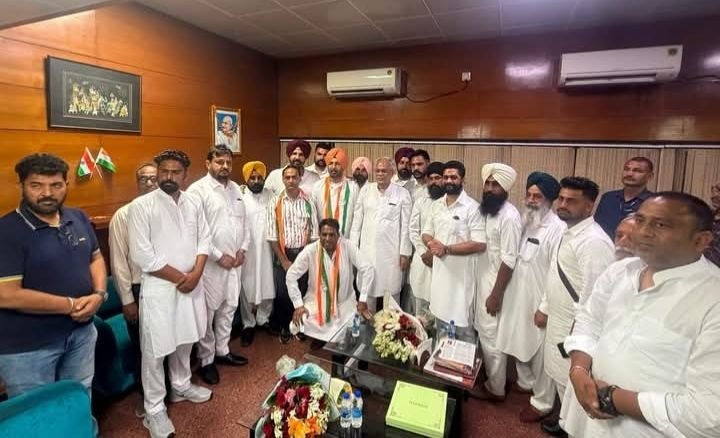
The Congress leadership in Punjab is facing renewed attention over its internal organisation, but the party has indicated that there is no immediate plan to change the leadership of its state unit.
Chhattisgarh Chief Minister and senior Congress leader Bhupesh Baghel has said there will be no change in Punjab Congress leadership, amid speculation and reports of internal differences within the party. His comments are aimed at putting an end, at least temporarily, to speculation about a leadership reshuffle.
The issue matters because Congress remains one of the principal political forces in Punjab and is seeking to rebuild its organisation ahead of the next Assembly election.
The party has faced organisational challenges since losing power to the Aam Aadmi Party in 2022. Since then, the Congress has attempted to strengthen its grassroots structure and present itself as the principal alternative to the AAP government.
However, internal disagreements have periodically affected the party’s public image. Questions over leadership, strategy and the balance between senior leaders and the state organisation have contributed to uncertainty about its political direction.
The latest clarification suggests that the central leadership is currently more interested in stability than another organisational shake-up.
For Congress, the challenge is not simply choosing a leader. It must also coordinate competing political personalities, strengthen its district-level organisation and establish a coherent narrative against the ruling AAP.
Punjab’s opposition space is becoming increasingly complicated. The BJP is attempting to expand its independent political base, while the Shiromani Akali Dal is trying to recover from its political decline. A possible renewal of ties between the SAD and BJP could further change the electoral landscape.
Harsimrat Kaur Badal has recently indicated an openness to “agreements” with the BJP, prompting fresh discussion about a possible political understanding between the two former allies.
For Congress, this means that the next election could involve a more fragmented contest than the one it faced in 2022.
The party therefore needs organisational clarity. A leadership change could create another period of internal uncertainty, while retaining the existing structure could provide continuity.
The bigger question is whether Congress can convert its organisational presence into a credible statewide campaign. The party still has established leaders and a network across Punjab, but the AAP’s incumbency advantage and the BJP’s growing ambitions could make the contest more complicated.
The Congress leadership will also have to decide how aggressively to target the Mann government on issues such as drugs, employment, agriculture, finances and law and order.
Meanwhile, the AAP government is attempting to highlight its welfare and development record while portraying the opposition as divided.
The Congress has an opportunity to benefit from anti-incumbency if dissatisfaction develops, but political parties cannot rely on anti-incumbency alone. Candidate selection, grassroots organisation and a clear leadership message will be crucial.
For now, Baghel’s statement provides some clarity: there is no immediate change in Punjab Congress leadership. But that does not end the larger debate about the party’s strategy.
With Punjab’s next electoral contest approaching, internal unity could prove as important as campaign messaging.