
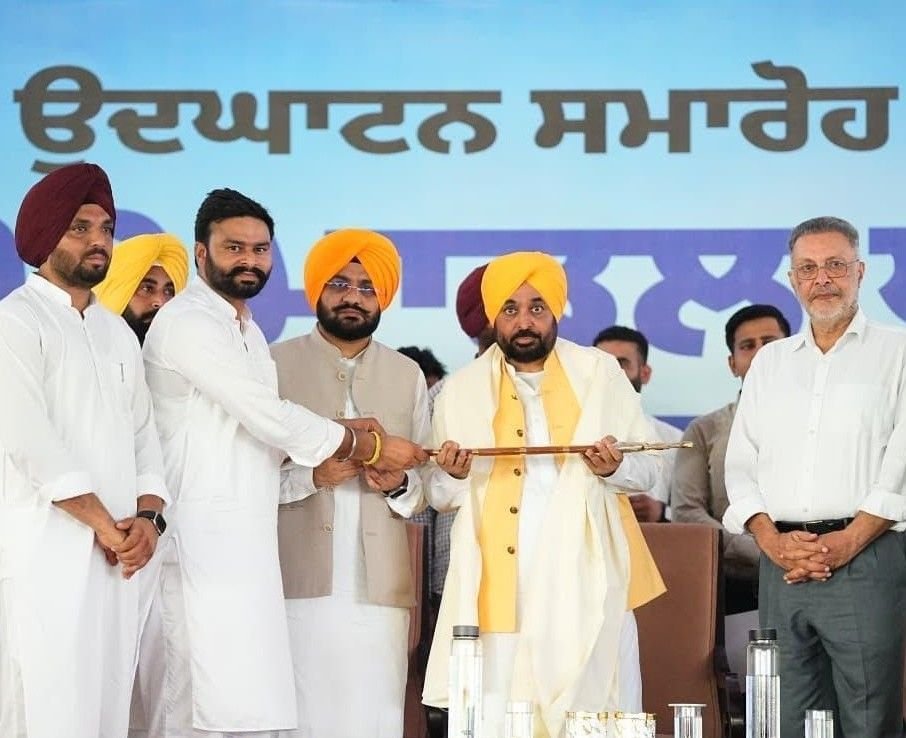
Punjab Chief Minister Bhagwant Singh Mann has unveiled more than 500 modern rural sports grounds across the state in what the government is presenting as a major investment in grassroots sport, youth development and the campaign against drug abuse.
Launching the second phase of the ambitious ‘Pendu Khed Maidan’ programme from Patiala on August 24, Mann said the newly dedicated facilities had taken the number of completed rural sports grounds under the initiative to 734. The government aims to complete 3,100 such grounds across Punjab during 2026, backed by a major expansion in public spending on sports infrastructure.
The significance of the project, however, goes beyond new playing fields, floodlights and sporting equipment. For a state that has repeatedly confronted concerns over drug addiction and unemployment among young people, the Mann government is seeking to position sport as a social intervention as much as a recreational activity.
The Chief Minister said the central message behind the initiative was simple: “Say No to Drugs, Say Yes to Sports.”
The new grounds are designed to bring organised sporting opportunities closer to villages, where access to quality infrastructure has often been limited. According to the government, the facilities will cater to games including football, volleyball and cricket, along with traditional sports popular in different parts of Punjab. Equipment will also be provided according to local sporting preferences, allowing individual villages to develop facilities around the games their young people actively play.
Mann said 255 Pendu Khed Maidan had been dedicated during the first phase, while another 509 were being opened in the latest phase. The new grounds are spread across Punjab, including 43 in Ludhiana, 41 in Mansa, 36 in Sangrur, 34 each in Bathinda and Patiala, 33 in Sri Muktsar Sahib and 32 in Amritsar, besides projects completed in several other districts.
The ambition is to ensure that rural sporting infrastructure is not confined to basic open spaces. The grounds are being equipped with facilities intended to support regular use throughout the day. High-mast lighting is being installed to enable sporting activities after sunset, while footlights along walking tracks are meant to encourage fitness activities among people of all age groups. Chain-link fencing, football goalposts, volleyball poles, children’s swings and other amenities are also part of the infrastructure plan.
The project also seeks to widen the definition of who a sports ground is for. While young athletes are expected to be the principal beneficiaries, the government says activities for children and senior citizens will also be encouraged. In that sense, the Pendu Khed Maidan are being conceived as community spaces where exercise, recreation and social interaction can become part of everyday village life.
“If a child has access to a good school for education and a proper sports ground for physical development, that child can bring glory to the village, Punjab and the country,” Mann said, underlining the government’s effort to connect investment in education and sport with Punjab’s long-term human development.
The Chief Minister said the programme formed part of a wider sports strategy for the state, with 2026 being dedicated to sports and sportspersons. Punjab has allocated ₹1,744 crore for sports, according to the Chief Minister, with ₹1,500 crore earmarked specifically for the development of Pendu Khed Maidan.
Alongside the rural grounds, the government is also developing a network of rural gyms. Mann said 500 international-standard gyms had already been completed, while the wider programme envisages the creation of 600 such facilities.
The expansion of infrastructure is being accompanied by efforts to strengthen Punjab’s competitive sporting culture. The fourth season of Khedan Wattan Punjab Diyan is scheduled to begin in Bathinda on September 5, with the government expecting participation from around 10 lakh players.
Punjab is also preparing to host the Hockey Asian Champions Trophy later this year, with matches expected to be organised in Jalandhar and Mohali. For a state with a deep historical association with hockey and a long record of producing national and international players, hosting the tournament would offer another opportunity to bring elite sport closer to local audiences.
Cricket, too, is being drawn into the state’s expanding sporting calendar. Mann announced that the She-e-Punjab T20 League, conceived on the lines of franchise-based T20 competitions, would be held at the PCA Stadium in Mohali from August 30 to September 13.
The government has also highlighted financial support as a key element of its sports policy. Mann said that since 2022, prize money worth ₹135 crore had been distributed among 40,415 sportspersons. Assistance is also being provided to athletes preparing for major international events, including up to ₹15 lakh for Olympic preparation and ₹8 lakh for athletes preparing for the Asian and Commonwealth Games.
The Chief Minister said 85 sportspersons had been honoured with the Maharaja Ranjit Singh Award, while 11 athletes who had brought distinction to Punjab at national and international levels had been appointed to PCS and DSP-level positions.
For the Mann government, the Pendu Khed Maidan programme is also closely tied to its broader political and social messaging. At the inauguration, the Chief Minister said his government was focused on fighting corruption, drug abuse and unemployment, while accusing opposition parties of concentrating on political power.
But the long-term success of the initiative will ultimately depend on what happens after the inauguration ceremonies. Building grounds is only the first stage. Their real value will be measured by whether they remain well maintained, actively used and accessible to children and young people across Punjab’s villages.
If the facilities are sustained and supported by trained coaches, regular competitions and local sporting institutions, they could help revive a culture in which village playgrounds once served as the starting point for many of Punjab’s finest athletes.
For now, the government is betting that the road to a healthier and more confident generation may begin not in a stadium in a major city, but on a floodlit playing field in a Punjab village.
The inauguration of more than 500 Pendu Khed Maidan marks one of the largest visible steps in that direction. It is an attempt to turn sport into a daily habit, a community institution and, above all, a positive alternative for Punjab’s young generation — offering them a message that the state hopes will travel far beyond the boundaries of the playing field: say no to drugs, and say yes to sport.