
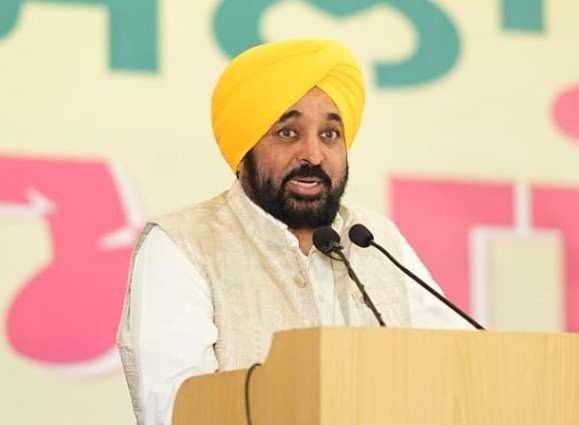
The Bhagwant Singh Mann government is facing a growing political challenge from an increasingly vocal section of Punjab’s own workforce, with government employees and pensioners turning long-pending service and financial demands into a major issue just as the state begins its long march towards the 2027 Assembly election.
The announcement of a statewide “Maha Bandh” on August 27 has brought the confrontation into sharper focus. Employee and pensioner organisations have been demanding the release of pending dearness allowance, settlement of arrears, restoration or implementation of pension-related commitments, regularisation of contractual employees and resolution of several other service issues. The proposed statewide action has the potential to affect government functioning and public services across Punjab.
For the Mann government, the immediate challenge is administrative. But politically, the implications are much wider.
AAP swept to power in Punjab in 2022 with an overwhelming mandate, presenting itself as an alternative to the state’s traditional political parties and promising a government that would be more responsive, transparent and accessible. Four years later, the party is preparing to defend its record as an incumbent, and protests by employees have become an uncomfortable reminder that sections of the electorate which once welcomed political change are now demanding delivery on specific commitments.
Recent protests have brought Finance Minister Harpal Singh Cheema under particular political pressure. Reports have highlighted demonstrations by a wide range of employee groups, including teachers, sanitation workers and employees associated with government corporations and public services. The protests have focused on issues such as dearness allowance, pension arrangements, pay-related grievances, regularisation and service conditions.
The confrontation has also given the opposition a ready-made political issue.
Congress leaders have accused the AAP government of failing to fulfil commitments made to employees, while the BJP and Shiromani Akali Dal have also sought to raise questions about the government’s handling of financial and employment-related concerns. The opposition’s strategy is straightforward: to challenge the gap, if any, between AAP’s promises of change and the experience of those working within Punjab’s public system.
The Mann government, however, faces a more complex reality than the political slogans suggest.
Punjab’s finances have long been under pressure. Any decision involving dearness allowance, arrears, pensions or large-scale regularisation carries a significant financial cost. The government must therefore balance employee expectations with its ability to sustain expenditure while continuing to fund welfare schemes, infrastructure, health, education and other development programmes.
This is where an administrative dispute becomes a political test.
Employees are not merely a separate interest group. They include teachers, healthcare workers, clerical staff, technical personnel and others who form an important part of the state’s public-service machinery. Their dissatisfaction can affect not only political perceptions but also the everyday functioning of government.
The political consequences become even more serious when protests disrupt public services. The Mann government has built much of its political narrative around improving the delivery of government services. If schools, offices, healthcare facilities or citizen-service centres are affected by prolonged disputes, the opposition will inevitably use the disruption to challenge AAP’s governance claims.
The latest unrest has already spread across different sections of the workforce. ETT teachers recently staged a protest outside the residence of Finance Minister Harpal Singh Cheema, while other employee organisations have separately raised concerns over pending demands. Sewa Kendra employees have also warned of a possible statewide disruption from September if their issues remain unresolved.
For the Chief Minister, the issue presents a difficult political balancing act.
On one hand, the government cannot afford to ignore a sustained protest movement, particularly when the Assembly election is approaching. On the other, conceding every demand without considering the financial implications could create additional pressure on the state exchequer.
The most effective political response, therefore, may not necessarily lie in a dramatic announcement. It may depend on sustained negotiations, a clear timeline for addressing legitimate demands and better communication between the government and employee organisations.
The episode also reveals a broader shift in Punjab’s political environment.
As governments move closer to elections, public attention often turns from promises to performance. The first years of a government may be dominated by announcements, new schemes and claims of reform. The final phase, however, is usually marked by a more demanding question: who remains dissatisfied, and why?
For the Mann government, employees and pensioners are now emerging as one of the groups that require sustained political engagement.
The opposition senses an opportunity. If employee anger continues to grow, it could become part of a wider anti-incumbency narrative combining concerns over jobs, public finances, law and order and the delivery of government promises. But opposition parties will also have to convince voters that they have credible solutions rather than merely criticism.
For AAP, the challenge is equally clear. The party cannot allow every protest to be seen as evidence that its relationship with key sections of Punjab society is deteriorating.
The August 27 Maha Bandh will therefore be watched closely, not simply for the scale of participation or disruption, but for what follows. A constructive settlement could allow the government to contain the issue. A prolonged confrontation, however, could provide opposition parties with an increasingly powerful political weapon.
Punjab’s 2027 election will not be decided by employee unions alone. But politics is often shaped by the accumulation of grievances, and the Mann government will know that an unresolved dispute with its own workforce can quickly become larger than the original demands.
The government has built its political identity on the promise of change. As employee unrest intensifies, the next test will be whether it can demonstrate that change also includes the ability to listen, negotiate and deliver.
In the increasingly competitive politics of Punjab, that may prove to be as important as any new welfare scheme or election announcement.