
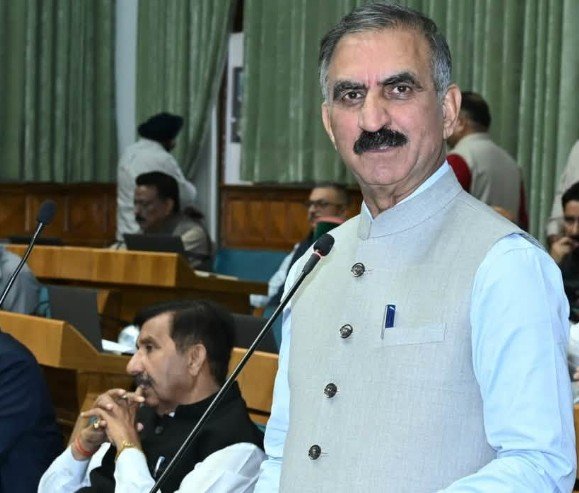
The monsoon session of the Himachal Pradesh Assembly has quickly turned into a major political confrontation between the ruling Congress government and the Opposition BJP, with corruption allegations, governance, law and order and the conduct of the House emerging as the principal fault lines.
The latest escalation came on August 25, when BJP legislators staged a protest outside the Assembly in Shimla carrying suitcases and alleging large-scale corruption under the government led by Chief Minister Sukhvinder Singh Sukhu. Leader of Opposition Jai Ram Thakur accused the Congress administration of allowing corruption to spread across government departments and claimed that development activity had slowed significantly.
The protest was more than a symbolic demonstration. It reflected the BJP’s broader strategy of using the ongoing Assembly session to put the Sukhu government on the defensive and turn allegations of corruption and administrative failure into a sustained political narrative.
Thakur alleged that corruption had become entrenched in several areas of government functioning, including road works, health supplies, medicines, education-related procurement and government tenders. The BJP’s use of suitcases was intended to dramatise its allegations and reinforce its charge that financial irregularities had become a defining feature of the Congress administration. These remain political allegations by the Opposition and have not been established as facts by the government or a court.
For the Sukhu government, the confrontation comes at a particularly sensitive moment. The Assembly’s monsoon session, being held from August 21 to September 3, was expected to provide an opportunity for the government to discuss policy and development issues, but political tensions have repeatedly overshadowed legislative business.
The Opposition had entered the session prepared to raise questions about alleged political vendetta, corruption, law and order and cases registered against BJP leaders. The government, meanwhile, has argued that the Assembly should focus on substantive issues and fact-based debate rather than political disruption.
The dispute over the national song Vande Mataram has added another layer to the confrontation.
Proceedings were disrupted after BJP members objected to the manner in which Vande Mataram was handled at the beginning of the session. Congress leaders, led by Chief Minister Sukhu, accused BJP legislators of disrespecting national symbols, while Jai Ram Thakur rejected the allegation and demanded evidence from the proceedings. The disagreement resulted in repeated adjournments and competing protests by the two sides.
The controversy has become politically important because it has shifted the Assembly debate from purely administrative issues to questions of nationalism, parliamentary conduct and political propriety. Governor Kavinder Gupta has also urged respect for national symbols and said that issues concerning them should not become partisan political disputes.
Yet beneath the immediate political confrontation lies a much broader contest over the performance of the Sukhu government.
The Opposition is seeking to portray Congress as an administration struggling with corruption, weak development momentum and deteriorating public services. The government, in turn, is attempting to defend its record while maintaining that it inherited serious financial and administrative problems.
The session has provided the BJP with a natural political platform. More than 1,000 questions were reportedly submitted by Congress and BJP legislators, covering vacancies in educational institutions, healthcare facilities, monsoon damage, roads, tourism, agriculture, horticulture and transport. The breadth of these questions demonstrates that the political contest is not limited to the corruption allegations currently dominating headlines.
For Sukhu, the challenge is to ensure that the government does not lose control of the legislative narrative. His administration needs to demonstrate that it can answer questions on public services and development while simultaneously confronting the BJP’s allegations.
The political stakes are significant even though Himachal is not immediately facing an Assembly election. The Congress government is approaching the midpoint of its tenure, and both parties are already positioning themselves for the longer electoral battle.
The BJP, led in the Assembly by Jai Ram Thakur, sees an opportunity to exploit dissatisfaction with the government and consolidate the gains it has made in recent political contests. The Congress, meanwhile, needs to protect its organisational position and demonstrate that Sukhu’s leadership can withstand sustained Opposition pressure.
The recent municipal corporation results have already provided the BJP with political confidence. The party won three of Himachal’s four municipal corporations — Mandi, Dharamshala and Solan — while Congress retained Palampur. Those results were widely seen as an encouraging sign for the BJP and a warning for the ruling party.
That background makes the Assembly session more consequential than an ordinary legislative sitting.
For Congress, the immediate task is to move the discussion back towards governance and policy. For BJP, the objective is to ensure that every controversy reinforces its larger argument that the state needs a change in political direction.
The Sukhu government also faces the challenge of balancing political defence with the delivery of administration. Himachal’s recurring monsoon disasters, road connectivity problems, healthcare pressures, employment concerns and financial constraints remain issues that directly affect voters. A government that allows the Assembly to become consumed entirely by political confrontation risks losing the opportunity to explain its response to these practical challenges.
The coming days of the session will therefore be closely watched. The question is not simply whether Congress and BJP can exchange sharper accusations, but whether the Assembly can return to substantive debate on the issues that matter most to Himachal’s citizens.
For the Sukhu government, the political test is one of credibility. It must answer allegations without allowing the Opposition to define its entire record through them.
For the BJP, the test is equally demanding. Allegations can generate political momentum, but voters ultimately expect evidence, accountability and credible alternatives.
As the monsoon session continues, Himachal’s political contest is increasingly becoming a battle over competing narratives: Congress wants to defend its governance record and accuse BJP of obstruction, while the BJP is seeking to portray the Sukhu administration as politically vulnerable and administratively ineffective.
The Assembly has become the immediate arena for that battle.
And with the 2027 electoral contest still ahead, both parties know that the political arguments being made in Shimla today could become the foundations of tomorrow’s campaign.