
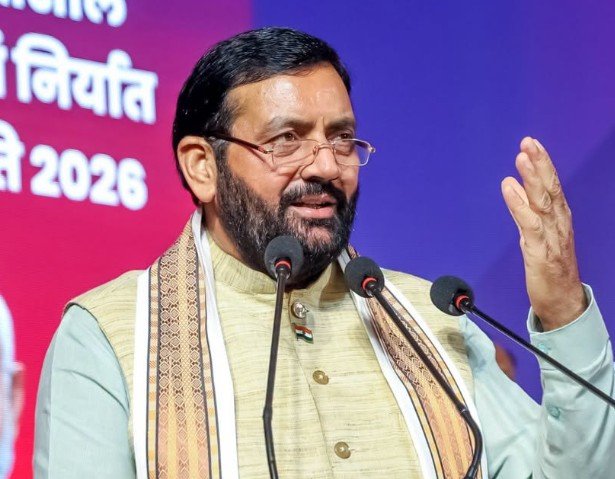
The Nayab Singh Saini government in Haryana is facing a fresh and politically sensitive social question after its move to recommend replacing the term “Chamar” with “Meghwal” on caste certificates for members seeking the change. The proposal has opened a wider debate over caste identity, administrative recognition and the BJP government’s effort to consolidate its relationship with Scheduled Caste communities in the state.
The issue is significant because caste remains deeply connected with social identity and political mobilisation in Haryana. Any government decision concerning official caste terminology therefore carries implications beyond administration. It touches questions of dignity, community identity and representation, while also inevitably becoming part of the wider political contest between the ruling BJP and Opposition parties.
The Saini government has decided to recommend the change to the Centre rather than treating the matter as a routine state-level administrative modification. That distinction is important because the classification of Scheduled Castes is governed by constitutional and central provisions, meaning that any substantive alteration requires action at the appropriate level.
For the Haryana government, the proposal is being presented in the context of demands from members of the community who want the term “Meghwal” reflected in official documents. Supporters of the move argue that people should have the ability to use the identity with which they associate themselves, particularly when the terminology appearing on official certificates has social consequences.
But the decision has also triggered questions about the political motivations behind the government’s move.
The BJP has been attempting to broaden its support among Scheduled Castes across Haryana, and the proposal comes against that larger political background. The party’s strategy increasingly involves combining welfare, representation and community-specific outreach with its broader development narrative.
That does not automatically mean the proposal is merely electoral politics.
Caste terminology has a genuine social dimension, and governments are often required to respond to demands for recognition that emerge from communities themselves. The political debate begins when such decisions are viewed through the lens of electoral calculations.
For Saini, the challenge will be to demonstrate that the proposal is based on a legitimate administrative and social demand rather than short-term political considerations.
The issue also highlights the complicated relationship between identity and official documentation.
A caste certificate is not simply another government document. It determines access to reservations and can influence eligibility for a range of educational and employment opportunities. Any change in terminology therefore requires careful legal and administrative examination to ensure that the process does not create uncertainty about the constitutional status or entitlements of eligible citizens.
That is likely to be an important part of the government’s next step.
The recommendation to the Centre means that the Haryana government will have to explain the precise legal basis of the proposed change and ensure that existing rights and entitlements remain protected.
For the Opposition, the development provides an opportunity to question the BJP government’s approach to caste politics. Congress is likely to examine whether the move genuinely responds to a long-standing social demand or represents an attempt to influence a particular electoral constituency.
The BJP, meanwhile, can argue that responding to community concerns is part of responsive governance.
The controversy illustrates the increasingly complex political environment in Haryana, where social issues and development politics are becoming closely interconnected.
The Saini government has been aggressively promoting investment and industrial expansion. Its latest investor outreach in Mumbai produced investment proposals worth around ₹66,000 crore, including a proposed ₹20,000-crore investment by the Godrej Industries Group. The administration is presenting these developments as evidence of Haryana’s growing economic attractiveness and its commitment to employment generation.
At the same time, the government has been pursuing social and welfare initiatives aimed at different sections of society.
The combination is central to Saini’s political strategy: economic growth on one side and social outreach on the other.
The caste-certificate issue now adds another layer to that strategy.
Haryana’s political history demonstrates that social identity can significantly influence electoral behaviour. Communities closely monitor government decisions relating to reservations, representation, welfare benefits and official recognition. Consequently, even a seemingly narrow administrative decision can become a much larger political conversation.
The government’s handling of the issue will therefore be closely watched.
If the process is transparent and legally sound, the administration can argue that it is simply responding to the wishes of citizens while preserving existing constitutional protections. If questions remain unanswered, the Opposition may attempt to portray the decision as politically motivated.
There is also a broader social question: how should governments balance community-specific demands with the need for consistent official classification?
That is not an easy question.
Changing terminology can provide recognition and dignity to people who feel inadequately represented by an official label. But government records must also remain legally consistent so that citizens do not face confusion over their eligibility for constitutional safeguards.
This makes the Centre’s eventual response particularly important.
For the Saini government, the political calculation is equally delicate. The BJP has already built a strong electoral position in Haryana, but maintaining that position requires continued engagement with different social groups.
The Chief Minister has increasingly presented his administration as one that combines development with inclusive governance. The proposed terminology change can be incorporated into that narrative if the government successfully establishes that it is responding to a genuine community concern.
However, the government will need to avoid allowing the issue to become unnecessarily polarised.
A constructive approach would involve consultation with community representatives, legal experts and relevant administrative authorities before the recommendation moves forward. Such consultation could help ensure that the process is both socially sensitive and legally robust.
The episode also reflects the broader political transformation taking place in Haryana.
The state’s political competition is no longer confined to the traditional contest between major parties over agriculture, jobs and rural development. Identity, welfare, urbanisation, industrial investment and social representation are increasingly overlapping.
The Saini government is attempting to manage all these pressures simultaneously.
Its investment campaign seeks to create new economic opportunities. Its administrative policies are aimed at improving governance. Its welfare measures seek to maintain support among different sections of society. And now, through the caste-certificate proposal, it is responding to a question that sits at the intersection of identity and public administration.
The political success of this approach will ultimately depend on credibility.
Haryana’s citizens are likely to ask whether government decisions improve their lives, protect their rights and provide equal access to opportunities. Symbolic recognition can be important, but it will carry greater political weight when accompanied by improvements in education, employment, social security and representation.
For the Saini government, the latest controversy is therefore both an opportunity and a test.
It has an opportunity to demonstrate sensitivity towards a community’s identity concerns, but it must also ensure that the process is legally clear and socially inclusive.
The BJP’s broader political objective will be to strengthen its relationship with communities that can play a decisive role in Haryana’s electoral landscape. The Opposition will attempt to scrutinise that outreach and determine whether it represents genuine social policy or political positioning.
For now, the caste-identity debate has moved beyond the wording on a government certificate. It has become another indicator of how Haryana’s BJP government is navigating the increasingly complex intersection of governance, social justice and electoral politics.
How Saini handles the next stage of the process could determine whether the issue becomes an example of responsive administration or another flashpoint in Haryana’s increasingly competitive social and political landscape.