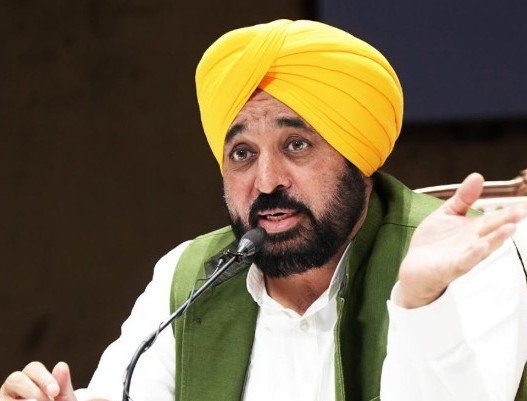
A confrontation between the Punjab government and its employees has rapidly developed into a significant political issue for Chief Minister Bhagwant Mann’s AAP administration.
More than three lakh government employees participated in a mass casual-leave protest on 27 August, according to reports, while pensioners also joined the agitation. The employees’ demands include pending dearness allowance payments and issues related to the Old Pension Scheme.
The dispute intensified after a scheduled meeting between Mann and employee representatives was cancelled.
The government’s response has since become tougher. Departments have been instructed to identify employees who remained absent and initiate action where the absence was considered unauthorised. Show-cause notices are being issued in connection with the strike.
The confrontation comes at a politically sensitive moment.
Punjab is less than a year away from an Assembly election, and government employees represent a large organised constituency. Their families and wider networks give the dispute significance well beyond the public sector.
The employees argue that their demands concern long-pending financial and service-related issues. The government, meanwhile, has a responsibility to maintain public services and ensure that employees do not remain absent without authorisation.
The strike has already affected public services in some areas. Reports said outpatient services in several government hospitals were disrupted during the agitation.
For Mann, the political challenge is to prevent an industrial dispute from becoming an election issue.
The AAP government has consistently highlighted its record on employment, recruitment and welfare measures. It has also attempted to present itself as an administration focused on improving public services.
The employees’ agitation creates a different narrative: one centred on salaries, pension rights, allowances and dissatisfaction among sections of the government workforce.
Opposition parties are likely to use the dispute to question the government’s financial management and administrative approach. AAP, in turn, can argue that government discipline and fiscal constraints cannot be ignored.
Neither side has an easy position.
For employees, prolonged confrontation risks further disruption and disciplinary action. For the government, a heavy-handed response could deepen resentment among a politically influential section of the electorate.
The timing is particularly important because political parties are already beginning to campaign indirectly for 2027.
The dispute also illustrates a broader challenge facing the Mann government: welfare commitments, employee demands, debt pressures and development spending must all be balanced against the state’s fiscal position.
Whether the confrontation is resolved through negotiation or becomes a prolonged political dispute could matter beyond the immediate demands.
Punjab’s government employees are not simply a pressure group. They are part of the state’s administrative machinery and an important social constituency.
As the election approaches, the government’s handling of the dispute will therefore be judged not only as an administrative matter but also as a test of political management.