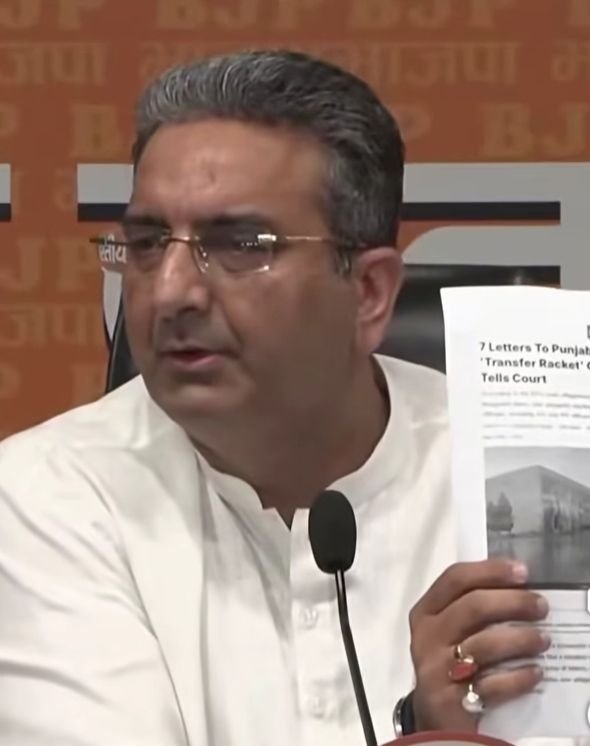
The political battle over alleged corruption in Punjab’s transfer and posting system intensified on Wednesday, with the Bharatiya Janata Party demanding the resignation of Chief Minister Bhagwant Mann and a Central Bureau of Investigation (CBI) probe into what it described as a “cash-for-transfer” racket.
Addressing a press conference in New Delhi, BJP national spokesperson Gaurav Bhatia alleged that an organised system was operating within Punjab’s administrative machinery in which postings and transfers of senior government officials were allegedly determined through a “rate card”. He claimed that the allegations had emerged from material examined by the Enforcement Directorate (ED) and demanded an independent investigation into the matter.
The BJP’s allegations come against the backdrop of proceedings before the Punjab and Haryana High Court concerning a petition seeking an investigation into alleged corruption in transfers, postings and other government decisions. The High Court has described the allegations as serious and sought details of communications sent by the ED to the Punjab Police.
According to Bhatia, the alleged “rate card” determined which officer would receive a particular posting and what price would allegedly be attached to that appointment. He specifically referred to senior IAS and IPS officers and questioned how such a system could allegedly operate without the knowledge of the Chief Minister.
Bhatia also alleged that Punjab Chief Minister’s Officer on Special Duty (OSD) Rajbir Singh Ghuman had figured in material emerging from the ED investigation. He questioned whether an OSD could exercise influence over the transfer and posting of more than 20 senior IAS and IPS officers without the Chief Minister being aware of it. These claims are allegations made by the BJP and have not been established as criminal findings against the individuals concerned.
Another serious aspect raised by the BJP concerns the alleged circulation of confidential government information. Bhatia claimed that the ED had placed before the Punjab and Haryana High Court material indicating that confidential documents, draft lists of transfers and postings, and proposed government policy documents were allegedly found on the mobile phones or WhatsApp accounts of private intermediaries.
The BJP argued that if confidential administrative documents were indeed reaching individuals outside the government system, the issue went beyond alleged financial corruption and raised questions about the security and functioning of the state administration.
Bhatia further accused the Punjab Police of failing to register an FIR despite repeated communications from the ED. He claimed that the ED had written to the Punjab Police seven times and had conveyed that the information involved a cognisable offence requiring registration of a criminal case.
The issue, however, is already before the judiciary. The Punjab and Haryana High Court recently directed the ED to place its communications with the Punjab DGP on record after hearing a public interest litigation seeking a court-monitored CBI investigation. The ED told the court that it had sent communications to the Punjab DGP in July and August regarding the alleged irregularities.
The BJP has now sought to turn the controversy into a direct political challenge to the Mann government.
Bhatia argued that Chief Minister Mann should step aside to ensure that any investigation into the allegations could proceed independently. The BJP also demanded that the entire matter be handed over to the CBI rather than being investigated by agencies under the control of the state government.
The party also targeted AAP national convenor Arvind Kejriwal, questioning his alleged role in the purported network and accusing both Kejriwal and Mann of becoming symbols of corruption. These are political allegations by the BJP and are not findings established by a court.
The controversy has added another layer to the increasingly charged political atmosphere in Punjab ahead of the 2027 Assembly election. The BJP has been seeking to expand its political footprint in the state and has increasingly attacked the Mann government over issues of governance, corruption and law and order.
For the AAP government, the immediate challenge is to address the allegations with documentary evidence and a clear explanation of the administrative process governing transfers and postings.
The legal proceedings could prove more consequential than the political rhetoric. The High Court is examining whether the allegations warrant further investigation and what role, if any, should be played by central investigative agencies. More recently, the CBI told the High Court that it had no objection to investigating the alleged cash-for-transfer matter, potentially opening the way for a more comprehensive probe.
At this stage, the allegations of a “cash-for-transfer” system remain allegations and should not be treated as proof of corruption by the Chief Minister, his OSD or any other individual unless established through investigation and judicial proceedings.
But politically, the issue has already become significant. The BJP is attempting to frame the alleged transfer-posting network as evidence of “institutional corruption”, while the judicial proceedings will determine whether the material cited by the ED and the allegations placed before the court are sufficient to warrant a formal criminal investigation.
For the Mann government, the central question is no longer simply about individual transfers or postings. It is whether the administration can convincingly demonstrate that decisions concerning senior officers are being made through a transparent and accountable system — and that confidential government information is not being channelled through private intermediaries.
The coming hearings in the Punjab and Haryana High Court are therefore likely to determine whether the controversy remains primarily a political confrontation or develops into a formal investigative case with wider implications for the functioning of Punjab’s bureaucracy.