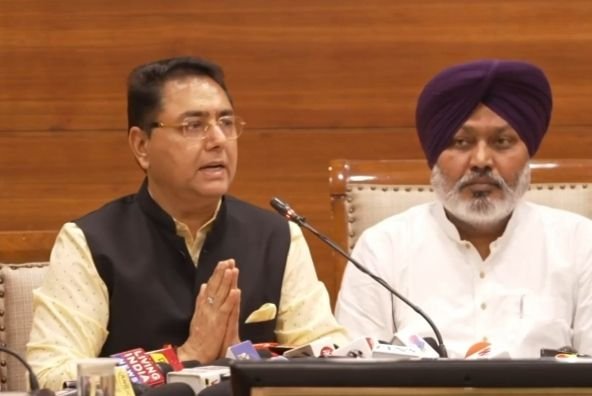
Punjab’s prolonged confrontation with its government employees over dearness allowance arrears, pension-related demands and other service issues has entered a politically sensitive phase, with Aam Aadmi Party state president and Cabinet Minister Aman Arora making a fresh appeal to employees to abandon confrontation and return to negotiations.
Speaking against the backdrop of growing employee unrest, Arora folded his hands while appealing to government employees and described them as an integral part of the state’s administrative family. He argued that the government’s objective was not to defeat employees in a confrontation but to find workable solutions to their demands through dialogue.
Arora’s intervention assumes significance because the dispute has moved well beyond the issue of pending DA. It has developed into a wider confrontation involving employee organisations, the Punjab government and opposition parties, with the 2027 Assembly elections approaching.
The immediate dispute centres on a substantial backlog of DA and dearness relief. The Punjab government has acknowledged arrears of around Rs 14,191 crore, while maintaining that the amount cannot be paid in one instalment because of the state’s financial and constitutional constraints. The government has approached the Supreme Court against a Punjab and Haryana High Court order directing payment of the arrears within a fortnight.
Arora’s message is therefore aimed at creating political and administrative space for negotiations before the confrontation escalates further.
The government has been particularly concerned about the consequences of prolonged employee agitation. On August 27, more than 150 employee organisations participated in a statewide ‘Maha Hartal’. Reports estimated that around four lakh government employees stayed away from work, while pensioners also joined protests. The shutdown affected government functioning across the state.
Instead of allowing the dispute to develop into a prolonged strike-versus-government confrontation, the Mann government is now seeking to bring employee representatives back to the negotiating table.
Arora has sought to draw a political distinction between the AAP government and its predecessors. He accused the Congress, BJP and Shiromani Akali Dal of misleading employees, arguing that political parties should not make attractive promises to government employees merely to secure votes before an election. He said the AAP government did not want to follow what he described as the practice of making commitments before elections and subsequently failing to honour them.
His message was also built around a direct assurance: whatever is discussed and agreed with employees would be treated seriously by the government. In political terms, the statement is designed to reassure a large and organised section of Punjab’s electorate that the government is willing to negotiate rather than simply use administrative measures to suppress the agitation.
Why the government wants dialogue now
There are several reasons behind the renewed emphasis on negotiations.
First, the scale of the employee movement makes it difficult for any government to treat the dispute as an isolated service matter. Government employees, pensioners, contractual workers and other organised groups collectively represent a substantial social and electoral constituency.
Second, the confrontation is beginning to affect the functioning of the administration. Employee unions have already announced plans for further agitation if show-cause notices issued after the August 27 strike are not withdrawn. They have threatened mass leave and demonstrations outside the residences of ministers and AAP legislators.
Third, the financial issue cannot be separated from the legal battle. The Punjab government has argued before the Supreme Court that clearing Rs 14,191 crore in one go would place an enormous burden on the state exchequer. It has also contended that such expenditure has constitutional implications because withdrawals from the Consolidated Fund have to follow the prescribed appropriation process. The government says its earlier plan was to clear the arrears over five financial years.
The government has further argued that Punjab already spends a much larger proportion of its revenues on salaries and pensions than the national average. According to the state’s submission, committed expenditure on salaries and pensions accounts for about 51 per cent of revenue receipts, compared with an all-India average of around 38 per cent.
The argument over DA is also more complicated than simply comparing percentages with central government employees. Punjab has told the Supreme Court that its revised basic pay is higher in several categories because the Sixth Punjab Pay Commission adopted a multiplication factor higher than that of the Seventh Central Pay Commission. Consequently, the government argues, the same DA percentage applied to a higher basic salary does not necessarily produce the same overall benefit.
But employees see the matter differently. Their demands include the release of pending DA, implementation of the Old Pension Scheme, regularisation of contractual workers and improvements in pay scales and allowances. They are also seeking better remuneration for workers such as ASHA, Anganwadi and mid-day meal staff and restoration of the Assured Career Progression system.
For the employees, therefore, the issue is not simply a percentage of DA. It is increasingly about trust.
That is where Arora’s “family” appeal becomes politically important.
The AAP government is aware that its record on employee agitations provides ammunition to its critics. An Indian Express review of previous protests found that the government has made concessions in several cases, but many major employee demands remain only partially resolved. The OPS was notified in 2022 but has still not been implemented, while a 40-day ministerial employees’ strike in 2023 resulted in the release of one 4 per cent DA instalment, with subsequent instalments remaining pending.
This history makes the current promise of dialogue both necessary and politically challenging. Employees may be willing to return to negotiations, but they are likely to demand a concrete timetable and written commitments rather than another round of assurances.
The 2027 election factor
The timing is crucial.
Punjab is moving steadily towards the 2027 Assembly election, and the employee dispute could become an important political issue if it remains unresolved. Government employees and pensioners are not only an organised pressure group; they also have influence within families and communities across the state.
For the AAP government, a prolonged confrontation could create an uncomfortable political narrative: a government that came to power promising a change in governance could face accusations that it has failed to resolve the concerns of its own workforce.
The opposition Congress, BJP and SAD are likely to use the issue to attack the Mann government, particularly over DA arrears, the Old Pension Scheme and the state’s finances. Congress leaders have already backed employee demands and criticised the government over pending dues and fiscal management.
AAP, on the other hand, is attempting to frame the dispute differently. Its argument is that the government inherited substantial financial liabilities and is making payments within its fiscal capacity rather than making promises it cannot fulfil.
Arora’s warning against “false promises before elections” is therefore more than a statement about employee negotiations. It is also an attempt to establish an electoral narrative in which AAP portrays itself as more responsible than previous governments, while accusing its political rivals of exploiting employee grievances for electoral purposes.
Yet this strategy carries its own risk. Once a government publicly tells employees that commitments made at the negotiating table will be treated as firm, expectations rise. Any future delay could then become politically more damaging.
The immediate challenge, therefore, is to convert Arora’s appeal into a credible negotiating process.
For the Mann government, bringing employees back to the table could prevent the dispute from becoming a prolonged statewide confrontation during the run-up to the election. For employees, negotiations offer a route to seek a structured settlement without repeatedly disrupting government services.
The political test will ultimately be whether dialogue produces measurable results.
If the government can reach a settlement on DA arrears, pension issues and other demands while keeping the state’s finances under control, Arora’s appeal could help the AAP government turn a potentially damaging confrontation into a political opportunity. If negotiations once again end with assurances but no implementation, the employee movement could become one of the most significant pressure points against the government as Punjab heads towards the 2027 Assembly elections.