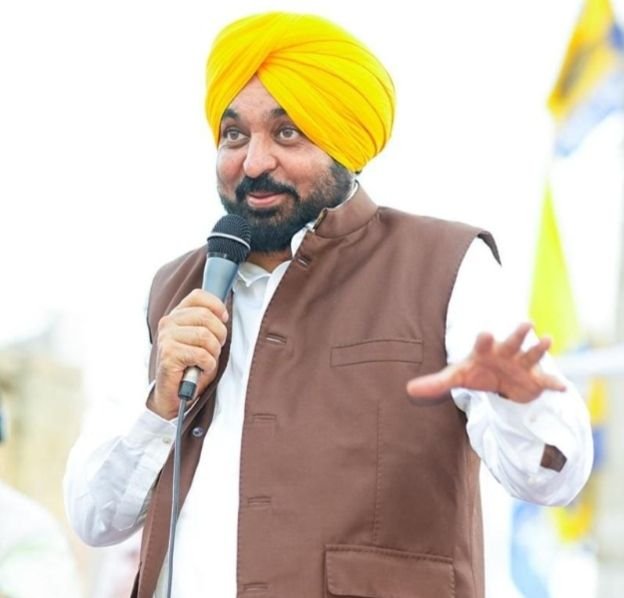
BATHINDA — Punjab Chief Minister Bhagwant Singh Mann on Sunday launched a broad political offensive against the Opposition, accusing rival parties of being more interested in regaining power and control over the state’s resources than in addressing the concerns of ordinary Punjabis.
Addressing a Lok Milni programme at Ghudda village in Bathinda, Mann portrayed his government as a sharp departure from the political establishment that had governed Punjab before the Aam Aadmi Party came to power in 2022. He argued that his administration was putting public money into education, healthcare, roads, electricity, agriculture, women’s welfare and employment, while his political opponents were seeking opportunities to return to power.
Mann repeatedly framed the political contest as a choice between governments that, in his words, worked for themselves and one that worked for the people.
“Every rupee belonging to the people is being spent for the people,” he said, arguing that the Opposition was uncomfortable precisely because government resources were being directed towards public welfare rather than private interests.
The Chief Minister also sought to reinforce his personal political identity, presenting himself as a leader who emerged from an ordinary background rather than through an established political family or national party hierarchy. Taking a dig at both the BJP and Congress, he said some politicians belonged to the “Modi quota” and others to the “Rahul Gandhi quota”, while describing himself as being from the “people’s quota”.
Mann recalled the 2022 Assembly election, when voters handed the AAP an overwhelming mandate and made him Chief Minister. He said the people had given a “teacher’s son” an opportunity five years ago and would give him another opportunity in 2027.
The statement underlines the central political message Mann is expected to carry into the next Assembly election: that his government represents a break from Punjab’s traditional political establishment and should be judged primarily on its record of governance and delivery.
Punjab’s Political Battle Begins to Take Shape
Mann’s remarks also came against the backdrop of renewed political manoeuvring in Punjab ahead of the 2027 Assembly election. He used the Bathinda gathering to target both the BJP and the Shiromani Akali Dal, alleging that the two parties were again moving towards an alliance.
According to Mann, the Akali Dal was prepared to join hands with the BJP on the condition that the three controversial farm laws be brought back. He argued that such a political understanding would expose what he described as the absence of a genuine ideological commitment to Punjab’s interests.
Mann also invoked the farmers’ agitation, saying Punjab would not forget the deaths of farmers during the protests against the farm laws. He put the number of deaths at around 750 and accused the BJP of carrying political responsibility for what he described as one of the most painful episodes in recent agricultural politics.
The Chief Minister further attacked the Akali Dal for what he called its long record of compromising Punjab’s interests. He accused the party of presiding over a period marked by allegations of sacrilege, patronage of mafias, the drug crisis and damage to the social and emotional fabric of the state.
Taking direct aim at Akali leader Sukhbir Singh Badal, Mann questioned his understanding of rural Punjab and the problems confronting farmers. His criticism was designed to reinforce the AAP’s effort to present itself as a party rooted in the everyday realities of Punjab rather than in established political families.
Congress Also Comes Under Fire
Mann reserved another part of his attack for the Congress, portraying the party as divided and preoccupied with internal competition for leadership.
He alleged that while Congress leaders were engaged in factional battles, the AAP government was concentrating on education, healthcare, employment and public welfare.
The Chief Minister also revived some of the most politically sensitive issues associated with Congress governments in Punjab and at the national level, including Operation Blue Star, the killings of Sikhs in 1984, the drug crisis and the unresolved sacrilege cases.
He argued that Congress had lost the moral authority to seek the confidence of Punjab’s voters because, in his assessment, the party had failed to address these issues adequately when it was in power.
Mann’s strategy was clear: to place both the Congress and the Akali Dal within what he described as Punjab’s old political order, while positioning the AAP as the alternative that emerged from outside that establishment.
Development as Mann’s Main Political Pitch
Alongside his political attacks, Mann devoted considerable attention to the AAP government’s development and welfare record.
He said the government had provided free electricity to households, created more than 70,000 government jobs without corruption, improved roads and expanded infrastructure and public services.
According to Mann, more than 90 per cent of households are receiving free electricity, while farmers are being supplied power during the daytime. He presented these measures as evidence that government policy could simultaneously provide relief to households and support agricultural activity.
Education, he said, remained the government’s most important long-term priority.
Mann argued that welfare schemes alone could not permanently eliminate poverty and social inequality and that quality education was essential to breaking the cycle of deprivation. He said the government was working to transform Punjab’s education system so that children from ordinary families could aspire to better careers and opportunities.
The Chief Minister also highlighted the construction of around 3,100 sports stadiums across Punjab, saying the infrastructure was intended to give young people greater opportunities in sports and help keep them away from drugs.
On infrastructure, Mann said approximately 45,000 kilometres of roads were being renovated or upgraded. He also claimed that the proportion of cultivable land covered by canal irrigation had risen from around 26 per cent to 80 per cent, presenting the expansion as an important intervention for Punjab’s agricultural future and groundwater conservation.
Healthcare and Women-Centred Welfare
Mann also highlighted the government’s healthcare and women-focused welfare programmes.
He referred to the Mukh Mantri Sehat Yojna, under which, according to the government, families are entitled to cashless medical treatment of up to ₹10 lakh. Mann described the programme as an attempt to reduce the financial pressure of medical treatment and expand access to healthcare.
He also spoke about the Mawan Dheeyan Satkar Yojna, under which eligible women aged 18 and above are to receive financial assistance of ₹1,000, with eligible Scheduled Caste women receiving ₹1,500. The assistance is intended to be transferred directly into beneficiaries’ bank accounts.
Mann said the scheme could benefit around 97 per cent of women in Punjab and that the state government had made a budgetary provision of ₹9,300 crore for the programme.
The political significance of such announcements is considerable. With the 2027 Assembly election approaching, the AAP government is increasingly likely to make welfare delivery, public services and direct financial support central components of its campaign narrative.
‘Days of Loot Are Over’
Mann concluded his Bathinda address by returning to one of the strongest themes of his political messaging: the contrast between the old political establishment and the AAP government.
He accused successive governments of having allowed Punjab’s wealth to be misused and claimed that the era of what he called “loot” had ended.
In its place, he said, Punjab was witnessing a “storm of development”.
The phrase captures the political narrative Mann is seeking to build ahead of 2027. His argument is that voters should not view the next election merely as a contest between political parties, but as a referendum on the way public resources are governed and distributed.
At the same time, his increasingly sharp attacks on the BJP, Akali Dal and Congress indicate that the Chief Minister sees the coming election as a multi-cornered political battle in which the AAP will have to defend its 2022 mandate against established rivals.
For Mann, therefore, the message from Ghudda was both a governance report card and an early campaign argument: Punjab, he says, has moved beyond the politics of the past, and the people who gave an outsider from an ordinary family the opportunity to lead the state in 2022 should be given the chance to continue that experiment in 2027.