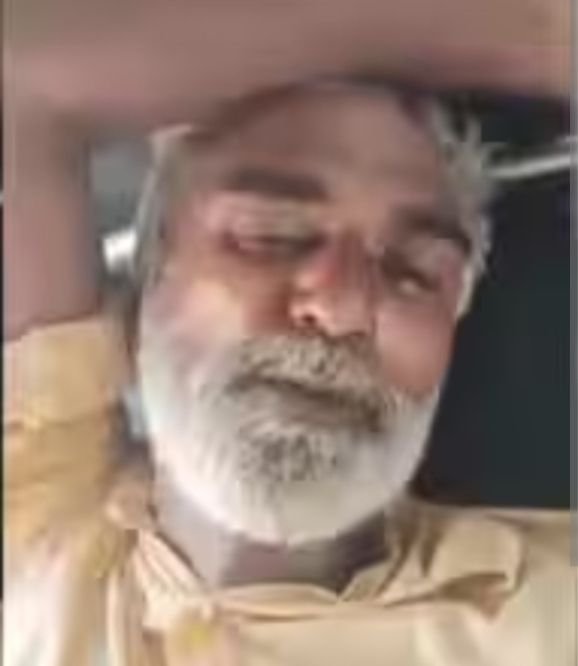
Sangrur : Punjab’s long-running battle against drugs has once again come under scrutiny after the death of 50-year-old Gulzar Singh, who allegedly consumed a poisonous substance, reportedly sulphas, following an incident linked to a programme in Dirba.
Heavy police deployment was witnessed at a hospital in Sangrur on Tuesday as Gulzar Singh’s post-mortem examination was conducted. More than 100 police personnel were reportedly deployed in and around the hospital as villagers and local residents gathered at the site, reflecting the tension and strong emotions surrounding the case.
Gulzar’s death has brought the state’s drug problem back into sharp focus, particularly the persistent allegations surrounding the availability and sale of ‘chitta’ in parts of Punjab and the growing frustration among sections of the rural population.
According to allegations made by villagers and local residents, Gulzar had raised questions about the alleged sale of chitta during an Aam Aadmi Party programme. His death came days after anti-drug activist Mohanjit Singh claimed that he had been subjected to alleged harassment and torture after displaying a black flag during a rally involving Punjab Chief Minister Bhagwant Mann in Sunam.
The circumstances surrounding Gulzar Singh’s death are now the subject of scrutiny. While the allegations made by villagers and activists are serious, the precise circumstances leading to his death, including the sequence of events preceding the alleged consumption of the poisonous substance, will need to be established through an impartial investigation.
The heavy police presence at the Sangrur hospital underlines the sensitivity of the situation. The gathering of villagers suggests that the incident has touched a much wider nerve in a region where the drug problem has repeatedly emerged as a major social and political concern.
A drug crisis that goes beyond politics
Punjab’s confrontation with drugs is not a new issue. For years, families across the state have complained about addiction destroying young lives, damaging household finances and creating social instability. The political debate has often centred on whether governments have done enough to control the supply chain while providing meaningful treatment and rehabilitation to those already trapped in addiction.
What makes the latest incident particularly significant is that it combines two deeply sensitive issues: the alleged presence of drugs in society and allegations of harassment following questions raised about the drug trade.
If the allegations are substantiated, they would raise serious questions about the ability of ordinary citizens to speak openly about an issue affecting their communities. At the same time, if the allegations are found to be incorrect, the investigation should establish that clearly as well.
Either way, the matter cannot be allowed to disappear amid political accusations and counter-accusations.
Questions that demand credible answers
Several questions now require a transparent examination.
What exactly happened during the programme in Dirba? What preceded Gulzar Singh’s alleged consumption of the poisonous substance? Was he subjected to any pressure, intimidation or harassment? Were complaints regarding the alleged sale of chitta made to the authorities before the incident? If so, what action was taken?
Most importantly, was Gulzar Singh’s death connected in any manner to the events surrounding his allegations, or was it the result of circumstances unrelated to them?
Only a credible investigation can answer these questions.
For the Punjab Government, the episode is also a reminder that the fight against drugs cannot be reduced to raids, arrests and seizures alone. The state must also address the social environment in which drug addiction thrives, strengthen rehabilitation services and ensure that citizens who raise concerns about drug activity are able to approach the authorities without fear.
The real cost is being paid by Punjab’s families
Behind Punjab’s drug statistics are thousands of families dealing with addiction, financial hardship, broken relationships and, in some cases, the loss of young lives.
The state has repeatedly promised a decisive campaign against drugs. But public confidence depends not only on government announcements; it depends on whether people see sustained action against the entire drug network and whether they believe that complaints will be heard fairly.
Gulzar Singh’s death has therefore become more than an individual tragedy. It has raised uncomfortable questions about the relationship between Punjab’s drug crisis, public anger and the ability of ordinary people to demand accountability.
The government now faces a responsibility to ensure that the investigation remains impartial and that every allegation is examined on evidence rather than political affiliation.
Punjab’s battle against drugs is ultimately a battle for the future of its young people. If the state wants to win that battle, it must ensure that the fight reaches not only those who consume drugs, but also the networks that allegedly supply them—and that citizens who speak about the problem are heard rather than ignored.
The circumstances surrounding Gulzar Singh’s death deserve answers. For his family and community, those answers are not a political demand; they are a matter of justice.