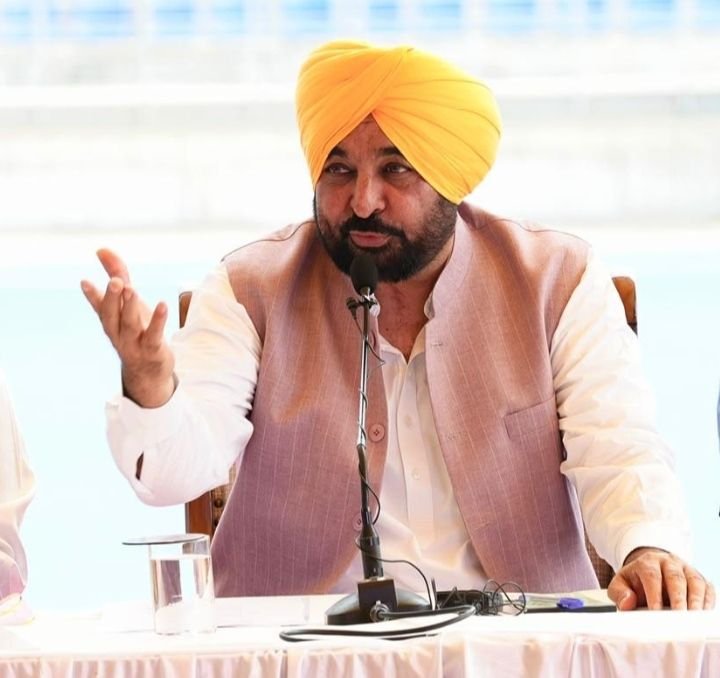
Punjab is preparing to welcome international hockey to its traditional heartland as the state gets ready to host the Asian Champions Trophy for the first time. Chief Minister Bhagwant Singh Mann on Monday unveiled the tournament logo in Chandigarh in the presence of senior officials of the Asian Hockey Federation and described the championship as both a major sporting occasion and a tribute to Punjab’s deep-rooted contribution to Indian hockey.
The tournament will be played from October 27 to November 5, with the league phase and opening ceremony scheduled at the Olympian Surjit Hockey Stadium in Jalandhar before the competition moves to the Olympian Balbir Singh Senior International Hockey Stadium in Mohali for the semi-finals and final.
The biggest attraction of the tournament will be the India-Pakistan encounter in Jalandhar on November 1, which will coincide with Punjab Day. The high-profile match is scheduled for 7 pm and is expected to draw enormous attention from hockey followers across Punjab and beyond.
In a move aimed at making the championship accessible to the public, the state government has announced free entry for all matches. Mann said international hockey should not be confined to those who can afford tickets and that young people, students and aspiring players should have the opportunity to watch some of Asia’s leading hockey teams in person.
“This is not simply another tournament on the international calendar,” Mann said, stressing that bringing the Asian championship to Punjab represents the return of elite hockey to a region that has produced generations of Indian players.
The six participating teams are India, Pakistan, Japan, South Korea, Malaysia and China, while Oman and Bangladesh have been kept as reserve teams. The presence of Pakistan is expected to add considerable interest to the competition, particularly with the two traditional rivals scheduled to meet on Punjab Day.
Mann said the India-Pakistan fixture should be viewed through the spirit of sport, with competition remaining intense on the field while mutual respect is maintained outside it. He said the contest would provide an opportunity for spectators to celebrate hockey rather than allow sporting rivalry to overshadow the broader values of the game.
For Punjab, the tournament also carries a strong cultural significance. Places such as Sansarpur, Khusropur and Mithapur have long been associated with Indian hockey, producing players who have represented the country at the highest level. The state has contributed numerous Olympians, national champions and captains to Indian hockey, making the decision to stage an international championship here particularly symbolic.
Mann pointed to Punjab’s continuing contribution to the national team, noting that 10 players from the state were part of India’s hockey contingent at the Paris 2024 Olympics, with Harmanpreet Singh leading the side.
The Punjab government has earmarked ₹25.40 crore for the organisation of the tournament. Of this, ₹22.96 crore is being spent on improving the two principal venues. Jalandhar’s Olympian Surjit Hockey Stadium is receiving an investment of ₹14 crore, while ₹8.96 crore has been allocated for the Olympian Balbir Singh Senior International Hockey Stadium in Mohali.
The government views the expenditure not merely as preparation for a single tournament but as an investment in Punjab’s long-term sporting infrastructure. The objective, according to the Chief Minister, is to ensure that participating teams receive international-standard facilities while spectators experience a championship worthy of Punjab’s reputation as a hockey state.
The tournament will begin in Jalandhar, where the opening ceremony and league matches will be held from October 27 to November 2. The competition will then shift to Mohali, which will host the semi-finals on November 4 before staging the final and closing ceremony on November 5.
The two venues will consequently showcase two different but complementary sides of Punjab’s sporting identity: Jalandhar’s long association with hockey and the wider Doaba region, and Mohali’s emergence as a major modern sporting centre.
The state government is also planning to turn the championship into a wider grassroots sporting campaign. Schools and colleges are expected to be encouraged to participate in promotional activities, while hockey academies, sports associations and grassroots centres will be linked to the tournament. The government intends to encourage young players to attend matches and gain direct exposure to international-level hockey.
Mann said the larger objective was to ensure that children watching the tournament do not remain merely spectators but begin to see sport as a realistic career option. The government wants international hockey stars appearing in Punjab to inspire a new generation of players at schools, academies and village-level grounds.
The hosting of the Asian Champions Trophy comes against the backdrop of a substantial increase in Punjab’s sports spending. The state has allocated a record ₹1,743 crore sports budget for the current financial year. According to the Chief Minister, work is also underway on 3,148 rural sports grounds, of which 750 have already been inaugurated, alongside a programme to establish 6,000 modern gymnasiums, with around 500 already operational.
The government has also highlighted its athlete-support programmes. Players preparing for the Olympics are eligible for financial assistance of ₹15 lakh, while athletes preparing for the Asian and Commonwealth Games receive ₹8 lakh. Since 2022, more than 40,000 players have received cash awards totalling ₹135 crore, Mann said.
Punjab’s medal-winning athletes also remain eligible for substantial cash rewards, with ₹3 crore for an Olympic gold medal, ₹2 crore for silver and ₹1 crore for bronze.
For the Mann government, therefore, the Asian Champions Trophy is being projected as part of a broader sporting policy rather than as a standalone international event. The state is seeking to use the tournament to reinforce its sports infrastructure, increase public engagement with hockey and strengthen the pathway between grassroots participation and elite competition.
The championship also has a longer-term significance. India is scheduled to host the Hockey World Cup in 2030, and Mann said Punjab would seek an opportunity to host matches of that tournament. A successful Asian Champions Trophy, the government believes, could strengthen Punjab’s case to stage future international hockey fixtures.
The political and cultural importance of the tournament is equally evident in the government’s messaging. Hockey remains deeply embedded in Punjab’s sporting identity, and bringing a major Asian championship to Jalandhar and Mohali allows the state government to connect its infrastructure and sports-spending agenda with a sport that has historically been associated with Punjab.
The immediate test, however, will be organisational. With international teams, large crowds and an India-Pakistan fixture all forming part of the schedule, the government machinery will face the task of delivering a smooth championship both on and off the field.
Mann has directed the government machinery to work collectively to ensure that the tournament is conducted to international standards. The state is also seeking to showcase Punjabi hospitality to visiting teams and international hockey officials.
The championship will culminate in Mohali on November 5, but the government hopes its impact will extend well beyond the closing ceremony. By bringing top-level Asian hockey back to Punjab and making every match free for spectators, the state is seeking to create an atmosphere in which international competition and grassroots sporting aspirations meet.
For a state that has contributed some of India’s greatest hockey players, the Asian Champions Trophy is being presented as more than a sporting event. It is an opportunity for Punjab to reconnect with its hockey heritage, expose a new generation to international competition and make a renewed claim to its place at the centre of Indian hockey.