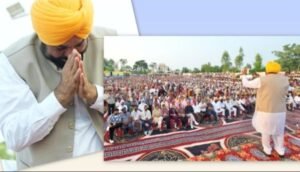
SRI ANANDPUR SAHIB — Punjab Chief Minister Bhagwant Singh Mann has said the state has significantly expanded access to canal irrigation under the Aam Aadmi Party government, claiming that water is now reaching about 80% of agricultural land compared with around a quarter before his government took office.
Speaking at a Lok Milni programme in Jindwari village in Sri Anandpur Sahib, Mr Mann said his government would work towards extending canal water coverage to every field in the state. He presented irrigation, electricity, education, employment and rural development as key elements of his government’s efforts to reshape Punjab’s economy and improve living standards.
According to the chief minister, the expansion of canal irrigation has been supported by a network of about 14,000 kilometres of pipelines designed to carry canal water to agricultural areas. He said the government would continue investing in the system until all eligible farmland had access to canal irrigation.
The irrigation claim formed the centrepiece of Mr Mann’s address, but the programme also became an occasion for a wider political attack on Punjab’s traditional parties ahead of the state’s next electoral cycle.
Mr Mann accused the Congress, Bharatiya Janata Party and Shiromani Akali Dal of being primarily interested in political power, contrasting them with what he described as the AAP government’s focus on public welfare and development.
He also warned voters against the BJP and Akali Dal, arguing that Punjab’s interests relating to water, Chandigarh and Panjab University needed to be protected. His remarks come amid continuing political realignments and disagreements among the state’s major parties over issues closely linked to Punjab’s identity, resources and federal relations.
The chief minister criticised the Akali Dal in particular, accusing its leadership of repeatedly compromising on the state’s interests in pursuit of political power. He also attacked former Deputy Chief Minister Sukhbir Singh Badal, questioning his understanding of Punjab’s agricultural and social realities.
Mr Mann’s criticism of the BJP centred on a series of long-running disputes between Punjab and the Centre, including the allocation of river waters, Chandigarh, the Bhakra Beas Management Board, the Sutlej-Yamuna Link canal and funding-related issues.
He also referred to the farmers’ agitation against the now-repealed central farm laws, blaming the BJP for the deaths of hundreds of farmers during the protests. Such claims remain part of the wider political contest in Punjab, where the farmers’ movement continues to influence public attitudes towards national political parties.
The chief minister also sought to highlight his government’s record on electricity and employment. He said more than 90% of households were receiving free electricity and that more than 70,000 young people had secured government jobs through what he described as a merit-based and corruption-free recruitment process.
Rural infrastructure was another major theme of the address. Mr Mann said cheques of Rs 20 lakh each had been handed to six village panchayats to accelerate local development. He also said about 45,000 kilometres of roads were being renovated or upgraded across Punjab.
The government, he added, was building around 3,100 sports stadiums as part of an effort to provide young people with alternatives to drugs. The move comes as Punjab continues to grapple with a persistent narcotics problem, which has become one of the most politically sensitive issues in the state.
Education, Mr Mann argued, was ultimately more important than welfare benefits alone. He said government programmes could provide temporary relief but that better education was necessary to break cycles of poverty and create long-term economic opportunities.
Healthcare was another area highlighted by the chief minister. He referred to the Mukh Mantri Sehat Yojna, under which the state government says families are entitled to cashless treatment of up to Rs 10 lakh. The scheme is being presented by the AAP government as a major expansion of publicly funded healthcare.
Mr Mann also spoke about the Mawan Dheeyan Satkar Yojna, under which the government says eligible women will receive financial assistance of Rs 1,000 a month, with Rs 1,500 for eligible Scheduled Caste women. The government has allocated Rs 9,300 crore for the programme, according to the chief minister.
The political message running through the speech was clear: Mr Mann sought to frame the AAP government’s performance around tangible benefits such as irrigation, electricity, jobs, roads, education and healthcare, while portraying the opposition parties as focused primarily on regaining power.
The chief minister said the government’s broader objective was to create a prosperous and self-reliant Punjab, repeatedly invoking the idea of a “Rangla Punjab” — a prosperous Punjab — as the political vision behind its policies.
His remarks come at a significant time for Punjab politics. The state’s political landscape is increasingly shaped by competition among the AAP, Congress, BJP and Akali Dal, with questions over governance, drugs, agriculture, employment and Punjab’s relationship with the Centre likely to remain central to the political debate.
For the Mann government, the expansion of canal irrigation offers an especially important political narrative. Punjab’s agricultural economy remains heavily dependent on reliable water supplies, while excessive dependence on groundwater has raised serious long-term sustainability concerns.
If the government’s claimed expansion from roughly 26% to 80% canal-irrigated coverage is sustained and eventually extended to 100%, it could become one of the more consequential infrastructure achievements of the administration. It would also allow the government to argue that improving access to surface water can reduce pressure on Punjab’s rapidly depleting groundwater reserves.
The challenge now will be to convert the political promise of universal canal-water access into measurable and sustained benefits for farmers across the state.
At Jindwari, however, Mr Mann’s message was both administrative and electoral: his government, he said, was investing in Punjab’s basic infrastructure and public services, while voters should judge the opposition parties by their record and their commitment to the state’s interests.