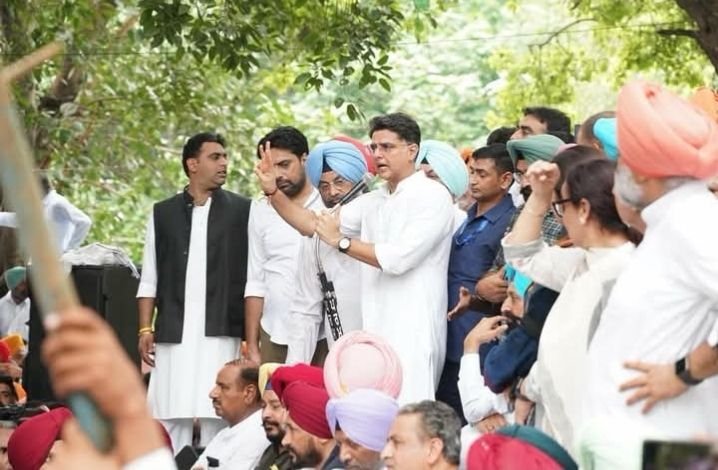
CHANDIGARH — Punjab Congress mounted its first major street mobilisation under newly appointed state in-charge Sachin Pilot on Tuesday, bringing rival factions of the party together in a protest against the Aam Aadmi Party government over the death of Gulzar Singh, a Dalit resident of Sangrur.
The demonstration in Chandigarh marked Pilot’s first visit to Punjab since taking charge as the Congress general secretary responsible for the state. It also produced an unusual public show of unity, with former chief minister Charanjit Singh Channi and Punjab Congress president Amarinder Singh Raja Warring appearing together on the same platform after months of differences within the state unit.
The protest was aimed primarily at Finance Minister Harpal Singh Cheema, whose constituency includes Dirba in Sangrur district. Congress leaders demanded Cheema’s resignation and called for an independent investigation into the circumstances surrounding Gulzar Singh’s death.
The march began from the Punjab Congress headquarters in Sector 15 and moved towards Cheema’s official residence. Police erected barricades to stop the protesters and later used water cannons when the marchers attempted to move forward. Pilot, Warring, Leader of Opposition Partap Singh Bajwa and several other Congress leaders were detained during the protest.
The confrontation gave the new Congress state in-charge an immediate test of his ability to bring the party’s different camps together around a common political issue.
For months, Punjab Congress has faced internal disagreements, particularly between supporters of Warring and Channi. The two leaders have previously been on opposing sides of the organisational debate. Their decision to appear together at Tuesday’s demonstration was therefore one of the most closely watched aspects of the protest.
Photographs and video from the event showed Pilot positioned between the two leaders on the stage, while Channi and Warring were seen speaking to each other and sharing the platform. Their joint appearance suggested a temporary effort to put organisational differences aside as the party takes on the ruling AAP government.
The immediate trigger for the protest was the death of Gulzar Singh, a resident of the Sangrur area, who died after allegedly consuming poison. According to reports, Gulzar had raised questions about the availability of drugs in his area during a public programme attended by Cheema. His family and supporters have alleged that he subsequently faced humiliation and harassment. Five people, including the village sarpanch, have been arrested in connection with allegations surrounding his death, while the government has ordered an investigation. Cheema has denied wrongdoing.
Congress has demanded that Cheema’s name be included in the FIR and has called for an independent, time-bound investigation. Pilot said the case raised serious questions about the treatment of people who speak about the drug problem and called for accountability.
The issue has also allowed Congress to connect two major concerns in Punjab politics — the continuing problem of drug abuse and the treatment of socially vulnerable communities.
Speaking at the protest, Pilot accused the state government of failing to adequately address the concerns raised by Gulzar and said the Congress would continue to raise the issue with people across Punjab. Partap Singh Bajwa similarly questioned the government’s handling of the drug crisis and argued that the effectiveness of the state’s anti-drug campaign should be judged by the situation on the ground rather than by official announcements.
For Pilot, however, the significance of the Chandigarh protest went beyond the immediate confrontation with the AAP government.
His appointment comes at a time when Congress is attempting to manage long-standing differences within its Punjab organisation while preparing for the next state election. His first major public mobilisation in the state has therefore been closely watched for signs of whether the party’s competing groups can work together.
Tuesday’s events offered a visible example of such coordination. Channi and Warring, who had remained separated by organisational differences, shared the stage, while Bajwa and other senior Congress figures joined the demonstration.
The protest also gave Congress a platform to challenge the Mann government on one of Punjab’s most politically sensitive issues. Drug abuse has remained a central concern in the state, with successive governments facing pressure to curb supply networks and address addiction among young people.
The AAP government has defended its record and has repeatedly highlighted police action and anti-drug measures. Congress, meanwhile, has argued that the continued availability of drugs demonstrates that the problem remains unresolved.
The use of water cannons and the detention of senior Congress leaders added another dimension to Tuesday’s confrontation. Police action brought the protest to a halt, while the Congress used the episode to intensify its criticism of the state government.
The immediate political outcome of the demonstration will depend on whether the temporary unity displayed by Punjab Congress can continue beyond the protest.
For now, however, Pilot’s first major Punjab mobilisation has produced two simultaneous developments: a direct confrontation with the AAP government over the Gulzar Singh case and a rare public coming together of senior Congress leaders who have spent months on opposing sides of the party’s internal debate.
The challenge for Pilot will be to translate that moment of unity into sustained organisational coordination as Congress seeks to rebuild its position in Punjab.