At Lok Milni in Ajnala, Punjab CM highlights free power, canal irrigation, education and healthcare while accusing BJP, Congress and Akali Dal of putting political interests ahead of the state
Ajnala, September 21: Punjab Chief Minister Bhagwant Mann has stepped up his attack on opposition parties, warning that a change of government could lead to the withdrawal of welfare schemes, weakening of government institutions and decisions affecting the state’s water interests.
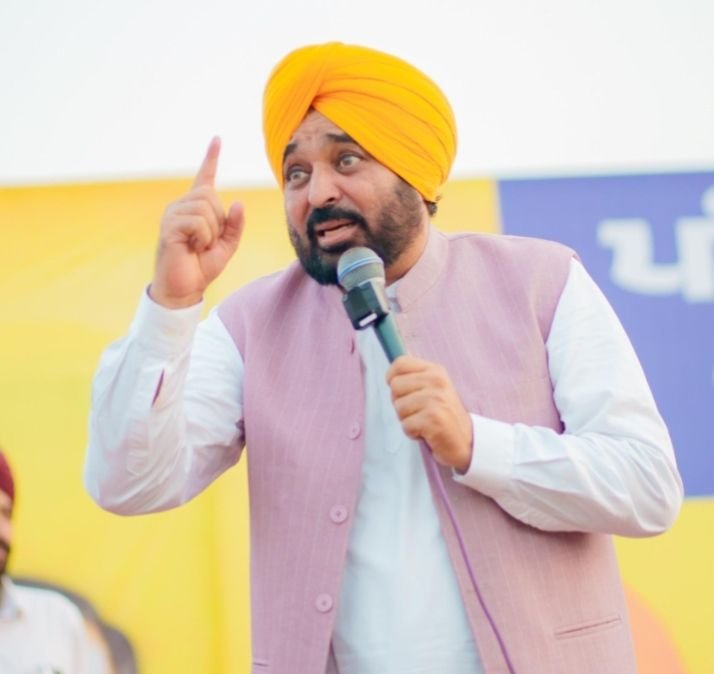
Addressing a Lok Milni programme at Sansra village in the Ajnala assembly constituency, Mann said the opposition would discontinue free electricity, free bus travel for women and the ₹1,000 monthly assistance being provided under the state’s women-focused welfare programme. He also alleged that government schools and Mohalla Clinics would be weakened in favour of private institutions.
Mann’s remarks come as political parties in Punjab intensify their public outreach ahead of the next state election. The Chief Minister presented the Aam Aadmi Party government’s record in welfare, education, healthcare, electricity and irrigation as the basis on which voters should assess its performance. His comments about opposition parties were political claims and allegations, rather than announcements of policies by those parties.
One of the central issues raised by Mann was Punjab’s water rights. He criticised the state government’s exclusion from the agreement signed on September 15 by Himachal Pradesh, Uttarakhand, Uttar Pradesh, Haryana, Rajasthan and Delhi to take forward the long-delayed Kishau Multipurpose Project.
The project involves a dam on the Tons river and is intended to provide water and generate hydropower for participating states. Punjab was not among the six signatories.
Mann questioned why Punjab had not been included in discussions concerning a project in the wider Yamuna basin. He said Punjab had contributed significantly to India’s food security and national defence and should not be excluded from decisions that, in his view, could have implications for the state’s water interests.
Punjab has subsequently indicated that it intends to challenge the Kishau project in the Supreme Court and seek recognition of its position on the sharing of Yamuna basin waters. The state government has argued that an earlier 1994 Yamuna water-sharing agreement did not include Punjab.
Mann also alleged that the BJP wanted to divert Punjab’s share of water to Haryana and Rajasthan and sought to separate Chandigarh and Panjab University from Punjab. These are allegations made by the Chief Minister and were not independently established in the material reviewed for this report.
Mann puts government record at centre of campaign
Defending his government’s performance, Mann said more than 90% of households in Punjab were receiving zero electricity bills under the free-power scheme. He also highlighted the acquisition of the Goindwal Sahib private thermal power plant as part of the government’s efforts to strengthen the state’s power supply.
Water management was another major focus of his speech. Mann said the proportion of Punjab’s agricultural fields receiving canal water had increased substantially since his government took office, citing a rise from about 22% to around 88%.
He attributed the expansion to work on canal infrastructure and the laying of about 14,000 kilometres of underground pipelines. Independent reports have also carried the government’s claim of a rise in canal-water utilisation from 22% to 88%, although the precise measure used for the comparison is important when assessing the figure.
The Chief Minister said the expansion of canal irrigation was intended to reduce dependence on groundwater and improve the long-term sustainability of agriculture.
Mann also pointed to government schools and the establishment of Schools of Eminence as evidence of the government’s education policy. He referred to teacher-training programmes involving institutions and programmes in countries including Finland and Singapore.
On healthcare, he cited the Mukh Mantri Sehat Yojana and said health cards had been issued to about 54 lakh families. The stated objective, he said, was to reduce the financial burden on families requiring medical treatment.
Attack on Congress and Akali Dal
The Chief Minister also targeted the Congress and Shiromani Akali Dal during the programme.
Referring to the Congress, Mann said its leaders were competing for the chief minister’s position despite the party’s current political position in the state. He also criticised the Akali Dal, saying its political activities had become increasingly limited.
He alleged that the Akali Dal relied on daily-wage workers to fill its rallies and made a prediction about the party’s performance in the next election. Such electoral predictions are political claims and cannot be treated as established outcomes.
Mann also attacked what he described as the influence of political families in previous governments, arguing that his administration had sought to focus public resources on ordinary citizens rather than particular families.
He referred to the issue of sacrilege cases and accused opposition parties of failing to provide satisfactory answers to questions raised by the public. These remarks form part of his political criticism of rival parties.
Welfare versus fiscal criticism
The ₹1,000 monthly assistance programme for women, described by the government as the Mawan-Dheeyan Satkar Yojana, was another major element of Mann’s speech.
He argued that financial assistance was being used by women for household expenses, children’s education and other essential needs. He rejected criticism of welfare spending, saying the schemes were intended to provide direct support to families.
The broader question of welfare spending has become an important part of Punjab’s political debate, with the government presenting such schemes as direct benefits to citizens while questions about their long-term fiscal sustainability remain part of public policy discussions.
Mann said voters should judge governments by the benefits that reach them in their everyday lives. He maintained that his administration’s priorities included electricity, health, education, irrigation, infrastructure and rural development.

A contest over Punjab’s future
The Ajnala speech brought several of the issues likely to dominate Punjab’s political debate into a single address: welfare guarantees, government services, education, healthcare, agriculture, groundwater, inter-state water disputes and the status of Chandigarh and Panjab University.
Mann sought to portray the next political contest as a choice between his government’s welfare and development record and what he described as the priorities of traditional political parties.
For the opposition, however, the same issues are likely to be viewed through questions of governance, finances, implementation and the long-term sustainability of welfare commitments.
The water question could prove particularly significant. Punjab’s exclusion from the Kishau agreement has already become a matter of political and legal contention, with the state government preparing to challenge the project while the Centre and participating states have presented the agreement as a major water-management and energy initiative.
At Sansra, Mann also distributed development grants totalling ₹60 lakh to three village panchayats, with ₹20 lakh allocated to each for local development works.
He ended his address by saying that the government’s objective was to extend public services and welfare benefits to every family and build what he called a more prosperous “Rangla Punjab”.
The coming months are likely to see the debate move beyond political claims and counterclaims towards a closer examination of the government’s record, the financial implications of welfare schemes, the management of Punjab’s water resources and the competing positions of political parties on the state’s long-standing issues.