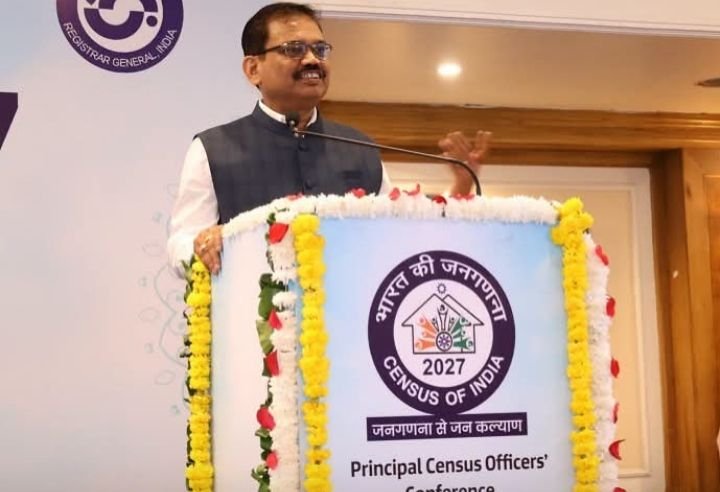
CHANDIGARH: Punjab has stepped up preparations for the second phase of Census 2027, with Chief Secretary KAP Sinha calling for coordinated, accountable and closely supervised efforts to ensure that the population enumeration exercise is completed accurately and without leaving any section of the population outside its ambit.
Chairing a one-day conference of Principal Census Officers in Chandigarh, Sinha described the Census as one of the country’s most important national exercises and stressed that its significance extends far beyond the collection of population figures. Census data provides a critical foundation for demographic and socio-economic assessment, government planning, policy formulation and the delivery of public services.
The conference brought together members of the State Level Census Coordination Committee, divisional commissioners and Principal Census Officers, including Deputy Commissioners and Municipal Commissioners of Municipal Corporations. The meeting reviewed Punjab’s operational preparedness for the population enumeration phase and examined the arrangements required to translate the national Census framework into effective field-level execution.
Sinha emphasised that successful enumeration cannot depend merely on administrative arrangements made on paper. He called for personal ownership of the exercise by officers at every level, clear assignment of responsibilities, continuous monitoring and close coordination between district administrations, municipal bodies and other departments.
The Chief Secretary asked the Principal Census Officers to treat the exercise as a priority and ensure that every stage is planned and monitored within the prescribed timelines. Particular emphasis was placed on the quality of field-level preparation, training of census personnel and ensuring that officials understand their responsibilities before they begin visiting households.
For Punjab, the challenge is not simply to count its population but to ensure that the resulting database accurately reflects the state’s demographic and socio-economic profile. Reliable population data has a direct bearing on how governments assess requirements for schools, healthcare facilities, housing, transport, civic infrastructure and other public services.
It can also provide important inputs for understanding population distribution, migration, age structures, household characteristics, education levels and other demographic trends. Such information is particularly relevant for a state like Punjab, where changing population patterns, rural-urban shifts and migration have implications for future planning.
The second phase will include population enumeration, with officials collecting information on individuals through a notified set of questions. The exercise also includes a self-enumeration facility, allowing citizens to provide information through the designated online process before verification by Census personnel.
According to the schedule discussed at the conference, self-enumeration in Punjab will take place from November 16 to November 30, 2026. Door-to-door population enumeration will follow from December 1, 2026, to January 4, 2027. A revisional round is scheduled from January 5 to January 9, while January 5, 2027, will serve as the reference date for the exercise in Punjab.
The Census questionnaire for the population enumeration phase contains 40 questions covering a range of demographic and socio-economic characteristics. These include personal and household-related information, along with details relating to education, migration and other prescribed parameters.
The administration is also required to ensure coverage of vulnerable and difficult-to-reach populations, including people living in institutional households, slums, isolated settlements and newly developed areas. Ensuring that such groups are properly covered is essential to preventing gaps or duplication in the final data.
Earlier reviews of Punjab’s Census preparations had set deadlines for finalising enumeration blocks, supervisors, enumerators and field trainers, with preparatory work for Phase-II scheduled to be completed before the commencement of field operations.
The state has already completed the first phase, involving house listing and housing-related information. The focus has now shifted towards population enumeration, making training, manpower deployment, public awareness and field supervision particularly important.
The role of public participation will also be significant. Authorities are expected to undertake extensive awareness campaigns so that residents understand the purpose of the Census, provide accurate information and make effective use of the self-enumeration facility.
The Chief Secretary’s message effectively places responsibility for the exercise across the entire administrative chain rather than on the Census Directorate alone. From senior state officials to district administrations, municipal authorities, supervisors and enumerators, each level will have a defined role in ensuring that the final database is comprehensive and reliable.
Census 2027 is the first Census exercise in India to incorporate extensive technology-based processes, including mobile-based data collection and self-enumeration. The Union government has approved an overall outlay of ₹11,718.24 crore for the exercise, with arrangements for training, logistics, technology infrastructure and other requirements.
For Punjab, the immediate priority is therefore to convert planning into disciplined field execution. The accuracy of the eventual Census figures will depend not only on the technology being deployed but also on the preparedness of personnel, the quality of public participation, the completeness of household coverage and the ability of different arms of the administration to work together.
As Punjab moves towards the population enumeration phase, KAP Sinha’s emphasis on coordination, accountability and personal ownership underlines the larger importance of the exercise: the Census is not merely a statistical operation, but a foundational source of information for understanding Punjab and planning its future.