Bathinda: In Punjab’s agriculture heartland, Union Agriculture and Farmers’ Welfare Minister Shivraj Singh Chouhan has put the spotlight once again on a challenge that has become central to the future of farming in the state — reducing dependence on the traditional paddy-wheat cycle while creating more reliable sources of income for farmers.
Addressing farmers at the Punjab Agricultural University’s Krishi Vigyan Kendra in Bathinda, Chouhan called for a wider shift towards crop diversification, integrated farming, allied agricultural activities and greater use of modern technology. His message came during a Kisan Mela and Kisan Samvad focused on crop-residue management, where he interacted directly with farmers, progressive agriculturists, mushroom growers and members of self-help groups.
The emphasis on diversification carries particular significance in Punjab, where intensive paddy cultivation has long been associated with pressure on groundwater and agricultural resources. Chouhan urged farmers to consider short-duration recommended paddy varieties, including PR-126, alongside alternative crops and more resource-efficient farming practices. He also stressed the need for balanced fertiliser use and scientific management of agricultural resources.

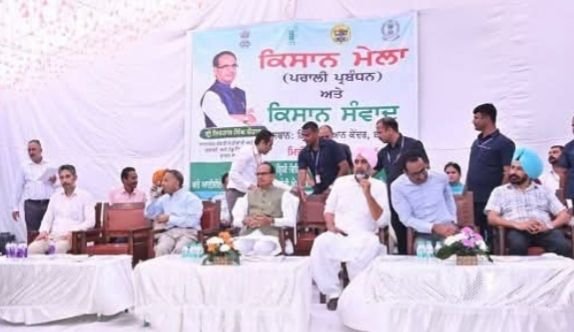
But the interaction in Bathinda was not limited to government prescriptions. Farmers used the occasion to place some of their most immediate economic concerns before the Union minister, particularly those relating to market access and value realisation.
Honey producers, mushroom growers and Farmer Producer Organisations raised problems linked to marketing and access to better markets. Chouhan called for focused agricultural research to address the marketing difficulties faced by mustard-honey producers and underlined the importance of processing, value addition and improved utilisation of fruits, vegetables and other farm products.
The larger message was that increasing farm income cannot depend only on higher crop yields. According to the approach outlined by Chouhan, farmers need multiple income streams through activities such as mushroom cultivation, beekeeping, food processing, livestock and other allied enterprises. The Union Agriculture Ministry has also been stressing integrated farming and sustainable agricultural practices as part of its broader strategy for improving farm incomes.
The minister’s interaction also brought several examples of emerging opportunities in agriculture to the forefront. Progressive farmer Gurpreet Singh spoke about the benefits he had received through carbon credits, while Aparpal Singh highlighted issues confronting Farmer Producer Organisations. Jasvir Kaur discussed the challenges involved in marketing honey, and mushroom growers drew attention to difficulties in finding suitable markets for their produce.
Crop-residue management remained another major component of the discussion. Progressive farmers Malkit Singh and Ranbir Singh shared their experiences of managing paddy straw and attempting to reduce dependence on crop-residue burning.
For Punjab, this issue has an importance that extends beyond agriculture. The state’s recurring stubble-burning problem has linked farm practices with air pollution, environmental concerns and political disagreements over responsibility between the Centre and state governments. Against that backdrop, Chouhan’s call for diversification and better residue management places greater emphasis on changing the economics of farming rather than relying only on enforcement.
The minister also visited the Technology Park at KVK Bathinda, where he reviewed demonstrations of modern agricultural technologies and farming systems. He urged farmers to make greater use of scientific advice and technologies developed through agricultural research.
PAU officials highlighted the role of the university’s extension network in taking such research from laboratories to farms. Dr Makhan Singh Bhullar, Director of Extension Education at PAU, said the university’s 18 Krishi Vigyan Kendras and Farm Advisory Service Centres were providing farmers with technical guidance and training in modern agriculture and allied occupations. PAU has also reported strong participation of farmers in its seasonal Farmers’ Fairs.
Dr Parvinder Siuran, Zonal Director of ATARI, Ludhiana, briefed the minister on the work of Krishi Vigyan Kendras and efforts to expand their reach, including the objective of establishing a KVK in every district of Punjab.
The visit also carried a broader political message. The Centre has increasingly framed agricultural diversification, technology adoption, value addition and stronger market linkages as necessary steps towards improving farm incomes and making Indian agriculture more sustainable. Chouhan has recently reiterated the importance of resource-based crop planning and stronger coordination between governments, scientists and farmers.
For Punjab, however, the challenge lies in translating that policy direction into economically viable alternatives for farmers. Diversification will depend not merely on asking farmers to reduce paddy cultivation, but on ensuring that alternative crops and allied activities have dependable markets, processing infrastructure, technology, procurement or price support where applicable, and access to institutional finance.
That gap between policy advice and market reality was evident in the farmers’ interaction itself. Issues surrounding honey, mushrooms and FPOs showed that producing a different commodity is only one part of the transition; ensuring that farmers can sell it profitably remains equally important.
The Bathinda meeting therefore placed the focus on a broader question confronting Punjab’s farm economy: how to move from a production-centred model towards one where technology, diversification, processing, marketing and multiple sources of rural income work together.
Chouhan’s message was clear — the future of Punjab agriculture cannot depend solely on increasing production from the existing crop cycle. The next phase, according to the policy approach outlined at Bathinda, will require farmers to diversify, conserve resources, adopt technology and build stronger links with markets so that farming becomes not only productive, but economically sustainable.