Jalandhar : Union Home Minister Amit Shah has placed the fight against drugs at the centre of the Bharatiya Janata Party’s strategy for the 2027 Punjab Assembly election, turning Wednesday’s large rally in Jalandhar into an early campaign statement on one of the state’s most politically sensitive issues.
Addressing the concluding event of the BJP’s 13-day ‘Nasha Mukt Punjab Yatra’, Shah said that if the BJP is voted to power, his party would work to free Punjab from the trade in ‘chitta’ by December 31, 2029. He appealed particularly to the state’s mothers and young people, presenting the anti-drug campaign as the BJP’s principal electoral commitment for Punjab.

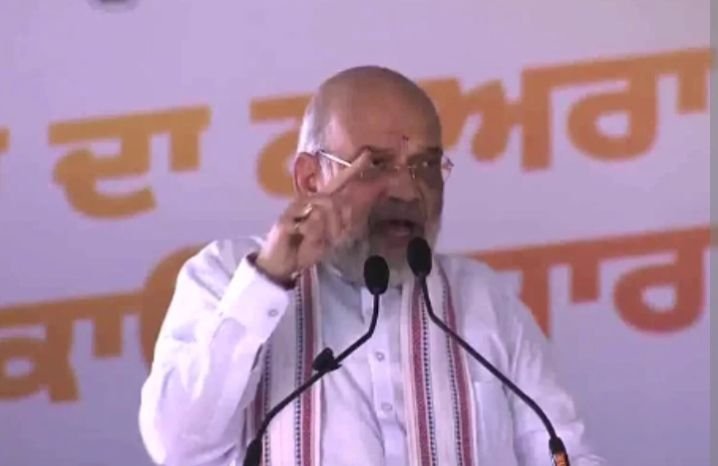
Shah directly targeted the ruling Aam Aadmi Party government, alleging that the trade in ‘chitta’ had been allowed to flourish openly under its tenure. The allegation is part of the BJP’s political attack on the Mann government; it was presented by Shah as the principal reason why, in his view, Punjab needs a change in its approach to the drug problem.
What made the Jalandhar address significant was Shah’s decision to distinguish the drug issue from the other concerns likely to shape the 2027 election. He acknowledged that Punjab’s electoral debate would include farmers, industry, law and order and women’s safety, but said the BJP would contest the election primarily on the promise of a drug-free Punjab.
The announcement gives the BJP a clearly defined campaign theme well ahead of the Assembly election. The party’s anti-drug mobilisation began on September 18, when four separate ‘Nasha Mukt Punjab Yatras’ were launched from different parts of the state. The campaign travelled roughly 4,000 km and passed through all 117 Assembly constituencies before converging in Jalandhar.
For the BJP, the importance of Punjab goes beyond the immediate drug debate. The party has been attempting to expand its independent political footprint in a state where the 2022 Assembly election was dominated by the AAP and Congress, with the AAP winning 92 of the 117 seats. BJP’s own presence in the 2022 Assembly was limited, making the 2027 election an important test of its ability to build a wider organisation and voter base in the state.
The BJP’s approach has also evolved from its earlier role as the junior partner of the Shiromani Akali Dal. The Tribune reported before Shah’s rally that the party had previously indicated that it was preparing to contest all 117 seats, although uncertainty over a possible future understanding with the SAD has continued after recent contacts between SAD leader Sukhbir Singh Badal and Prime Minister Narendra Modi.
That political positioning makes the Jalandhar rally particularly important for the BJP’s Punjab strategy. Rather than waiting for the formal election campaign, the party has begun building a state-wide narrative around an issue that it believes can connect with families, youth and communities affected by substance abuse.
The BJP’s anti-drug campaign also fits into a wider national agenda being articulated by Shah. Earlier this month, while addressing the National Conference of Anti-Narcotics Task Force heads in New Delhi, the Home Minister had set December 31, 2029, as a national target for eliminating the drug trade and called for a shift from simply making seizures to dismantling entire narcotics networks. He highlighted intelligence gathering, financial investigations, precursor chemicals, inter-state distribution networks and international linkages as key elements of the strategy.
In Punjab, however, the political contest over drugs is unlikely to remain limited to the BJP and AAP. Opposition parties have also sought to make substance abuse, organised crime and law-and-order issues central to their criticism of the government. Congress leader Sukhjinder Singh Randhawa, for instance, criticised the BJP’s anti-drug yatra before the Jalandhar rally and argued that the issue should be addressed through cooperation rather than political confrontation.
The AAP government, meanwhile, faces the political challenge of demonstrating that its own anti-drug measures have produced measurable results. The BJP’s accusation that the drug trade has been allowed to operate openly is a political claim, rather than an established judicial finding, and the state government’s response is likely to become an important part of the election debate.
Shah’s Jalandhar speech therefore marks more than the conclusion of a party campaign. It signals an attempt by the BJP to define the terms of the Punjab election debate well before polling. By setting a specific December 31, 2029 deadline and repeatedly linking the issue to the future of Punjab’s youth, the party has put the drug question at the centre of its emerging electoral narrative.
For Punjab, the significance of the pledge will ultimately depend on how political parties translate promises into measurable policies — including enforcement against trafficking networks, prevention, rehabilitation, treatment, border and supply-chain controls, and economic opportunities for young people. The 2027 election is likely to put each of these approaches under scrutiny as voters assess the competing claims of the BJP, AAP, Congress and other political forces in the state.