KHADOOR SAHIB : Punjab Chief Minister Bhagwant Mann has used the latest disbursement under the Mawan Dhiyan Satkar Yojana to underline his government’s welfare agenda while simultaneously turning the scheme into a political argument ahead of the 2027 Assembly election.
At a state-level programme at Goindwal Sahib, Mann oversaw the transfer of the second three-month instalment of financial assistance to 36,87,677 women. A total of ₹1,262.54 crore was transferred directly into beneficiaries’ bank accounts. Women from the general category receive ₹3,000 for the three-month period, while eligible Scheduled Caste beneficiaries receive ₹4,500.
The scheme, launched by the AAP government earlier this year, has emerged as one of its principal welfare initiatives. With the latest transfer, the government says the programme has covered 73.99 lakh women and that ₹3,824.87 crore has been disbursed in total. The government has also set a longer-term target of extending the scheme to one crore women.

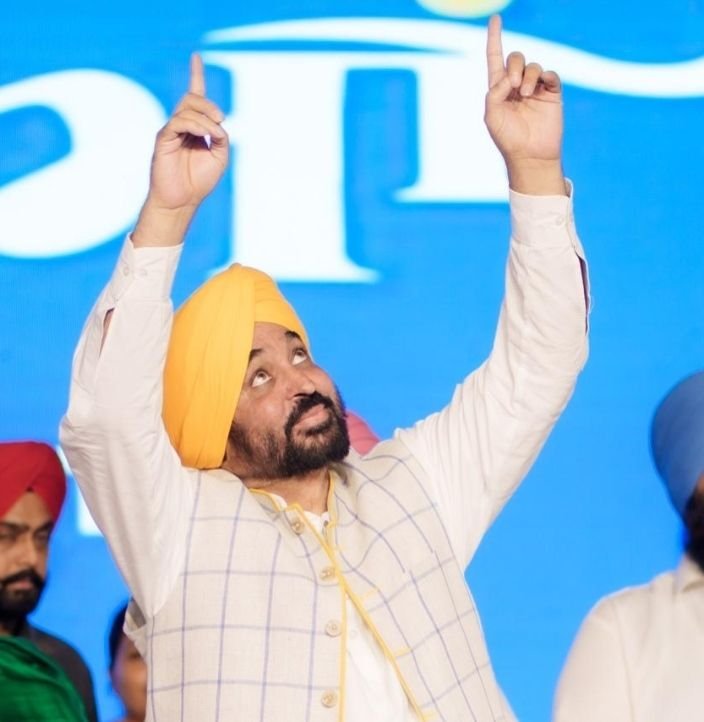
Mann sought to frame the direct transfers as an example of what he described as the government returning taxpayers’ money to the people through welfare and development programmes. He said the familiar mobile notification received by beneficiaries after the money reaches their accounts had become a symbol of the scheme’s direct-delivery model.
But the Chief Minister’s address went well beyond the welfare announcement. He turned the event into a broader political attack on the Congress, BJP and Shiromani Akali Dal, arguing that a change of government could put several existing welfare schemes at risk.
Mann claimed that if any of the three opposition parties came to power, programmes such as the monthly assistance for women, free bus travel for women and free electricity for eligible households could be discontinued. These were political assertions by the Chief Minister and not announcements of policy by the opposition parties.
The Chief Minister also defended the wider record of his government, pointing to employment, education, agriculture, electricity and infrastructure as areas where he said Punjab had made progress since the AAP came to power in 2022.
He highlighted the government’s claim that Punjab had improved its position in the Centre’s school education assessment, while citing the increase in the number of students from government schools clearing competitive examinations. Mann said free coaching and improvements in government schools were intended to give children from economically weaker families greater access to professional opportunities.
Education, he argued, was more important than simply providing short-term relief to poor families. In his formulation, welfare assistance could provide immediate support, but better education was necessary to create a lasting improvement in living standards.
The Chief Minister also pointed to the state government’s agricultural initiatives, particularly the expansion of canal water and the laying of pipelines to take irrigation water to farms. He claimed that around 14,000 kilometres of pipelines had been laid and said farmers were increasingly receiving daytime power for agricultural operations.
Another major claim in his address concerned electricity. Mann reiterated the AAP government’s position that eligible households were receiving up to 300 units of free electricity each month. He also referred to the ₹1,080-crore purchase of the Goindwal Sahib thermal power plant, presenting it as part of the government’s effort to strengthen Punjab’s power supply.
Mann further said that the government was working towards expanding opportunities for young people through employment and new centres for UPSC preparation. He cited the recruitment of more than 70,000 people as evidence of the government’s approach to public spending and employment generation.
The Chief Minister also used the occasion to attack the traditional political establishment in Punjab. Without limiting his criticism to one opposition party, he accused successive Congress and Akali governments of failing to deliver the level of development he believes Punjab deserved. He argued that the AAP’s rise had opened political space for people from ordinary backgrounds.
His remarks also came a day after Union Home Minister Amit Shah’s Jalandhar rally, where the BJP put the drug issue at the centre of its emerging campaign for the 2027 Punjab election. Mann responded by defending his government’s record and challenging the BJP’s criticism.
The competing political narratives are increasingly becoming visible in Punjab well before the Assembly election. The BJP is seeking to make drugs, law and order and governance major campaign issues, while the AAP government is emphasising welfare delivery, education, employment, electricity and infrastructure.
The Mawan Dhiyan Satkar Yojana is therefore becoming more than a welfare programme in the emerging political contest. For the Mann government, the direct transfer of money into women’s bank accounts provides a tangible example of its claim that government resources are reaching households directly. For the opposition, the programme’s cost, eligibility and long-term sustainability are likely to remain subjects of political scrutiny.
Mann, however, made his own political calculation clear at Goindwal Sahib: he wants the welfare schemes delivered by his government to become part of the public debate before Punjab returns to the polls in 2027.