Saptrishi Soni
Farmers, rural voters, welfare delivery, drugs and regional identity will shape a five-way contest in which national political narratives must compete with Punjab’s distinctive electoral realities

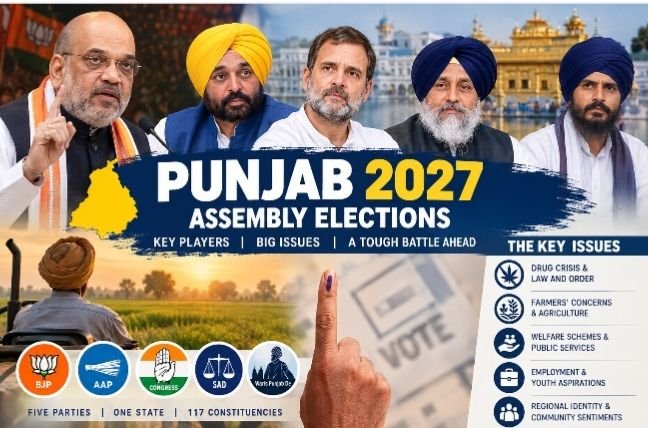
CHANDIGARH — The road to Punjab’s 2027 Assembly election is becoming a contest over much more than party slogans. The Aam Aadmi Party (AAP) is preparing to defend its government, Congress is attempting to establish itself as the principal challenger, and the Bharatiya Janata Party (BJP) is working to expand its presence by putting drugs, law and order and national leadership at the centre of its campaign.
The Shiromani Akali Dal and the political space represented by Shiromani Akali Dal (Waris Punjab De) add further complexity to an already crowded field. With 117 Assembly constituencies, Punjab presents a political landscape in which regional loyalties, local candidates, farmers’ concerns and community issues can all influence the outcome.
AAP enters the contest with the advantage of incumbency and the memory of its sweeping victory in 2022, when it won 92 seats. But that mandate belongs to a previous election. The question for 2027 is whether the government can persuade voters that its record merits another term, while the opposition seeks to turn public concerns into electoral support.
AAP’s welfare record and the burden of incumbency
AAP’s central argument is likely to focus on the benefits and public services it says it has delivered. Its political pitch includes subsidised electricity, healthcare initiatives, government recruitment and financial assistance programmes. The state’s Mukh Mantri Mawan Dhiyan Satikar Yojana, announced in the 2026–27 Budget, is among the measures the government can highlight in its appeal to households.
For many families, welfare schemes have immediate relevance. Support that eases household expenses, access to local healthcare and opportunities for government employment can influence how people assess a government’s performance. These issues may be particularly important in rural areas, where household income can be affected by agricultural uncertainty, limited employment options and the cost of essential services.
Yet welfare delivery does not automatically eliminate anti-incumbency. Voters can value a scheme while remaining dissatisfied with other aspects of governance. Drug trafficking, law and order, employment, public infrastructure, agricultural incomes and the performance of local administration may all shape their assessment.
AAP’s challenge is to demonstrate that its programmes are reaching the intended beneficiaries while responding convincingly to areas where people believe progress has been inadequate.
Congress seeks to turn criticism into a credible alternative
Congress is working to position itself as the main challenger to AAP. The party has criticised the state government over drugs and public safety and will seek to broaden that challenge to employment, rural concerns and the overall performance of the administration.
Its prospects will depend not only on public dissatisfaction but also on its ability to present a coherent alternative. Organisation at the constituency level, candidate selection, leadership coordination and the ability to connect state-level messaging with local concerns will be crucial.
Congress has a substantial history in Punjab politics, but past strength does not automatically translate into a new mandate. It must convince voters that it can address current problems and provide stable, effective governance.
If Congress consolidates its support in constituencies where it is competitive, the election could become difficult for AAP. If opposition votes are divided among several parties, the impact may be different from one constituency to another. The consequences of a multi-cornered contest cannot be assumed to be uniform across the state.
BJP’s campaign: drugs, law and order and national leadership
The BJP is seeking to build a wider political base in Punjab, where it faces established regional competitors and a strong tradition of state-specific political mobilisation. Union Home Minister Amit Shah’s scheduled visit, including outreach to families affected by drugs, reflects the party’s effort to make public safety and accountability prominent election issues.
For the BJP, the drug crisis offers a way to challenge AAP’s governing record while presenting itself as a party capable of taking decisive action. But a campaign focused on one issue will have to connect with the wider priorities of Punjab’s electorate.
The party also faces the challenge of establishing deeper local networks and persuading voters that its approach reflects the state’s particular concerns. Punjab’s farmers, regional identity and relationship with the Centre are politically significant factors. The BJP’s position on these questions will matter alongside its national leadership and campaign promises.
The party may hope to build its organisational strength and increase its representation, even if it faces a difficult contest against parties with deeper state-level roots. However, its eventual performance will depend on candidates, alliances, voter response and constituency-level dynamics—not simply on the prominence of national leaders.
Farmers and rural voters remain pivotal
Punjab’s agricultural economy gives farmers and rural communities a central place in the election. Crop prices, input costs, procurement arrangements, irrigation, electricity, rural employment and the future of younger generations are likely to remain important considerations.
Farmers’ organisations have demonstrated their capacity to mobilise and influence political debate. Their relationship with the Union government, as well as the state government’s agricultural policies and delivery, may shape how voters evaluate the competing parties.
But rural Punjab should not be treated as one unified voting bloc. Farmers, agricultural labourers, small business owners, young jobseekers and households dependent on different sources of income may have distinct priorities. Even within the same village, political preferences can vary according to local leadership, economic circumstances and views on governance.
The parties that can connect their broader promises to these everyday concerns may be better placed to earn public trust. For voters, the question is likely to be practical: which government can improve livelihoods, strengthen public services and create credible opportunities for the next generation?
Five political forces complicate the contest
AAP, Congress, BJP, the Shiromani Akali Dal and Waris Punjab De represent different political traditions and constituencies. Their influence will vary by region, and their presence may alter the calculations in individual seats.
The Shiromani Akali Dal will seek to rebuild its standing by appealing to its traditional support base and emphasising regional and agricultural concerns. Waris Punjab De may influence the debate in constituencies where Panthic identity and related political issues carry particular weight.
The presence of several parties means that vote distribution could be as important as the overall level of support each party receives. A party may perform strongly in some regions but struggle in others, while local contests may produce outcomes that differ from statewide impressions.
This makes the election difficult to reduce to a straightforward two-party contest. Alliances, candidate choices, local grievances and shifts in voter mobilisation could all affect the final result.
Can opinion polls predict the outcome?
Some online poll listings have projected AAP ahead of its rivals, but their reliability must be assessed carefully. A survey without transparent information about its sample size, methodology, fieldwork and margin of error cannot provide a firm basis for predicting an election result.
AAP’s strong 2022 performance gives it an established electoral base, but it does not guarantee another victory. Equally, criticism of the incumbent does not establish that the opposition has already secured a majority of public support.
A meaningful assessment will require credible polling, attention to regional differences and evidence of how voters respond as the campaign develops. Political commentary should distinguish between a party’s current strengths, the challenges it faces and any prediction about the final result.
Punjab will make its own assessment
The 2027 election will test AAP’s ability to defend its record, Congress’s capacity to offer a credible alternative and the BJP’s effort to convert national political visibility into a stronger state-level presence. The Akali Dal and Waris Punjab De will also seek to influence the electoral balance.
The issues will overlap. A family may appreciate a welfare benefit but demand better action against drugs. A farmer may assess the state government’s services separately from the Centre’s agricultural policies. A young voter may prioritise employment, while another may focus on public safety or regional identity.
Punjab’s electorate will weigh these concerns in its own way. The state’s political choices cannot be explained solely through national narratives, a single campaign issue or an unverified opinion poll.
For the parties, the task is to demonstrate credibility through policy, organisation and delivery. For voters, the election will offer an opportunity to judge promises against experience and decide which leadership best reflects their priorities. The final outcome will be determined not by campaign claims, but by the choices made across Punjab’s 117 constituencies.