
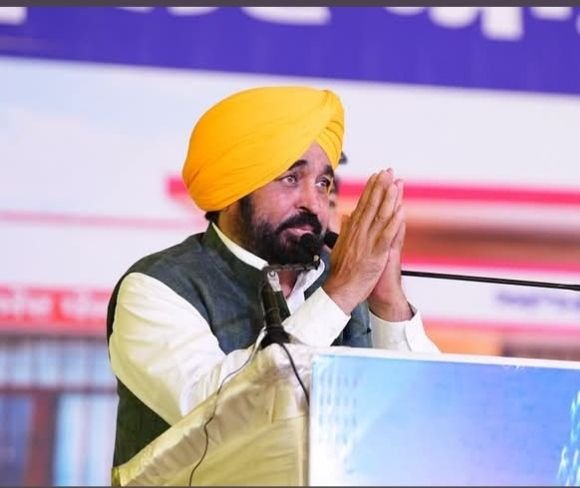
Punjab CM challenges Centre over border security, alleged drug trafficking networks and farmers’ deaths; vows to intensify ‘Yudh Nashean Virudh’ campaign
Punjab Chief Minister Bhagwant Singh Mann on Tuesday mounted a strong counterattack against Union Home Minister Amit Shah, accusing the BJP of using the state’s drug crisis and the suffering of bereaved families for electoral gains while failing to adequately address narcotics trafficking at the national level.
Responding to Shah’s visit to Ludhiana and his call for CBI investigations into cases involving the deaths of Parvinder Singh Jhota, Gulzar Singh and Bikramjit Singh, Mann said the Centre must first answer questions about its own record on drug enforcement, border security and action against alleged trafficking networks.
The Chief Minister welcomed Shah’s visit but urged him to meet grieving families with genuine sympathy rather than political motives. He reiterated that the Punjab government had agreed to refer the Jhota case to the Central Bureau of Investigation (CBI) in response to the family’s demand, adding that the government would cooperate with the investigation and would not shield anyone found responsible.
The exchange has intensified the political confrontation over drugs, an issue expected to feature prominently in Punjab’s run-up to the 2027 Assembly elections. While the BJP has questioned the AAP government’s handling of narcotics and law and order, Mann has sought to shift the focus towards the Centre’s responsibilities in securing international borders and disrupting the supply of drugs entering the country.
Mann questions BJP’s record during its alliance with SAD
Mann challenged Shah to explain why the BJP had not taken stronger action against drug trafficking during its alliance with the Shiromani Akali Dal (SAD) government in Punjab between 2007 and 2017.
He argued that the drug problem had become a major public concern during that period and questioned why demands for a CBI investigation into allegations involving then minister Bikram Singh Majithia had not resulted in such a probe at the time.
The Chief Minister also questioned the Centre’s response to allegations involving influential political figures and individuals accused of involvement in the drug trade. He said the BJP could not present itself as the sole force capable of tackling the crisis without addressing questions about the period in which it shared power in Punjab and its subsequent years in government at the Centre.
Mann’s remarks were part of a broader effort to challenge the BJP’s political narrative and remind voters that Punjab’s drug problem has persisted across successive governments. However, responsibility for individual allegations must be established through evidence and due legal process.
Border security and drug consignments become flashpoints
A central element of Mann’s response was the division of responsibilities between the Punjab government and the Union government in tackling narcotics trafficking.
He argued that the Centre must strengthen surveillance along the India-Pakistan border, prevent drugs from entering the country and take effective action against trafficking networks operating through ports and other supply routes.
Mann referred to anti-drone systems along Punjab’s approximately 532-kilometre international border with Pakistan, saying that he had repeatedly raised the issue with central authorities. He claimed that his government had sought stronger technological support to counter the use of drones for smuggling narcotics and other contraband.
The Chief Minister also cited large drug seizures at Gujarat’s Kandla port and questioned the fate of a reported 2,200-kg heroin consignment in Gujarat, referring to an explanation that the narcotics had been consumed by rats. He demanded clarity on the handling and disposal of the seized drugs.
These claims and figures require examination against official seizure records, investigation findings and relevant court proceedings. The wider issue, however, is significant: seizures alone do not establish how much narcotics reaches consumers, and effective enforcement requires transparent accounting of seized substances alongside action against the networks responsible for their movement.
Mann maintained that the Centre must focus on preventing drugs from entering India rather than placing the entire burden of the crisis on Punjab’s police and administration.
Farmers’ protest and Punjab’s political grievances
The Chief Minister also invoked the farmers’ protest against the Centre’s three agricultural laws, asking why Shah had not visited the families of farmers who died during the prolonged agitation at Delhi’s borders.
Mann said more than 700 farmers had lost their lives during the protest and asserted that the Punjab government had provided compensation of ₹5 lakh and government jobs to the families of those covered by its assistance measures.
His reference to the agitation sought to connect the present dispute over drugs with a wider sense of political grievance in Punjab. The farmers’ movement remains a powerful part of the state’s political memory, particularly among rural communities, and disagreements over agricultural policy continue to influence relations between Punjab and the Centre.
Mann further accused the BJP of raising concerns about Punjab mainly when elections approach, while remaining silent, in his view, on issues involving the state’s rights and interests. He cited disputes over Chandigarh, water-sharing concerns involving neighbouring states and Punjab’s representation in the Bhakra Beas Management Board.
These issues have long been politically sensitive in the state. By bringing them into the debate over drugs, Mann sought to portray the BJP’s intervention as part of a broader electoral strategy rather than an isolated public-safety initiative.
Law and order: Mann turns the spotlight on BJP-ruled states
Mann also challenged Shah’s criticism of Punjab’s law-and-order situation by referring to the recent firing incident involving Bollywood actor Tiger Shroff in Mumbai and reported links to suspects in Haryana and Rajasthan.
He questioned why Punjab was being singled out when criminal activity and alleged gangster networks also posed challenges in states governed by the BJP.
The Chief Minister additionally referred to gangsters held in prisons in Gujarat and Delhi, arguing that the Union government should examine its own record before lecturing Punjab on crime prevention.
Such comparisons do not, by themselves, resolve questions about policing in any state. They do, however, underline the increasingly political nature of the debate, with both sides seeking to establish that the other has failed to deliver on public safety.
For Punjab, the substantive test remains whether law-enforcement agencies can prevent violent crime, dismantle organised criminal networks, protect witnesses and ensure that investigations lead to credible prosecutions.
AAP defends ‘Yudh Nashean Virudh’
Reaffirming his government’s position, Mann said the anti-drug campaign **‘Yudh Nashean Virudh’** would continue with greater intensity. He claimed that thousands of alleged traffickers had been arrested and that action had been taken against properties linked to the drug trade where legally warranted.
He also urged the Centre to strengthen the Narcotic Drugs and Psychotropic Substances (NDPS) Act, arguing that gaps in the legal process could allow alleged offenders to secure release quickly and return to their communities.
Any proposed changes to the law would need to balance effective enforcement with due process, judicial oversight and safeguards against wrongful prosecution. A sustainable anti-drug strategy must also include treatment and rehabilitation for people affected by addiction, alongside action against suppliers and organised trafficking networks.
Mann said the Punjab government would continue to stand with Jhota’s family and would take the steps necessary to establish the facts. His assurance came as Shah called for the CBI to investigate two additional deaths, extending the political and administrative pressure surrounding the cases.
Drug crisis likely to shape Punjab’s 2027 election debate
The confrontation between Shah and Mann has brought the drug crisis into sharper focus ahead of the 2027 Punjab Assembly elections. The BJP is seeking to challenge AAP’s record on law and order and drug control, while the ruling party is emphasising its enforcement campaign and questioning the Centre’s responsibility for border security and national-level trafficking.
The Congress and other political parties are also likely to scrutinise the performance of both governments, while farmers, young people and rural communities will weigh the parties’ positions on employment, agriculture, public services and the future of Punjab’s youth.
For voters, the central question will be whether political promises produce visible improvements: fewer drugs reaching communities, effective action against trafficking networks, protection for those who report the trade, and accessible treatment for people struggling with addiction.
Mann has promised to intensify his government’s campaign, while Shah has reiterated the BJP’s commitment to eliminating the drug menace by December 2029. The competing claims will now be judged against evidence and outcomes. As the election approaches, the party that can demonstrate credible progress on the ground may have a stronger case before Punjab’s electorate than one relying principally on accusations against its rivals.