
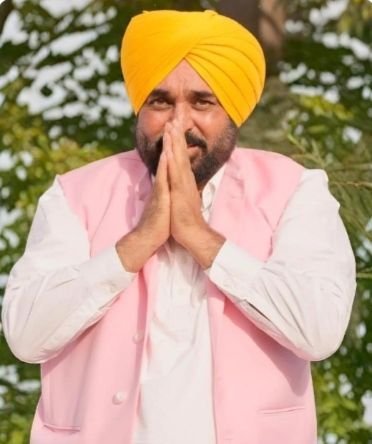
The political confrontation between the Aam Aadmi Party (AAP)-led Punjab government and the BJP-led Centre has intensified after AAP alleged that Chief Minister Bhagwant Mann was made to wait for nearly three hours at Delhi’s Indira Gandhi International Airport following his return from Paris and was subsequently issued a challan of ₹50,000.
Punjab AAP media in-charge Baltej Pannu raised the issue, alleging that airport officials referred to “tremendous pressure from above”. The party has portrayed the episode as part of what it describes as repeated obstacles placed by the Centre in the way of Punjab’s development and the state government’s efforts to promote Punjabi products internationally. However, AAP has not specified the official grounds for the challan, and the circumstances surrounding the alleged delay and fine remain unclear.
Paris visit becomes the centre of a political dispute
The controversy follows Mann’s visit to France to attend SIAL Paris 2026, an international food trade exhibition held from October 17 to 21. The chief minister led a Punjab delegation associated with the participation of the Punjab State Cooperative Supply and Marketing Federation, commonly known as Markfed. The stated objective was to showcase Punjab’s food products and explore opportunities to expand their presence in international markets.
The visit had already triggered a dispute between the state government and the Centre over political clearance for the chief minister’s overseas travel. After the Centre declined permission, the Punjab government approached the Punjab and Haryana High Court, which allowed Mann to proceed with the visit.
AAP has argued that international exhibitions can help Punjab’s agricultural and food-processing sectors reach new buyers, attract commercial partnerships and create opportunities for producers. Pannu alleged that repeated restrictions on the chief minister’s foreign visits could undermine these efforts.
AAP alleges deliberate delay and pressure on officials
According to Pannu, Mann was kept waiting at the airport while officials cited delays involving the arrival and checking of his luggage. He alleged that after the chief minister had been allowed to leave and was preparing to depart in a vehicle, officials approached him again and issued the ₹50,000 challan.
AAP has questioned why an elected chief minister was allegedly made to wait for so long and why the fine was imposed. The party has also interpreted the reported reference to pressure from higher authorities as grounds for demanding an explanation.
The allegations, however, do not by themselves establish who, if anyone, directed the airport officials to act in this manner. The specific reason for the challan has not been clarified in the reports available, and an official explanation would be necessary to establish the full circumstances of the episode.
Centre-state relations under renewed scrutiny
Pannu linked the airport controversy to broader disagreements between the Punjab government and the Centre, including the approval of Mann’s foreign visits, the release of funds claimed by the state government and the handling of farmers’ demands.
The dispute highlights the political and administrative tensions that can arise when a state government’s plans involve permissions or decisions falling within the Union government’s jurisdiction. AAP maintains that Punjab should be able to pursue investment, trade and development opportunities without what it considers unnecessary political interference. The Centre’s position on the airport allegations has not been established in the information available for this report.
For Mann and AAP, the Paris visit was presented as an opportunity to promote Punjab’s products beyond India. The controversy over his return has now shifted attention from that commercial objective to questions of official accountability, travel clearances and relations between Chandigarh and New Delhi.
Political implications for Punjab
The episode is likely to keep the relationship between the AAP government and the BJP-led Centre in the political spotlight. AAP is framing the matter as an issue concerning Punjab’s dignity, economic interests and the treatment of its elected leadership. The wider debate also raises questions about transparency in official procedures and the need for clear explanations whenever allegations involving public authorities emerge.
For now, the key claims remain those made by AAP. Establishing the precise reason for the reported delay and challan, and whether any higher-level intervention occurred, will require clarification from the relevant authorities. Until then, the allegations should be treated as claims by the political party rather than as independently established findings.