
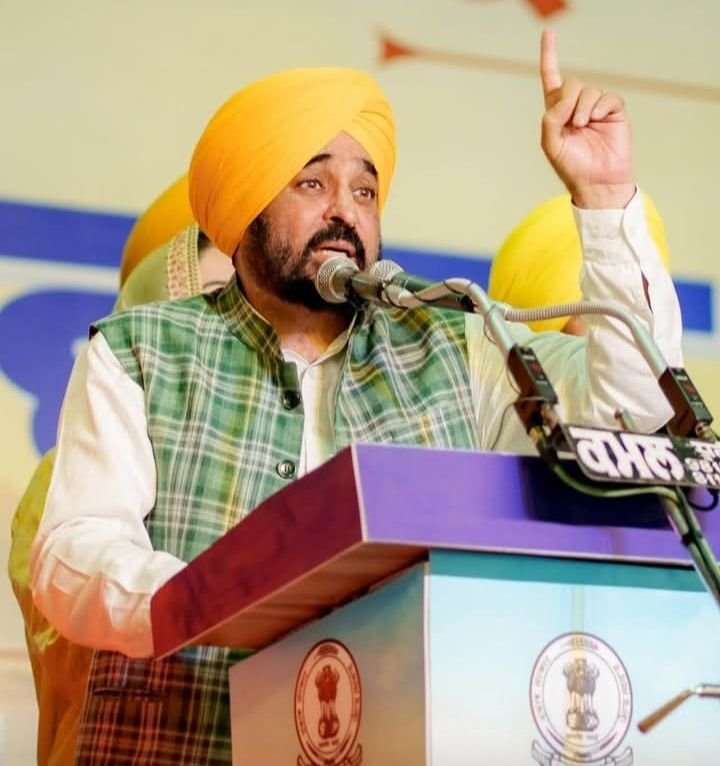
Punjab CM attacks BJP and Akalis over drugs, alleges ₹RDF and VAT dues withheld for 4.5 years; says his government will not compromise on the state’s interests
PATIALA : Punjab Chief Minister Bhagwant Singh Mann on Monday launched a sharp attack on the BJP-led Union government, alleging that Punjab’s institutional interests, water resources and financial entitlements were being undermined. He accused the BJP of seeking electoral support in the state while, in his view, failing to safeguard Punjab’s rights.
In a media interaction in Patiala, Mann raised concerns over Panjab University in Chandigarh, Punjab’s water resources and the alleged non-release of Rural Development Fund (RDF) and Value Added Tax (VAT) dues. He claimed that the funds had remained pending for four-and-a-half years, arguing that delays in releasing the money affected the state’s ability to undertake development and rural infrastructure projects.
The Chief Minister said Punjab’s contribution to the country’s food security and national defence deserved recognition, adding that the state should not have to repeatedly struggle to secure what his government considers its legitimate entitlements.
“Punjab’s rights and interests cannot be compromised for political calculations,” Mann said, asserting that his government would continue to raise issues concerning the state’s resources, institutions and finances.
Panjab University and water at the centre of political dispute
Mann alleged that the BJP was seeking votes in Punjab despite what he described as attempts to weaken the state’s control over matters linked to its identity and interests. He specifically referred to Panjab University, Chandigarh, and the state’s water resources.
The Chief Minister described the university as an institution deeply connected with Punjab’s academic history and cultural identity. He also underlined the importance of water to the state’s agricultural economy, particularly for farmers whose livelihoods depend on irrigation.
His remarks placed the protection of Punjab’s institutions and water interests at the centre of the Aam Aadmi Party government’s political argument against the BJP. Mann maintained that the state’s resources and institutional legacy should not become subjects of political bargaining.
The issues are politically sensitive in Punjab, where questions surrounding river waters, agricultural needs and the status of institutions associated with the state have long figured in public debate.
Mann questions delay in RDF and VAT dues
The Chief Minister also targeted the Narendra Modi government over the alleged delay in releasing Punjab’s RDF and VAT dues. He said the state was asking for funds it was entitled to receive and argued that prolonged uncertainty over these payments could constrain expenditure on public works.
Mann said rural infrastructure and development programmes required adequate financial support, adding that Punjab should not face what he described as unfair treatment from the Centre.
“The people of Punjab deserve their rightful funds, not repeated excuses,” was the thrust of his criticism. He said his government would continue to press for the release of pending amounts and oppose any decision it believes disadvantages the state.
The allegations over the duration and status of the outstanding dues were made by the Chief Minister; the detailed amounts, the Centre’s position and the basis for the claimed four-and-a-half-year period were not specified in the statement.
Akali-BJP ties and Punjab’s drug crisis
Turning to state politics, Mann accused the Shiromani Akali Dal and the BJP of contributing to Punjab’s drug problem during their earlier periods in power. He said families across the state had suffered because of substance abuse and argued that political parties should be held accountable for their past records.
The Chief Minister also claimed that the Akalis and the BJP were preparing to come together again for electoral advantage. He portrayed the possibility of renewed cooperation as a political arrangement that, in his view, could not erase questions about their earlier governance.
The remarks bring the drug issue back into the centre of Punjab’s political contest, where addiction, trafficking and the impact on young people remain major public concerns. Mann argued that the state needed sustained action against drugs and a long-term commitment to protecting young people rather than alliances driven by electoral considerations.
His accusations against the two parties reflect the AAP government’s political position. The claims about responsibility for the drug crisis and the prospect of an alliance were not independently established in the statement.
AAP support and the coming political contest
Mann also claimed that public support for the Aam Aadmi Party had left opposition parties frustrated. He said his government was focused on public services, farmers, young people, workers and ordinary families, and accused its opponents of struggling to present a credible alternative.
The Chief Minister said voters should assess political parties on their record and their commitment to Punjab rather than on slogans or election-time arrangements. He maintained that his government would continue to prioritise public welfare while raising issues involving the state’s finances and resources.
With Punjab’s political parties already positioning themselves around questions of governance, public services, drugs and the state’s relationship with the Centre, Mann’s remarks underline the issues likely to remain prominent in the political debate.
For the Punjab government, the challenge will be to translate its demands over pending funds and state rights into concrete outcomes, while demonstrating progress on concerns that directly affect residents. The status of the disputed dues, the position of the Union government and developments concerning Panjab University and water-related issues will be important in assessing the claims made by the Chief Minister.
Mann concluded by reiterating that Punjab’s water, institutions and financial entitlements should not be used as bargaining tools. He said his government would continue to defend what it regards as the state’s legitimate interests and would not allow electoral considerations to determine its position on these matters.