
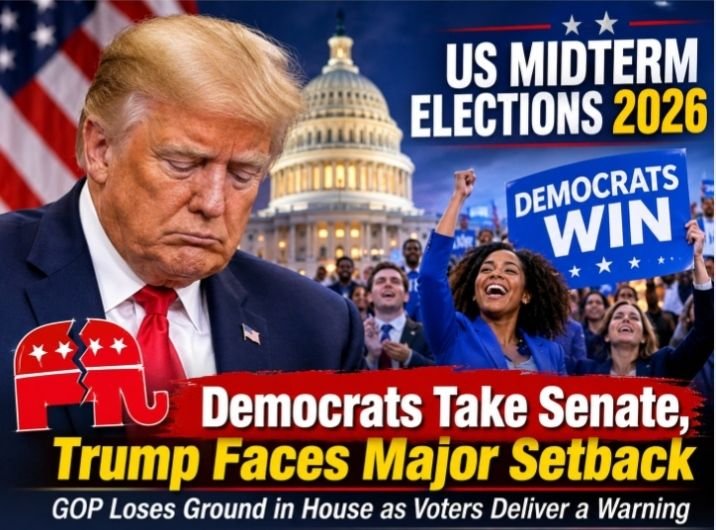
The November 3, 2026, US midterm elections have delivered a serious political setback to President Donald Trump, with Democrats winning control of the Senate and emerging strongly positioned to take the House of Representatives as well. The results represent a sharp reversal of the Republican position in Congress and threaten to turn the final two years of Trump’s presidency into a period of intense legislative confrontation, congressional investigations and political scrutiny.
The result is particularly significant because midterm elections are often treated as a public verdict on the performance of the sitting president. In this election, voters have delivered a message about the cost of living, the direction of the economy, Trump’s trade policies and the consequences of the US war with Iran.
A Midterm Revolt Against Trump: Democrats Seize Senate, House Slips from Republican Grip as Voters Deliver a Warning to the President
Washington, November 4: President Donald Trump has suffered one of the most consequential political setbacks of his second term, after Democrats made sweeping gains in the November 3 US midterm elections, capturing control of the Senate and moving towards a majority in the House of Representatives. The scale of the Democratic advance, including victories in states that have traditionally been Republican strongholds, has turned the election into a powerful national rebuke of Trump’s leadership, economic policies and increasingly controversial decisions on the international stage.
The result has fundamentally altered the political landscape in Washington. For nearly two years, Republicans had enjoyed control of both chambers of Congress, giving Trump considerable room to advance his legislative priorities. That advantage is now gone in the Senate, while the House is also moving towards Democratic control. Reuters reported Democratic victories in both chambers, although the Associated Press, in its latest election-night update, said the Senate result was decisive but the House outcome was still too early to call. The final House balance will become clearer as outstanding votes are counted and media projections are updated.
The election became a referendum on Trump
Trump had effectively made himself the central figure of the midterm campaign. He held an intensive series of rallies, urged Republican supporters to vote as if he himself were on the ballot and repeatedly portrayed the contest as a choice between his administration’s vision and what he described as the policies of the political left.
But the strategy appears to have worked against the Republicans. Instead of consolidating support, the president’s direct involvement made it easier for voters to use the congressional elections to express their dissatisfaction with his administration.
According to exit-poll findings reported by Reuters, around half of voters viewed the election as an opportunity to rebuke Trump, while approximately three-quarters said they were angry or dissatisfied with the direction of the country. About 70 per cent wanted Congress to exercise stronger checks and balances on presidential power. These figures suggest that the outcome was not simply a routine midterm swing but also reflected concern about the concentration and exercise of executive authority.
The economy and cost of living emerge as Trump’s biggest vulnerabilities
The economy, which helped Trump return to the White House in 2024, has become a major source of political difficulty for his administration. The promise of bringing down prices and improving household finances had been central to his appeal among voters. However, concerns over inflation, fuel costs, housing and everyday expenses remained prominent during the campaign.
The Washington Post reported that more than four in ten voters described their household financial position as worse than it had been two years earlier, while roughly three-quarters expressed dissatisfaction with the direction of the country. Its reporting also cited a Washington Post-ABC News-Ipsos poll in which Trump’s approval rating had fallen to 33 per cent in October. CBS News exit polling separately placed his approval at 38 per cent during the election period, reflecting the different polling samples and measurements.
The political problem for Trump is that economic performance is measured by families through their daily experience, not simply by government announcements or market indicators. When petrol, groceries, housing and healthcare remain expensive, voters can become increasingly sceptical of claims that the economy is entering a period of prosperity.
Trump’s tariff policy also became a campaign liability. Although the administration has presented tariffs as a means of protecting American industries, strengthening domestic manufacturing and negotiating better trade terms, the policy has faced criticism over its potential impact on import prices, businesses and consumers. Republican candidates in difficult contests increasingly distanced themselves from the president on tariffs as the election approached.
Iran war adds to the political cost
Another major factor weighing on the Republican position was the US war with Iran. The conflict, launched in February 2026 according to Reuters’ election coverage, has contributed to a sharp rise in fuel prices and intensified concerns about the economic consequences of America’s overseas military engagement.
For many voters, the issue was not limited to foreign policy. Higher energy costs feed into transport, food distribution, manufacturing and household budgets. The war therefore became directly connected to the cost-of-living debate.
Trump’s foreign policy approach, which has frequently emphasised American strength and a willingness to use military and economic pressure, has also faced questions over the long-term consequences of the conflict. The election results indicate that voters were not prepared to separate international policy from their domestic economic concerns.
The administration will now face a more hostile Congress, where Democrats are likely to demand greater scrutiny of the decisions that led to the conflict, its financial cost and the strategy for bringing it to an end.
Republican strongholds fall: Texas becomes the symbol of the Democratic surge
Perhaps the most striking feature of the election was the Democratic breakthrough in states that had long been considered difficult territory for the party.
In Texas, Democrat James Talarico defeated Republican Ken Paxton in the Senate race, marking the first Democratic victory in a Texas Senate contest since 1988. Democrat Gina Hinojosa also defeated Republican Governor Greg Abbott, becoming the state’s first Latina governor and the first Democrat to win the governorship since 1990.
The result was particularly damaging for Trump because Texas had been a reliable Republican state in recent presidential elections. The simultaneous victories in the Senate and gubernatorial contests exposed the extent of the political challenge facing the Republican Party.
Democrats also made major gains in South Carolina, Kansas, North Carolina and Ohio. In Ohio, former Democratic governor Sherrod Brown defeated Republican Senator Jon Husted. In Kansas, Adam Hamilton secured a historic Democratic Senate victory, while Democrats also flipped seats in other states that had previously appeared beyond their reach.
At the state level, Democratic candidates Keisha Lance Bottoms in Georgia, Amy Acton in Ohio, Rod Sand in Iowa and Gina Hinojosa in Texas won governorships previously held by Republicans, according to the Associated Press. These victories indicate that the Democratic advance extended beyond congressional contests and reached the broader political structure of several states.
Trump’s response: ‘I wasn’t on the ballot’
As Republican losses became apparent, Trump attempted to distance himself from the result. In a social media post, he said he had not been on the ballot and claimed that the Republicans would have won by a landslide if he had been a candidate.
The response reflected the political difficulty of accepting responsibility for an election in which the president had personally campaigned for several Republican candidates. Some Republican campaign officials, speaking to the Associated Press, blamed Trump’s policies and his handling of the economy for the party’s losses, particularly in Senate contests.
Trump had also made his position on a Democratic-controlled Congress clear before the results were known. In an interview with CBS News, he described the presidential veto as his ultimate power and said he was prepared to block Democratic legislation. He also argued that recent Supreme Court decisions had strengthened presidential authority, allowing his administration to continue pursuing its agenda even if Congress opposed it.
His response suggests that the White House is preparing for confrontation rather than accepting a reduced legislative role. However, the president’s assertion that he can use executive powers cannot eliminate Congress’s constitutional authority over legislation, federal spending, oversight and appointments.
What happens next: Investigations, legislative battles and a tougher Congress
The immediate consequence of Democratic control of the Senate is a change in the balance of power over legislation, committee leadership and presidential appointments. The Senate plays a central role in confirming senior administration officials, ambassadors and federal judges. Democratic control will therefore make it considerably more difficult for Trump to secure swift approval of his nominees, particularly where political disagreements are sharp.
If Democrats also secure the House, the administration will face a much more challenging environment. House committees can summon officials, demand documents, conduct hearings and investigate government decisions. Democratic leaders have already signalled an interest in examining the administration’s immigration enforcement, the activities of the Trump family and the handling of the Justice Department’s files relating to convicted sex offender Jeffrey Epstein.
Such investigations could keep the White House under sustained political pressure and generate a series of hearings and public confrontations. The House Democratic leadership, headed by Hakeem Jeffries, is preparing to use the party’s electoral gains to demand greater accountability from the administration.
The legislative consequences could be equally significant. Trump’s tax, trade, immigration and spending priorities will face greater resistance. Major legislation will require negotiations with Democrats, while disagreements over federal budgets, government funding and the debt ceiling could produce repeated confrontations in 2027.
The president retains the power to veto legislation passed by Congress. Overriding a presidential veto requires a two-thirds majority in both chambers, a threshold Democrats are not expected to command on the basis of the current election results. This means that a Democratic Congress could block or reshape much of Trump’s legislative programme, but it would not automatically be able to replace it with its own agenda.
The Senate’s role in judicial and executive appointments could also become a major battleground, particularly if vacancies arise in senior federal positions or the judiciary.
Is this the beginning of Trump’s political decline?
The midterm result is a serious warning, but it does not mean that Trump’s presidency has ended or that his political influence has disappeared. He remains president, retains substantial executive authority and continues to command a committed Republican base. The midterms also do not directly determine the outcome of the next presidential election.
However, the political message is difficult for the White House to ignore. The party that controlled Congress has suffered losses in states it expected to defend, while Democrats have demonstrated that they can compete in areas where Republican dominance had appeared secure.
The defeat also raises questions about the future direction of the Republican Party. Candidates who tied themselves closely to Trump now face the consequences of a national political environment in which the president’s popularity has weakened. Party leaders will have to decide whether to continue defending his approach or create greater distance from policies that appear to have alienated independent and moderate voters.
For Democrats, the victory offers an opportunity to rebuild their national standing, but it also brings responsibility. Voters who supported the party to check Trump’s power will expect more than investigations and political criticism. They will want practical responses to inflation, healthcare costs, employment, housing and economic insecurity. The party’s ability to turn electoral momentum into credible governance will determine whether this victory becomes the foundation of a lasting political recovery.
A defining moment for the second Trump presidency
The 2026 midterms have changed the political equation in Washington. Trump entered the election hoping to strengthen Republican control and secure greater freedom to pursue his second-term agenda. Instead, he faces a Congress where Democrats have taken the Senate and are positioned to challenge Republican control of the House.
The coming two years are likely to be marked by sharper institutional confrontation, investigations, disputes over spending and difficult negotiations on domestic and foreign policy. The president can still use his veto and executive powers, but governing without reliable congressional support will be considerably harder.
Ultimately, the election has exposed a widening gap between Trump’s political promises and the concerns of a significant section of the American electorate. The message from voters is not necessarily that they have embraced every Democratic policy. It is that they want a change in direction, greater accountability and stronger checks on presidential power.
For Trump, the challenge is now to decide whether to respond by adjusting his policies and rebuilding public confidence or to intensify the political confrontation with a Congress that has become far less willing to accommodate him. The answer will shape not only the remainder of his presidency but also the future direction of American politics.
Editorial fact-check note: The Senate Democratic victory is established in the latest Associated Press and Reuters reporting. The House result has been described differently across election-night updates: Reuters reported Democratic control, while AP’s latest update said the chamber was still too early to call. The article therefore distinguishes the confirmed Senate shift from the House outcome, which should be updated once the count and projections are settled. These are media projections and reported results, not a substitute for formal state certification.