
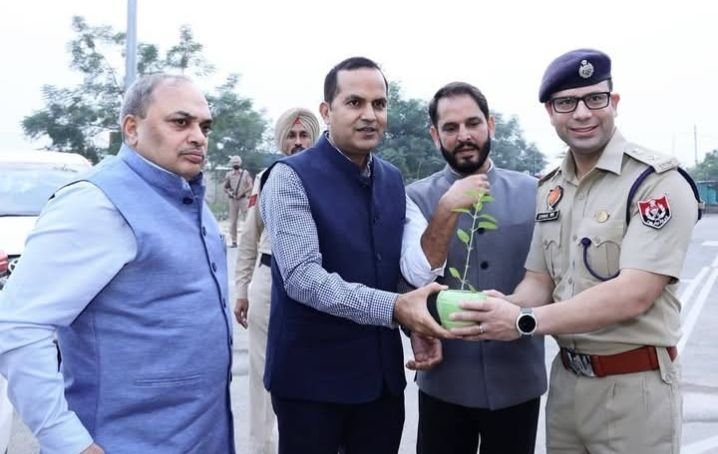
Bathinda’s efforts to promote scientific and environmentally responsible management of paddy straw received renewed attention with the visit of the Chairperson of the Commission for Air Quality Management (CAQM) in NCR and Adjoining Areas to the district’s 2G Ethanol Bio-Refinery Project. The visit provided an opportunity to review the potential of converting agricultural residue into a productive resource while strengthening measures to address stubble burning and its impact on air quality.
The Chairperson held discussions with district officials on the effective collection, management and utilisation of paddy straw, along with measures required to prevent its open burning. The deliberations focused on exploring practical ways to ensure that crop residue is channelled towards productive applications rather than becoming a source of environmental pollution.
Deputy Commissioner, Bathinda, and Senior Superintendent of Police, Bathinda, welcomed the visiting Chairperson. Kamal Yadav, Secretary, Department of Coordination, was also present during the visit.
The 2G ethanol refinery represents an important link between agricultural waste management, clean energy production and the creation of additional value from farm residue. The project, being set up by Hindustan Petroleum Corporation Limited (HPCL), is designed to use paddy straw as feedstock for producing ethanol, which can be blended with petrol. According to information released by the Ministry of Environment, Forest and Climate Change in November 2023, the project was envisaged with a production capacity of 100 kilolitres of ethanol per day and the potential to utilise around 570 metric tonnes of paddy straw daily, or approximately two lakh metric tonnes annually, at full capacity.
The significance of such facilities extends beyond waste disposal. By creating an industrial demand for paddy straw, bio-refineries and other biomass-based units can help develop a supply chain involving farmers, aggregators, transporters and processing industries. This can provide farmers with an alternative channel for managing crop residue while supporting the transition towards cleaner energy sources.
The visit also comes amid intensified efforts by CAQM and the concerned state and district authorities to prevent stubble burning during the ongoing harvesting season. The Commission has stressed the importance of strengthening both in-situ management, in which residue is handled within agricultural fields, and ex-situ utilisation, where straw is collected and supplied to industries and other facilities. It has also underlined the need for timely availability of crop residue management machinery, effective field-level monitoring and close coordination among farmers, government agencies and industrial users.
Bathinda’s experience with the 2G ethanol project underlines the importance of treating paddy straw as a resource with economic and environmental value. A stronger network for its collection and utilisation can help reduce dependence on crop-residue burning, contribute to pollution control and open up opportunities in the renewable energy sector.
The district administration’s engagement with the CAQM leadership reflects the importance of coordinated action at the local level. Sustained cooperation between farmers, industry and government departments will be essential to ensure that initiatives of this kind deliver tangible benefits and contribute to cleaner air and more sustainable agriculture across Punjab.