
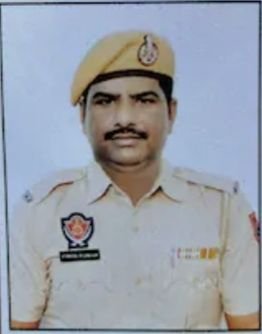
Gurdaspur/Chandigarh, November 16: The killing of Punjab Police Head Constable Vinod Kumar in Gurdaspur has taken a serious turn after a poster attributed to the Pakistan-based outfit Tehreek-e-Taliban Hindustan (TTH) surfaced on social media, claiming responsibility for the attack and issuing a threatening message to police personnel and security forces.
The development has raised concerns about a possible terror-linked dimension to the killing. However, Punjab Police have not yet authenticated the poster or independently established the group’s involvement. Investigators are examining the claim, its origin and the possibility of a wider network operating behind the incident.
The poster attributed to TTH claims that the organisation was responsible for killing Vinod Kumar. It also carries a threatening message directed at police and security personnel, warning that its members would carry out fewer killings on the streets and more inside people’s homes. The threatening language has added to concerns over the security of police personnel and their families.
Additional Director General of Police (Law and Order) P.K. Sinha confirmed that a poster claiming responsibility for the killing had circulated widely on social media. He said the police were examining the material, making it clear that the claim was being investigated rather than treated as an established conclusion.
Head constable was returning home after training
Vinod Kumar, 42, was associated with the Technical Services Wing of Punjab Police and was serving as a wireless operator attached to the Sujanpur police station in Pathankot district. He was a resident of Krishna Nagar village and had recently travelled to Sangrur for training.
According to accounts provided by his family, Kumar contacted his brother on Sunday night while returning home and asked him to pick him up from the bypass area near Gurdaspur. When his brother reached the designated location, Kumar was nowhere to be found. Repeated attempts to contact him over the phone also failed.
The family began searching for him in the surrounding area, including checking nearby buses. After more than an hour, his body was discovered near the Maankaur bypass.
Police subsequently reached the spot and initiated an investigation. Reports indicate that Kumar had sustained a gunshot injury to the head. His killing has prompted renewed concern over the safety of police personnel, particularly in view of earlier attacks on members of the force in Punjab.
Shahzad Bhatti network under scrutiny
The alleged involvement of Tehreek-e-Taliban Hindustan has also brought the activities of Pakistan-based operative Shahzad Bhatti into focus. Intelligence-related reports have linked the outfit to Bhatti and described it as a proxy organisation allegedly operating with support from Pakistan’s Inter-Services Intelligence (ISI).
The Union Home Ministry had listed the Shahzad Bhatti Network as a banned terrorist organisation on September 16, while Bhatti was also designated a terrorist under the Unlawful Activities (Prevention) Act (UAPA), according to media reports.
Nevertheless, the precise connection between the network, the TTH poster and Vinod Kumar’s killing remains to be established. Investigators will need to verify the authenticity of the communication, identify those responsible for circulating it and determine whether the murder was carried out at the direction of any terrorist or criminal network.
The appearance of such claims is not entirely new. In February this year, posters attributed to Tehreek-e-Taliban Hindustan had also surfaced after the killing of two police personnel in Gurdaspur. At that time, Punjab Police had questioned the outfit’s claimed presence in the state and described the allegations as unverified. The recurrence of similar claims makes independent verification particularly important.
Security concerns intensify after another attack on a police official
The killing has added to the growing concern over targeted violence against police personnel in Punjab. The latest incident has raised difficult questions about the security of serving officers, the possible involvement of cross-border networks and the ability of criminal or extremist groups to threaten law-enforcement personnel.
Shiromani Akali Dal leader Bikram Singh Majithia has also referred to CCTV footage which, according to him, shows two masked men abducting Kumar before shooting him. He questioned the security situation in the state, arguing that if a serving police employee could be targeted in this manner, ordinary citizens would also have reason to feel vulnerable. His interpretation of the footage remains a political statement and should be distinguished from the findings of the police investigation.
For Punjab’s security agencies, the immediate priorities are to identify and arrest the killers, establish the circumstances surrounding the murder and determine whether the social media claim is genuine or an attempt to mislead investigators and spread fear.
The central question now is whether Vinod Kumar’s killing was an isolated criminal attack or part of a wider, organised operation. Until investigators establish the authenticity of the TTH claim and its connection, if any, with the perpetrators, the alleged terror angle must remain under investigation rather than be treated as confirmed.