Saptrishi Soni

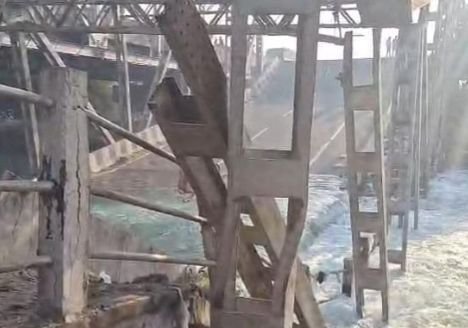
Two trucks trapped as Bhakra Canal bridge collapses near Patiala; one catches fire. No lives lost, but the incident exposes serious questions about construction quality, structural safety, maintenance and accountability in India’s highway development.
PATIALA : What could have turned into a major tragedy on one of Punjab’s important highway corridors ended without any reported loss of life on Thursday morning. But the collapse of a bridge over the Bhakra Canal near Pasiana village on the Patiala-Sangrur bypass has left behind a much larger question: how safe are the infrastructure projects being built in the name of India’s development?
The bridge, part of the National Highway-7 corridor connecting Chandigarh with Bathinda, suddenly gave way in the early hours while two trucks were crossing it. Both heavy vehicles became trapped in the collapsed portion, with one truck catching fire. The blaze was subsequently brought under control by fire brigade personnel, while rescue teams and police rushed to the site.
The absence of casualties should be regarded as a stroke of luck, not evidence that the incident was less serious. Two trucks were left stranded in a damaged bridge structure above a major canal, and the fire added another dimension to an already dangerous rescue operation.
A bridge barely ten years old: Why did it fail?
The age of the structure makes the collapse particularly disturbing. According to information reported from the site, the bridge was constructed by the National Highways Authority of India (NHAI) in 2016 as part of the highway development programme. The Patiala Southern Bypass, forming part of the Patiala-Sangrur highway corridor, was opened to commuters on April 17, 2017, following reconstruction and four-laning.
In other words, a public infrastructure asset that was expected to serve commuters and commercial transport for decades has suffered a major structural failure within approximately ten years of construction.
This raises questions that cannot be brushed aside as an ordinary road accident.
Was the original construction carried out in accordance with prescribed engineering specifications? Were the foundation, supporting structures and load-bearing components adequately designed? Were periodic structural inspections undertaken? Did the bridge receive proper maintenance? And, most importantly, if repairs had been carried out recently, were they sufficient to address the underlying structural weaknesses?
These are questions that NHAI and the concerned technical authorities must answer through an independent investigation.
The precise cause of the collapse has not yet been established. Some preliminary reports have suggested that the trucks may have been carrying excessive loads, but this cannot be accepted as the explanation without examining the bridge’s structural capacity, vehicle weights, foundation conditions and engineering records.
Even if overloading is established as a contributing factor, it would not absolve the authorities of examining whether the structure was adequately maintained and whether load restrictions were enforced.
The possibility that the remaining portion of the bridge could also be unsafe makes a comprehensive structural assessment even more urgent.
India’s infrastructure story: A growing pattern of structural failures
The Patiala incident cannot be examined in isolation. Across India, structural failures involving bridges, flyovers, roads and other public infrastructure have repeatedly raised questions about the quality of construction, supervision and maintenance.
The concern is not merely that structures sometimes fail. Engineering failures can occur for several reasons, including natural disasters, excessive loading, design deficiencies, construction defects, poor maintenance and unexpected ground conditions.
The real test of governance is whether these failures are investigated transparently, responsibility is fixed and those found negligent face meaningful consequences.
Significantly, the Union Ministry of Road Transport and Highways has itself placed substantial information about such failures before Parliament.
In a written reply to Rajya Sabha Unstarred Question No. 1226 on December 10, 2025, Union Road Transport and Highways Minister Nitin Gadkari disclosed that 72 National Highway projects or stretches had reported collapses or major deficiencies during the preceding five years and the current financial year.
The figure covered a wider category of highway failures and deficiencies, including bridges, culverts and road structures. It should not be misrepresented as 72 bridge collapses. Nevertheless, it reveals the scale of quality-related problems confronting highway infrastructure.
The government also informed Parliament that 11 officers had been removed from service following performance assessments, while disciplinary action had been taken against another 11 officers for various reasons, including negligence and dereliction of duty. Digital Sansad
The disclosures are significant because they come from the government’s own official records rather than political allegations.
Parliamentary disclosures expose the scale of the quality-control challenge
A further revelation came in the Ministry’s response to Rajya Sabha Unstarred Question No. 1216, answered on July 29, 2026, regarding safety audits and quality compliance of major highway structures.
The government acknowledged multiple instances of structural failures and major deficiencies across different states.
The official annexure recorded, among other cases:
- Bihar: Major structural deficiencies in highway projects, including a Rs 25 crore penalty imposed on a contractor in one case.
- Haryana: Two projects reported major failures or deficiencies in 2024, attracting penalties totalling Rs 90 lakh on contractors.
- Kerala: Seven projects reported major structural failures or deficiencies in 2025, with penalties totalling Rs 31.245 crore on contractors and Rs 5 lakh on an independent engineer.
- Madhya Pradesh: Two projects in 2025, with a penalty of Rs 119 crore imposed on a contractor.
- Maharashtra: Four projects in 2024, attracting combined contractor penalties of Rs 3.94 crore, besides a penalty on an authority’s engineer.
- Uttar Pradesh: Three projects in 2026, with termination of a contractor in one case.
These figures are drawn from the Ministry’s official annexure and cover projects involving collapses or major structural failures, including cases linked to substandard materials. They demonstrate that the problem extends well beyond an isolated geographical location.
The government has also acknowledged the need for third-party quality audits, independent engineering supervision and technical scrutiny of project designs.
It says academic and research institutions were engaged for design proof-checking in 79 projects during the last five years and the current year. It has also introduced technology-based monitoring mechanisms, including drone surveys, the NHAI One App and Network Survey Vehicles for periodic road-condition assessments.
However, the Patiala collapse brings the debate back to a fundamental issue: if inspection and monitoring mechanisms exist, why are serious structural failures still occurring?
The BJP government’s development narrative faces questions of accountability
Under Prime Minister Narendra Modi, infrastructure expansion has become one of the central pillars of the BJP government’s political messaging.
National highways, expressways, airports, railway corridors and large-scale construction projects are repeatedly presented as evidence of India’s transformation and the government’s development-oriented approach.
There is no denying that India needs modern infrastructure and that substantial highway development has taken place. But the credibility of development cannot be measured simply by the number of kilometres of roads constructed, projects inaugurated or foundation stones laid.
The durability, safety and quality of those assets matter equally.
The Patiala bridge collapse provides an opportunity to question the gap between political claims of rapid development and the actual performance of public infrastructure.
Opposition parties have repeatedly accused the BJP-led establishment of prioritising publicity, political messaging and headline-grabbing announcements over institutional accountability. Critics have also raised concerns about corruption, contractor-government relationships and inadequate enforcement of construction standards.
These allegations must be investigated on evidence rather than treated as established facts in the absence of specific findings. Nevertheless, when a bridge constructed with public money fails within a decade, the government cannot escape scrutiny.
The question is not whether every infrastructure failure can be attributed to corruption or political interference. The question is whether the system is strong enough to identify poor workmanship, prevent compromised construction and punish those responsible.
Development cannot become a political slogan that shields failures from public examination.
The economic cost: Beyond the damaged bridge
The immediate images of two trucks trapped in the collapsed structure understandably dominated attention. But the economic consequences extend considerably further.
The Patiala-Sangrur corridor is an important route for commercial transport and connectivity between Chandigarh, Patiala, Sangrur and the Bathinda region.
The collapse has forced authorities to suspend movement across the affected bridge and divert traffic towards Patiala city.
This means additional travel time, higher fuel consumption, inconvenience for commuters, disruption to goods movement and possible delays in commercial deliveries.
For transport operators, every additional hour on the road translates into operational costs. For businesses dependent on regular supplies, delays can affect delivery schedules and productivity.
There is also the substantial cost of removing the trapped vehicles, assessing the damaged structure, undertaking emergency stabilisation, reconstructing the bridge and restoring normal traffic.
The financial burden becomes even greater if an entire section has to be dismantled and rebuilt.
Ultimately, taxpayers bear the indirect consequences of infrastructure that fails prematurely, even when contractual provisions require defaulting contractors to undertake rectification at their own expense.
The loss is not restricted to the physical structure. It includes the time, public money, commercial activity and economic opportunities lost because an essential transport link has become unusable.
Who will take responsibility?
The most important aspect of the Patiala incident now is the investigation that follows.
Merely clearing the damaged vehicles, barricading the site and arranging a temporary traffic diversion cannot be considered an adequate response.
NHAI and the Union Ministry of Road Transport and Highways must ensure a comprehensive technical investigation covering:
- The original detailed project report, structural design and construction specifications.
- The quality of steel, concrete and other materials used in the bridge.
- The condition of foundations, piers, supporting structures and load-bearing components.
- The maintenance and inspection history, including any recent repair work.
- The actual weight of the two trucks and the prescribed load-bearing capacity of the bridge.
- The role of the original contractor, maintenance agency, independent engineer and supervising authorities.
- Whether previous warning signs, cracks, structural movement or other defects were reported and ignored.
The investigation should be conducted by an independent technical team, with its findings made public.
If construction deficiencies, negligent maintenance, substandard materials or supervisory failures are established, responsibility must extend beyond the contractor. Officials and consultants responsible for approving, inspecting and certifying the structure must also be examined wherever evidence warrants.
The government should also disclose the estimated reconstruction cost, the contractual liability of the agencies concerned and the timeline for restoring the route.
A lucky escape must become a wake-up call
India cannot aspire to become a major economic power while allowing critical public infrastructure to deteriorate or fail because of avoidable shortcomings.
A bridge is not merely a concrete-and-steel structure. It is an essential public asset on which thousands of people depend every day. Its safety is directly connected to people’s lives, livelihoods and confidence in the government machinery.
The Patiala collapse could have resulted in multiple fatalities. The trucks could have plunged into the Bhakra Canal, the fire could have spread, and other vehicles could have been caught in the disaster. That such an outcome was avoided is a matter of immense relief.
But relief must not turn into complacency.
The Modi government’s infrastructure agenda must be judged not just by the speed with which projects are announced and inaugurated, but also by how safely they perform over their intended lifespan.
The government’s own parliamentary disclosures show that highway-related structural failures and major deficiencies have been a recurring concern. The latest incident in Punjab adds another urgent reason to strengthen independent inspections and enforce accountability.
Political slogans, grand announcements and claims of unprecedented development cannot substitute for engineering standards, quality construction and responsible administration.
The bridge at Pasiana has collapsed, but the larger question it has raised cannot be allowed to collapse under political rhetoric: who is accountable when public infrastructure built with taxpayers’ money fails before its time?
Editorial note: The bridge’s reported construction year is 2016, and its failure occurred in November 2026. The precise cause remains under investigation. The article therefore distinguishes established facts, preliminary reports and questions requiring technical verification. The parliamentary figures cited relate to National Highway projects and major structural deficiencies, not exclusively completed bridge collapses.