
Ensuring a reliable supply of safe drinking water in the Himalayan region requires much more than laying pipelines and connecting households. Difficult terrain, scattered settlements, ageing infrastructure, electricity constraints and monsoon-related disruptions make the task particularly demanding. Kangra district in Himachal Pradesh has emerged as one of the districts showcasing its efforts to address these challenges through sustainable water management and community participation.
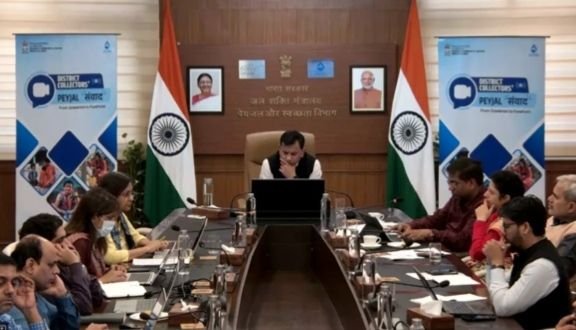
At the 14th District Collectors’ Peyjal Samvad, organised by the Department of Drinking Water and Sanitation (DDWS), Ministry of Jal Shakti, on November 19, Kangra presented its district-level experience of maintaining rural drinking water services in a geographically challenging environment. The virtual interaction brought together district administrators and senior officials from across the country to exchange practical solutions for accelerating the implementation of Jal Jeevan Mission 2.0.
Deputy Commissioner Kangra Hemraj Bairwa outlined the district’s progress, reporting 100 per cent coverage under the programme and substantial advancement in the process of Har Ghar Jal certification. The certification exercise is continuing in the remaining villages, indicating that the focus is increasingly shifting from providing household connections to ensuring that water supply systems remain functional and dependable over time.
Beyond household connections: The real test of Har Ghar Jal
The experience of Kangra highlights an important distinction in rural drinking water planning: providing a tap connection is only the first step; ensuring a regular and adequate supply of safe water is the larger challenge.
In the Himalayan landscape, villages are often spread across hillsides and valleys, making the construction, maintenance and monitoring of water supply networks more complicated. Pumping water across difficult elevations can increase dependence on electricity, while older distribution systems require regular repairs and improvements. Heavy rainfall and monsoon-related damage can further interrupt supply, particularly in remote habitations.
Kangra’s presentation drew attention to these ground realities and explained how the district is prioritising the revival and augmentation of older water supply schemes, strengthening pumping infrastructure and improving the operation and maintenance of existing assets. These measures are aimed at making rural water systems more resilient rather than relying exclusively on the creation of new infrastructure.
The district’s approach reflects a broader lesson for hill states: water security depends not only on the availability of infrastructure but also on its suitability to local geography, the capacity to maintain it and the involvement of communities that depend on it.
Jal Jeevan Mission 2.0: From infrastructure creation to sustainable services
The 14th Peyjal Samvad was chaired by Kamal Kishore Soan, Additional Secretary and Mission Director of the National Jal Jeevan Mission. The interaction focused on strengthening implementation, sharing district-level innovations and developing practical models that can be replicated in other parts of the country.
Soan emphasised the need for District Collectors to hold regular meetings of District Water and Sanitation Committees and use the Decision Support System for evidence-based planning. He also called for district-level improvement plans to address shortcomings identified through Jal Seva Aankalan.
He urged states and districts to explore opportunities under the 16th Finance Commission, strengthen community participation and improve the long-term operation and maintenance of rural water supply infrastructure. The emphasis on these issues is particularly relevant for districts such as Kangra, where geographical conditions can make maintenance more demanding and costly.
Local skills and community ownership at the centre of water management
An important aspect of the discussion was the development of a skilled local workforce to operate and maintain rural drinking water systems. Pooja Bhatt, Director, National Jal Jeevan Mission, highlighted the employment potential of the sector and outlined a proposed framework involving Jal Jeevan Mitras, multi-skilled technicians, diploma operators, supervisory personnel and district-level technical units.
The idea is to build local technical capacity so that routine repairs, system monitoring and maintenance do not always depend on personnel travelling from distant locations. For geographically dispersed settlements in Himachal Pradesh, locally available trained workers could help reduce response times and improve the continuity of services.
The presentation also highlighted the Sujalam Shakti initiative, which seeks to increase women’s participation in water quality surveillance, community mobilisation and the protection of drinking water assets. Training and refresher programmes, along with collaboration with Industrial Training Institutes, Rural Self Employment Training Institutes and State Rural Livelihood Missions, were identified as important elements of this effort.
Such an approach can make rural water management more participatory while creating opportunities for local employment and skill development.
Lessons from other states: Different solutions for different water challenges
The interaction also featured presentations from Valsad in Gujarat, Jorhat in Assam and Unakoti in Tripura, demonstrating how local conditions shape drinking water management strategies.
Jorhat presented its efforts to move towards 24-hour rural water supply through decentralised maintenance systems, Water User Committees, local workers known as Jal Mitras and Jal Doots, and improved tariff collection. Valsad highlighted performance-linked incentives for tariff collection, while Unakoti showcased community participation, groundwater recharge, pond rejuvenation, rainwater harvesting and greywater management.
Unakoti also shared an example of a surface water-based drinking water scheme for Reang tribal habitations, where groundwater-based solutions were technically unviable. Its experience demonstrated how scientific source identification and community involvement can help address water scarcity in difficult terrain.
These district-level examples underline that there is no single model capable of addressing every rural water challenge. The most effective solutions are those designed around local geography, available water sources, community needs and the capacity to maintain infrastructure.
Why Kangra’s experience matters for Himachal Pradesh
Kangra’s presentation at the national-level interaction carries significance beyond the district itself. Its experience offers lessons for other Himalayan regions where scattered settlements, difficult terrain and climate-related disruptions place additional demands on drinking water infrastructure.
The next phase of rural water security will depend on whether household connections translate into reliable services throughout the year. This requires regular monitoring of water quality, timely repairs, sustainable sources, trained local personnel and active participation by Gram Panchayats and village communities.
For Himachal Pradesh, the challenge is to ensure that the progress made in expanding household access is supported by systems capable of delivering safe drinking water consistently. Kangra’s focus on strengthening older schemes, improving pumping infrastructure and addressing maintenance challenges places these concerns at the centre of the discussion.
The 14th Peyjal Samvad thus offered an important opportunity to bring district experiences into national policy discussions. More importantly, it reinforced a central principle of Jal Jeevan Mission 2.0: the success of rural drinking water programmes must ultimately be measured not simply by the number of taps installed, but by the quality, reliability and sustainability of the water services reaching every household.