
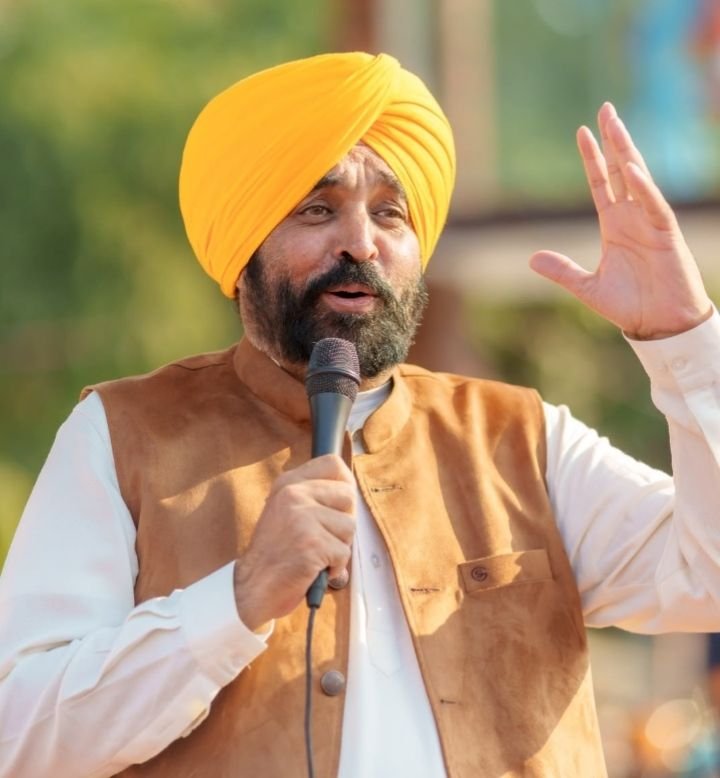
Chief Minister projects education, employment and welfare as pillars of his government’s record; announces ₹51 lakh for Hedon Bet’s development and vows not to betray public trust
SAMRALA : Chief Minister Bhagwant Singh Mann used a public interaction programme in Hedon Bet village of the Samrala Assembly constituency to mount a pointed political attack on successive Congress and Akali Dal-BJP governments, accusing them of damaging Punjab’s future through corruption, neglect and policies that failed to create opportunities for young people.
Positioning his government as a departure from the previous political order, Mann said his priority was public welfare rather than personal wealth or political privilege. He asserted that he had entered politics to bring about positive change in Punjab and would not betray the confidence of the people who had enabled the son of a teacher to become Chief Minister.
The Lok Milni programme also served as a platform for the government to showcase its development agenda. Mann handed over a grant cheque of ₹51 lakh to the village panchayat for a range of local works, including a dispensary, sports ground, community centre, Anganwadi centre and improved drainage facilities. He said the government intended to take administration closer to people and address their needs through direct interaction rather than relying solely on official channels.
The Chief Minister said the government was committed to ensuring that public money was spent on facilities that improve everyday life. Education, healthcare, employment, irrigation, infrastructure and women’s empowerment, he maintained, were central to its effort to make Punjab a leading state.
A direct challenge to the old political order
Mann accused the previous Congress and Akali Dal-BJP governments of allowing corruption and political influence to become entrenched in public life. He alleged that business owners, including small traders and people running food outlets, hotels and transport services, had faced demands for commissions and undue payments.
He argued that such practices had discouraged enterprise and made life difficult for ordinary people. Public funds, he said, belonged to citizens and should be channelled into schools, hospitals, roads, irrigation and other essential services rather than being diverted to serve the interests of political leaders.
Taking aim at Akali Dal president Sukhbir Singh Badal, Mann questioned the political consistency of the Akali leadership, pointing to its changing positions on the BJP and the possibility of renewed political understanding. He also criticised leaders who, according to him, changed political affiliations in pursuit of personal or electoral advantage.
The Chief Minister sought to draw a contrast between the public outreach model of his government and what he described as the aloofness of previous rulers. Referring to former Chief Minister Captain Amarinder Singh, he said earlier leaders had remained distant from ordinary citizens, whereas his government believed in meeting people, hearing their grievances and responding to their concerns.
The political message was clear: Mann wants the next assessment of his government to be based on its claimed record of delivery and accessibility, rather than on the familiar contest of political allegations.
Jobs and education at the centre of the defence
Employment and education formed the strongest part of the Chief Minister’s presentation. Mann said his government had provided more than 71,000 government jobs to young people in over four-and-a-half years, claiming that recruitment had been conducted on merit without political recommendations or favouritism.
He described the recruitment process as an attempt to replace a system in which influence and money allegedly determined opportunities. Young people, he said, should be able to secure employment through their qualifications and hard work, irrespective of their family background.
On education, Mann said Punjab had moved from the 27th position in 2022 to the number one position in primary education, according to the Union government’s assessment cited by him. He highlighted the training of teachers in Finland, Singapore and institutions such as the Indian Institutes of Management, alongside the development of Schools of Eminence.
The Chief Minister also cited the rise in the number of government-school students qualifying for NEET, from 80 in 2021 to 882, describing it as evidence of improved access to competitive education. He said children from families of daily-wage earners, small traders and street vendors were increasingly able to pursue professional careers.
For Mann, the argument goes beyond examination results. He presented education as a route out of poverty and a means of widening opportunities for families that have traditionally struggled to afford quality schooling. A ration card may provide immediate assistance, he said, but quality education can change the prospects of an entire generation.
Welfare, healthcare and irrigation claims
Mann also highlighted the government’s welfare initiatives, saying nearly 90 per cent of households were benefiting from the free electricity scheme. The savings from lower power bills, he argued, could help families meet expenses related to education, medicines and other necessities.
On healthcare, he urged eligible families to enrol under the Mukh Mantri Sehat Yojna, stating that health cards had been prepared for around 54 lakh families. The scheme, he said, was intended to ensure that financial constraints did not prevent people from seeking medical treatment.
Women’s welfare was another prominent element of his address. Mann said financial assistance would reach mothers and sisters across Punjab again on December 1, presenting the initiative as a responsibility of the government rather than a favour to beneficiaries. He said the dignity, security and economic empowerment of women remained among its priorities.
Agriculture and water management also featured prominently. Mann said approximately 14,000 kilometres of irrigation pipelines had been laid and that 18,000 cusecs of water were being supplied to agricultural fields through the irrigation network. He maintained that expanding canal irrigation would reduce dependence on groundwater and provide farmers with more reliable supplies.
Accusing previous governments of failing to adequately protect Punjab’s water interests, he said safeguarding the state’s resources remained a priority. Farmers, who have made a major contribution to national food security, deserved dependable irrigation facilities and sustained government support, he added.
The political significance of the outreach
The Lok Milni programme was more than a village-level grievance redressal exercise. It gave Mann an opportunity to connect the government’s welfare and development claims with a broader political argument: that Punjab needs a break from what he described as the politics of privilege, corruption and unfulfilled promises.
By invoking his modest family background and describing himself as someone familiar with the difficulties of farmers, labourers, small traders and working families, the Chief Minister sought to reinforce his image as a leader connected to ordinary people. He said the trust placed in him by the public was his greatest responsibility and that he had no intention of entering politics to accumulate wealth.
He also assured residents that genuine demands raised during Lok Milni programmes would receive priority attention, reiterating that governance should be accessible, transparent and accountable.
For the government, the challenge will be to translate these assurances and headline figures into sustained improvements that people can see in their villages and towns. Employment quality, the standard of public education and healthcare, reliable irrigation, women’s economic security and the effective use of public funds will remain important measures of performance.
Mann closed his address by saying that the affection and confidence of the people, particularly the blessings of mothers and sisters, would continue to motivate him. His central political pledge was that public trust would not be betrayed and that the government would keep working towards a prosperous Punjab.
The message from Samrala was therefore both a defence of the government’s record and a campaign-style appeal for public confidence: judge the administration by its work, he urged, and not merely by the political rhetoric of its opponents.