
Saptrishi Soni
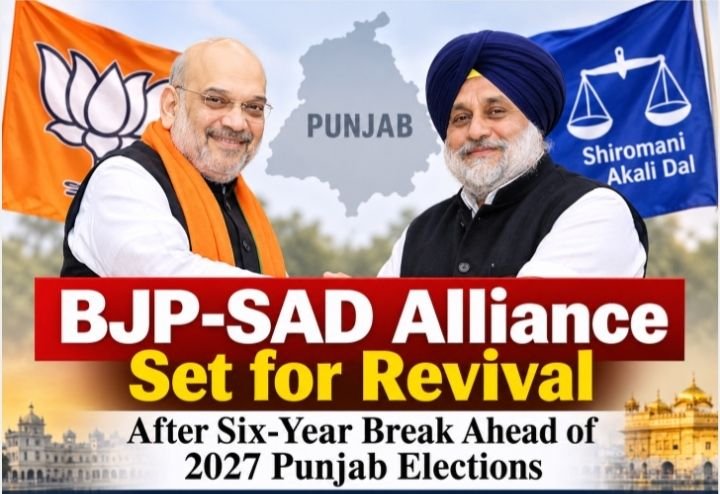
The Bharatiya Janata Party (BJP) and the Shiromani Akali Dal (SAD) are set to revive their long-standing political partnership ahead of the 2027 Punjab Assembly elections, marking a significant realignment in the state’s political landscape. The two former allies, who parted ways in September 2020 over the Centre’s three controversial farm laws, are moving towards a formal reunion after months of negotiations.
Union Home Minister Amit Shah, BJP national president Nitin Nabin and Shiromani Akali Dal president Sukhbir Singh Badal are expected to jointly announce the alliance at the BJP headquarters in New Delhi. The proposed understanding is being seen as an important development in the BJP’s efforts to strengthen its political position in Punjab and the Akali Dal’s attempt to regain its traditional electoral base.
According to reports, negotiations between the two parties have also covered seat-sharing arrangements for the 117-member Punjab Legislative Assembly. However, the precise seat-sharing formula and other details are yet to be formally announced.
The reunion will bring together two parties that shared power in Punjab for a decade between 2007 and 2017 under the leadership of former Chief Minister Parkash Singh Badal. Their political relationship had remained one of the longest-running alliances in Punjab politics, with the Akali Dal being a key constituent of the BJP-led National Democratic Alliance (NDA).
The partnership collapsed in September 2020 when the SAD withdrew from the NDA in protest against the three farm laws introduced by the Narendra Modi government. Harsimrat Kaur Badal, who was then a Union Minister, also resigned from the Union Cabinet. The subsequent farmers’ agitation and prolonged political confrontation created considerable distance between the two parties. The farm laws were eventually repealed by the Centre.
Electoral Setbacks Prompt Political Reassessment
The electoral performances of both parties in the 2022 Punjab Assembly elections underlined the political challenges they faced after contesting separately.
The Aam Aadmi Party registered a sweeping victory, winning 92 of the state’s 117 Assembly seats. The Akali Dal managed to secure only three seats, while the BJP won two. The results represented a major setback for both former allies and highlighted the difficulty of rebuilding their individual electoral strengths.
Before the separation, the two parties followed an established seat-sharing arrangement in which the SAD contested 94 Assembly constituencies and the BJP fielded candidates in 23. In Lok Sabha elections, the Akali Dal traditionally contested 10 seats, while the BJP contested the remaining three in Punjab.
Whether the old formula will return or the parties will negotiate a revised arrangement remains an important question.
A New Political Equation for Punjab
Speculation about the reunion intensified after Amit Shah repeatedly expressed confidence that the NDA would form the next government in Punjab. His remarks during his recent visits to Delhi and Chandigarh were widely interpreted as signals of renewed political engagement with the Akali Dal.
Sukhbir Singh Badal had also indicated that his party was open to alliances with political forces other than the Congress and the AAP, provided they accepted the Akali Dal’s political ideology.
The proposed reunion could significantly reshape the contest for the 2027 Assembly elections, bringing the ruling AAP, Congress and the revived BJP-Akali Dal combine into a more competitive political battle.
For the BJP, an alliance with the Akali Dal could provide access to the latter’s established rural network and traditional support base, while the SAD could benefit from the BJP’s organisational resources and national political machinery.
However, the two parties will also have to address the political legacy of their separation, particularly the farmers’ movement, which remains an important factor in Punjab’s electoral discourse.
The return of the BJP and Akali Dal to a common political platform could therefore become one of the defining developments in the run-up to the 2027 Punjab Assembly elections. Its actual electoral impact will depend on seat-sharing, leadership coordination and the response of Punjab’s voters.