
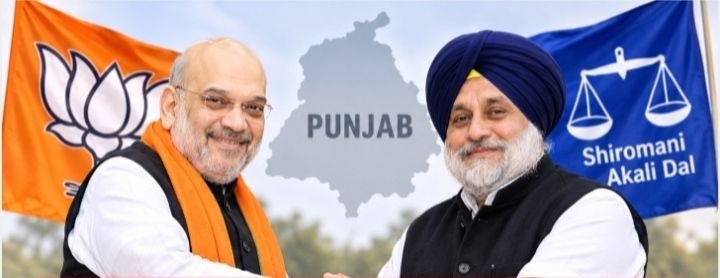
BJP and Akali Dal Revive 24-Year-Old Political Partnership, Join Hands for 2027 Punjab Polls
The Bharatiya Janata Party (BJP) and the Shiromani Akali Dal (SAD) have formally revived their long-standing political alliance, bringing an end to a six-year separation and setting the stage for a renewed electoral contest in Punjab ahead of the 2027 Assembly elections.
The announcement was made in New Delhi on Tuesday in the presence of Union Home Minister Amit Shah, BJP national president Nitin Nabin and SAD president Sukhbir Singh Badal at the BJP headquarters. The reunion marks a significant political development in Punjab, where the two parties had shared power and electoral space for several decades before their relationship broke down over the contentious farm laws in 2020.
The alliance, originally established in 1996, had remained one of the most enduring political partnerships in the state. The two parties governed Punjab together from 2007 to 2017, with the Akali Dal leading the coalition government and the BJP serving as its junior partner.
However, their relationship reached a breaking point in September 2020 when the SAD withdrew from the BJP-led National Democratic Alliance (NDA) in protest against the three farm laws enacted by the Narendra Modi government. The legislation had triggered a massive farmers’ movement, particularly in Punjab and Haryana, creating unprecedented political pressure on the Akali Dal.
The party’s decision to leave the alliance was accompanied by the resignation of its senior leader Harsimrat Kaur Badal from the Union Cabinet, where she was serving as a minister with Cabinet rank. Her resignation underlined the seriousness of the differences between the two former partners. The Centre subsequently repealed the three farm laws in November 2021.
The renewed partnership is expected to have considerable implications for Punjab’s political calculations, particularly as the state moves towards another Assembly election. Both parties will now seek to consolidate their respective organisational strengths and rebuild a common electoral platform after contesting separately in recent elections.
For the BJP, the Akali Dal’s established political network and grassroots presence, particularly in rural Punjab, could prove valuable in expanding its electoral reach. For the SAD, an alliance with the BJP offers an opportunity to strengthen its political position and return to a broader coalition framework.
The reunion also brings back memories of the previous coalition arrangement, under which the Akali Dal contested 94 of Punjab’s 117 Assembly constituencies while the BJP fielded candidates in 23 seats. Whether the parties retain this traditional seat-sharing formula or negotiate a revised arrangement will be closely watched.
The political significance of the development extends beyond the two alliance partners. The ruling Aam Aadmi Party, the Congress and other political forces will have to reassess their electoral strategies in response to the emergence of the revived BJP-SAD combine.
Nevertheless, the challenge for the reunited parties will be to overcome the political differences that led to their separation and rebuild public confidence, particularly among farmers, whose agitation was central to the breakdown of their relationship.
With the alliance now formally announced, Punjab’s political contest for 2027 has entered a new phase. The extent to which the reunion translates into electoral gains will depend on leadership coordination, constituency-level arrangements and, most importantly, the response of voters to the renewed partnership.