Saptrishi Soni

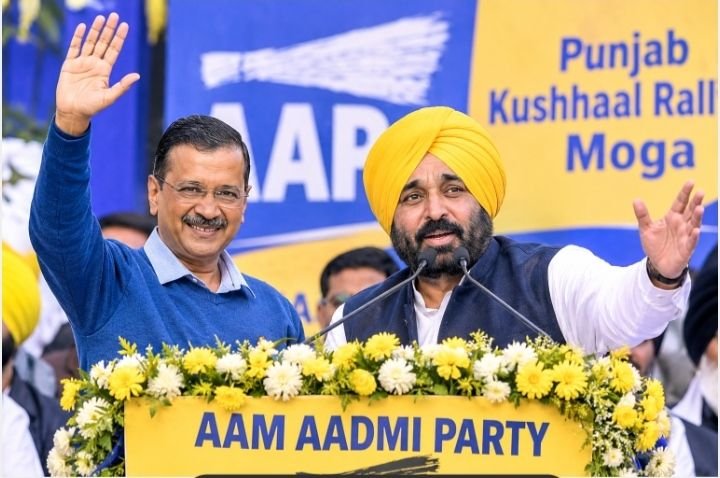
With governance, welfare delivery and an early candidate-selection strategy at the centre of its campaign, AAP seeks to turn five years in power into another electoral mandate in Punjab
MOGA : The political contest for Punjab’s 2027 Assembly elections is beginning to take a more decisive shape, with the Aam Aadmi Party (AAP) choosing Moga as the launchpad for an ambitious statewide campaign aimed at retaining power and establishing itself as a durable political force in the state. The presence of party national convenor Arvind Kejriwal alongside Chief Minister Bhagwant Singh Mann at the Punjab Kushhaal Rally is expected to underline the party’s determination to approach the coming electoral battle with a combination of governance credentials, organisational mobilisation and a renewed political narrative.
More than an ordinary party gathering, the Moga rally represents an important opportunity for AAP to place its five-year record before the electorate, communicate its priorities for the next term and demonstrate that its political influence in Punjab extends beyond the electoral breakthrough of 2022. With the party having already announced candidates for 71 of the state’s 117 Assembly constituencies, its preparations suggest an effort to gain an organisational advantage well before the formal election campaign reaches its peak.
The choice of Moga carries considerable political significance. Situated in the strategically important Malwa region, which accounts for 69 Assembly constituencies, the district offers AAP an opportunity to connect with a large section of Punjab’s electorate. Malwa has historically played a decisive role in determining the state’s political direction, and a strong performance in this region could prove crucial to the party’s prospects of returning to government.
Kejriwal and Mann: A combination of political direction and state leadership
The political importance of the rally also lies in the coming together of Kejriwal and Mann at a crucial stage of the electoral cycle. While Kejriwal remains the principal architect of AAP’s national political identity and its governance-oriented electoral model, Mann has emerged as the party’s most prominent political face in Punjab.
For AAP, maintaining a strong partnership between the two leaders is essential. Kejriwal brings organisational experience, national visibility and the party’s broader political narrative, while Mann provides regional connect, familiarity with Punjab’s political landscape and the advantage of being the incumbent Chief Minister.
The challenge before the party is to translate this leadership combination into a credible and locally rooted election campaign. Punjab’s electorate has its own political expectations, shaped by agrarian concerns, employment, economic conditions, regional identity, law and order and the performance of successive governments. The party will therefore need to demonstrate that its governance approach is not merely an extension of its national political model but is responsive to Punjab’s specific requirements.
Mann’s leadership will be particularly important in this exercise. As the head of the government, he will be expected to defend the administration’s record, respond to criticism and convince voters that another term would allow the government to complete projects and initiatives already under way.
Governance report card becomes the central election narrative
AAP’s strongest opportunity in the coming election lies in presenting a measurable account of what its government has delivered since taking office in 2022.
The party is expected to place particular emphasis on its free electricity scheme, government recruitment, education reforms, healthcare services, canal irrigation and road safety initiatives.
The provision of up to 300 units of free electricity every month to eligible domestic consumers has become one of the government’s most visible welfare measures. AAP leaders claim that nearly 90 per cent of households are receiving zero electricity bills. For ordinary families, this initiative has provided a tangible example of direct financial relief and is likely to remain a prominent component of the party’s campaign.
Employment is another major pillar. The Mann government has announced that more than 78,000 government jobs have been provided on merit. The political importance of this claim lies in the opportunity it offers AAP to address one of Punjab’s most persistent concerns: the migration of young people in search of employment and better economic opportunities.
Education and healthcare could also become important electoral advantages. The expansion of Aam Aadmi Clinics, improvements in government healthcare facilities and the government’s initiatives to strengthen public schools provide the party with an opportunity to appeal to middle-class families, economically weaker households and rural communities.
The government is also expected to highlight the expansion of canal irrigation. According to figures presented by AAP’s leadership, the proportion of agricultural land receiving canal water has increased from approximately 22-23 per cent to nearly 88 per cent. If supported by credible district-wise evidence and visible improvements in agricultural conditions, this could become an important part of the party’s outreach to farming communities.
The establishment of the Sadak Surakhya Force is another initiative that the government can showcase as a distinctive intervention in public safety. The administration has cited a significant reduction in road accident fatalities as evidence of its impact.
The effectiveness of these initiatives, however, will ultimately be judged by voters through their everyday experiences rather than political presentations alone.
Early candidate announcements: An attempt to gain electoral advantage
One of the most significant aspects of AAP’s preparations is its early announcement of candidates. The party has declared nominees for 71 constituencies in two lists, indicating that it wants its prospective candidates to begin connecting with voters well before the election schedule is announced.
This approach offers several advantages. Candidates receive additional time to establish their local presence, assess constituency-level concerns, mobilise workers and communicate the government’s achievements. It also allows the leadership to identify organisational weaknesses and address internal disagreements before the campaign enters its decisive phase.
However, early announcements also create expectations and responsibilities. Candidates must demonstrate their local acceptability, maintain coordination with party workers and remain accessible to constituents. The success of this strategy will depend on whether the party can convert early announcements into sustained grassroots engagement.
AAP’s 2022 victory, when it secured 92 of Punjab’s 117 Assembly seats, demonstrated its ability to build an extraordinary statewide political wave. Repeating that performance will be difficult, but the party’s early organisational preparations indicate that it is taking the next election seriously.
The opposition challenge: A more competitive political landscape
The 2027 election is unlikely to resemble the relatively one-sided contest that AAP dominated in 2022. The political landscape has evolved, and the ruling party will face challenges from several established political forces.
The Congress remains a significant contender, with an established organisational presence and the ability to mobilise voters around issues concerning governance, economic management and public accountability. Its ability to maintain internal unity and project credible leadership will influence the intensity of the contest.
The renewed political understanding between the Shiromani Akali Dal and the BJP has added another dimension to the electoral equation. Their combined political resources, organisational networks and attempts to reconnect with traditional voter groups could create a more challenging environment for AAP, particularly in constituencies where anti-incumbency sentiment develops.
The Akali Dal will seek to rebuild its traditional support among sections of the rural electorate, while the BJP is expected to concentrate on strengthening its independent organisational base and expanding its political appeal.
Other political formations, including Waris Punjab De, could also influence electoral calculations in selected constituencies, particularly where regional identity, religious sentiment and local political issues become decisive.
For AAP, the principal challenge will be to prevent opposition parties from consolidating public dissatisfaction into a broader anti-incumbency movement.
Can AAP overcome anti-incumbency?
This is arguably the most important question facing the ruling party.
After nearly five years in office, AAP cannot rely exclusively on the enthusiasm and expectations that accompanied its historic 2022 victory. Every incumbent government faces questions about promises fulfilled, commitments still pending and public expectations that have grown during its tenure.
Punjab’s financial position, industrial development, private-sector employment, farmers’ concerns, drug trafficking, gangster-related crime, law and order and the future of young people will remain central issues in the electoral debate.
The opposition is likely to focus on these concerns to challenge the government’s claims of transformation. AAP, meanwhile, will need to explain what has changed, what remains incomplete and how a second term would address the state’s long-standing structural problems.
The party’s strongest response could be a credible second-term development agenda rather than a campaign based entirely on defending its past performance.
Women, youth and farmers: The decisive electoral constituencies
AAP’s electoral prospects will also depend on how effectively it addresses three important sections of Punjab’s population: women, young voters and farmers.
Women voters have become increasingly influential in electoral outcomes across India. The government’s proposed and announced welfare commitments concerning women could provide AAP with an opportunity to strengthen its support among female voters. The credibility of these commitments, their implementation and the government’s ability to explain their financial sustainability will matter greatly.
For young people, the central concerns are employment, entrepreneurship, education, skill development and opportunities to build a future within Punjab. Government recruitment figures may help the party, but the larger challenge is creating a broader economic environment in which private investment and employment opportunities expand.
Farmers will remain equally important. Irrigation, groundwater conservation, crop diversification, agricultural profitability, procurement arrangements and the financial sustainability of farming are issues that cannot be addressed through political slogans alone. AAP’s performance in improving canal irrigation gives it an argument to present, but farmers will expect a comprehensive agricultural roadmap.
Moga: A political message beyond the rally stage
The scale of the Moga gathering will certainly attract attention, but its political significance will be determined by what follows.
AAP is attempting to communicate three messages through this rally: that the Mann government has a substantial record to defend, that its organisation is preparing well in advance and that the party leadership remains united behind a second-term ambition.
The gathering also provides an opportunity to bring announced candidates, ministers, legislators and grassroots functionaries onto a common platform. Such coordination will be necessary in a state where constituency-level equations, local leadership and personal voter connections frequently influence electoral outcomes.
At the same time, the rival parties will be closely examining the political signals emerging from Moga. The SAD-BJP alliance’s planned campaign mobilisation in the district further underlines the importance of this region in the emerging electoral contest.
AAP’s winning possibilities: A credible road to another mandate
AAP enters the 2027 election preparations with several advantages. It has the benefit of incumbency, an established statewide organisational structure, a Chief Minister with regional recognition, a visible welfare agenda and an early start in candidate selection.
Its 2022 electoral performance also demonstrated that the party can attract voters across traditional political divisions when it successfully combines public dissatisfaction with a compelling alternative.
The biggest opportunity for AAP is to make the election a comparison between its governance record and the performance of previous governments. If the party can establish that improvements in electricity relief, public education, healthcare access, employment and irrigation have made a meaningful difference to people’s lives, it could enter the electoral contest with a strong narrative.
But a second victory will require more than repeating the promises and political language of 2022. The party must show that it has addressed public concerns that have emerged during its tenure, maintained administrative accountability and delivered progress on the economic challenges confronting Punjab.
Its ability to maintain unity, select acceptable candidates, manage local dissatisfaction and respond effectively to the opposition’s campaign will be equally important.
The road to 2027
The Moga rally marks the beginning of a defining political phase for AAP in Punjab. For Arvind Kejriwal, the election will be an important test of whether the party’s governance model can sustain electoral support beyond its initial breakthrough. For Bhagwant Mann, it will be a personal test of leadership, administrative performance and his ability to secure another mandate on the strength of his government’s record.
The coming months will determine whether AAP can transform its welfare initiatives and organisational preparations into a broader political consolidation.
The party has a credible opportunity to remain a leading contender and potentially retain power. Its chances will be strongest if it combines the achievements it can demonstrate with a convincing response to the problems that remain unresolved.
Ultimately, Punjab’s voters will decide whether the Mann government deserves another term. The Moga rally may set the tone, but the verdict in 2027 will depend on governance, public confidence, candidate credibility and the ability of political leadership to translate promises into lasting improvements in people’s lives.