Saptrishi Soni।
The Punjab government’s decision to constitute a Special Investigation Team (SIT) to probe the disappearance of 328 sacred saroops of the Guru Granth Sahib has once again pushed the sensitive intersection of faith and politics to the centre of the state’s public discourse. What Chief Minister Bhagwant Mann describes as a moral and administrative necessity is simultaneously being viewed as a decisive political statement — one that challenges long-entrenched religious and political power structures in Punjab.
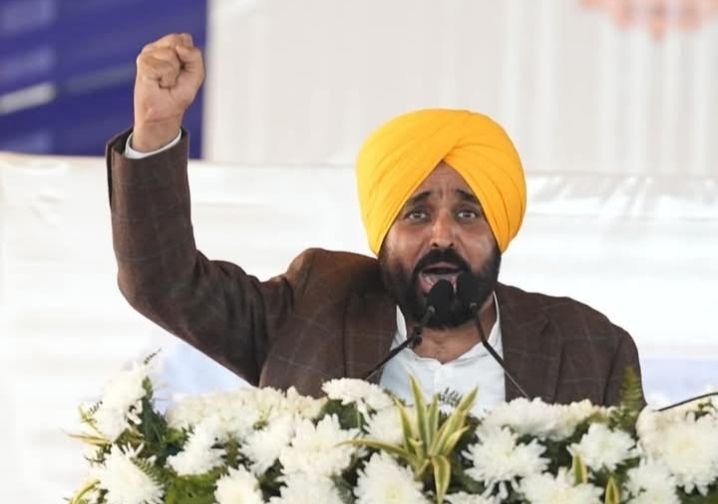
Speaking at a public gathering in Majitha, Mann made it clear that the investigation, in his view, was unavoidable. By directly holding the Shiromani Akali Dal and the Shiromani Gurdwara Parbandhak Committee (SGPC) responsible for what he termed as institutional failures, the Chief Minister has opened a fresh front against Punjab’s traditional custodians of Sikh religious management. His assertion that the government has “no intention of interfering in religious institutions” is meant to reassure the faithful, but it also underscores the fine line his administration is attempting to walk.
At the heart of the matter lies a deeply emotional issue. The missing saroops are not merely documents or artefacts; for Sikhs, they embody the living Guru. Any lapse in their safeguarding inevitably provokes outrage, grief and a demand for accountability. In that sense, the Mann government’s decision to order an SIT can be seen as a long-overdue attempt to address a wound that previous governments appeared reluctant to confront decisively.
Yet, the political ramifications are impossible to ignore. By publicly reaffirming the supremacy of Sri Akal Takht Sahib and recalling his decision to prioritise appearing before the Takht over attending a presidential event, Mann has carefully positioned himself as a leader who claims moral allegiance to Sikh institutions over constitutional symbolism. This messaging resonates strongly with sections of the Sikh electorate that have long accused political parties of selectively invoking religious sentiment for convenience.
The Chief Minister’s criticism of the Akalis goes beyond administrative lapses. By alleging that jathedars were appointed and removed arbitrarily in the past, he is questioning the very credibility of religious governance under previous regimes. This is a serious charge, one that challenges decades of Akali dominance over Sikh institutions. For Mann, it is also a calculated political move aimed at eroding the Akalis’ traditional support base ahead of the 2027 Assembly elections.
However, the government’s approach is not without risks. Any investigation involving religious institutions, no matter how well-intentioned, invites suspicion. Critics argue that unless handled with complete transparency and restraint, the SIT could be perceived as an attempt to assert state control over religious bodies. The success of this move will therefore depend less on rhetoric and more on outcomes — whether the investigation is credible, impartial and delivers tangible results.
The announcement of AAP leader Talbir Singh Gill as the party’s candidate from Majitha further highlights how governance decisions and electoral strategy are increasingly intertwined. By projecting AAP as a force of “new politics,” Mann is drawing a sharp contrast with what he describes as politics of entitlement and intimidation. The message is clear: Punjab’s politics, according to AAP, must move from dominance by institutions and families to accountability-driven representation.
From a broader perspective, the SIT decision reflects AAP’s attempt to redefine political legitimacy in Punjab. The party is seeking to portray itself as both respectful of religious traditions and uncompromising on administrative accountability — a difficult balance to maintain in a state where faith deeply influences political behaviour.
The outcome of this move will have lasting implications. If the SIT succeeds in tracing the missing saroops or fixing responsibility through a transparent process, it could significantly enhance the Mann government’s moral authority. Failure, delay or perceived political misuse, on the other hand, may reinforce skepticism and deepen polarisation.
As Punjab moves closer to the next electoral cycle, the handling of this issue will test not only the credibility of the AAP government but also the evolving relationship between faith, institutions and political power in the state. The question now is not just about what happened to the missing saroops, but whether Punjab’s politics can finally deliver accountability without turning faith into a battlefield.