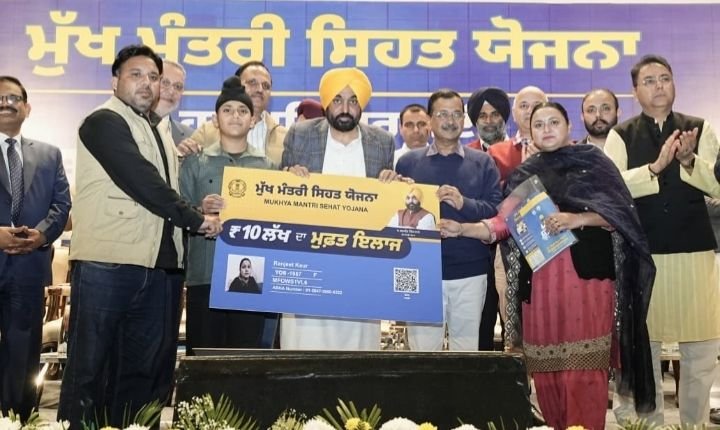
In a landmark move that reshapes the social welfare landscape of the country, the Aam Aadmi Party (AAP) government in Punjab has formally rolled out the *Mukh Mantri Sehat Yojna (MMSY)*, guaranteeing free medical treatment up to ₹10 lakh for every family in the state. Launched in Mohali by AAP National Convenor Arvind Kejriwal and Chief Minister Bhagwant Singh Mann, the scheme brings both government and premium private hospitals within reach of even the poorest citizens, signalling a decisive shift in the philosophy of public healthcare delivery.
With the implementation of MMSY, Punjab has emerged as the first state in India to simultaneously ensure free healthcare, free education, free electricity and free bus travel for women. On the occasion, Arvind Kejriwal and CM Bhagwant Singh Mann distributed health cards to beneficiaries, symbolising what the AAP leadership described as the fulfilment of a key electoral guarantee and a moral commitment to the people.
Addressing the gathering, Arvind Kejriwal described the launch as not merely a historic day for Punjab but a moment of national significance. He remarked that such a welfare-oriented step should ideally have been taken decades ago, soon after Independence. According to him, the freedom struggle was not fought so that Indian governments could replace the British and then fail to deliver basic necessities to citizens. For Kejriwal, MMSY represents a long-overdue correction in governance priorities.
Reflecting on the political history of the past 75 years, the AAP leader argued that successive governments made tall promises but neglected the common people. Punjab, he said, witnessed phases of militancy and later a devastating drug crisis, both of which left deep scars on society. However, he asserted that the period under the AAP government would be remembered as a turning point, one that future generations would recall as a golden phase in Punjab’s history.
Kejriwal recalled the scepticism his party faced during election campaigns when it promised free electricity, education and healthcare. At that time, opposition parties, particularly the then Congress government led by Captain Amarinder Singh and later Charanjit Singh Channi, repeatedly claimed that the state treasury was empty and that such guarantees were financially impossible. Today, he said, the AAP government has demonstrated that political will and honest governance can convert promises into reality.
Highlighting progress in the healthcare sector over the past four years, Kejriwal pointed out that the government has already built around 1,000 mohalla clinics across villages and urban neighbourhoods, with another 500 under construction. He noted that while previous governments collectively established only about 400 primary health centres in 75 years, the current administration has surpassed that many times over in a short span. In the coming months, he added, around 2,500 ‘Pind Clinics’ will be opened to ensure last-mile healthcare access in rural Punjab.
Contrasting the condition of earlier government health centres with the new facilities, Kejriwal said many old centres remained locked or non-functional, while the new mohalla clinics are well-equipped, air-conditioned and staffed with doctors. He claimed that patients visiting these clinics often feel as if they are entering private healthcare facilities rather than government institutions.
The AAP convenor also highlighted structural improvements in government hospitals, stating that more than 1,100 specialist doctors have been recruited in the past four years, addressing chronic staff shortages. Diagnostic machines have been installed and made functional, free medicines are now readily available, and hospital infrastructure has been upgraded to restore public confidence in state-run healthcare.
Explaining the rationale behind MMSY, Kejriwal acknowledged that serious illnesses often force families to seek private treatment, pushing them into crippling debt. Under the new scheme, even the most expensive private hospitals in Punjab—earlier accessible only to the affluent—will now treat farmers, labourers and daily wage earners without charging them a single rupee, up to the ₹10 lakh limit.
He spoke emotionally about farmers who toil in extreme conditions to feed the nation but are forced to sell land, jewellery or homes when a family member falls ill. With private hospitals often charging ₹2–3 lakh even for basic procedures, healthcare emergencies frequently result in financial ruin. MMSY, he said, is designed to break this cycle of poverty and illness.
Under the scheme, treatment for both minor and major ailments, including medicines and diagnostic tests, will be cashless. Patients need only present their health card upon admission. The coverage extends to approximately 65 lakh families—nearly three crore people—across all religions, castes and income groups, with no eligibility conditions or exclusions. Kejriwal emphasised that this universality sets MMSY apart from most government welfare schemes.
Turning to governance and law enforcement, Kejriwal drew comparisons with previous administrations, alleging that Punjab was once overwhelmed by drugs, with influential political figures allegedly involved in the trade. He claimed that the AAP government has shown unprecedented courage by taking action against corrupt elements, even when such steps invited political backlash in the name of human rights.
According to him, opposition parties express concern for human rights only when criminals are arrested, not when ordinary citizens suffer due to drugs, extortion or gang violence. He urged voters to remain vigilant, warning that returning such parties to power could revive the dark chapters of Punjab’s recent past.
In a broader political context, Kejriwal argued that AAP’s rise represents an unusual phenomenon in Indian politics—a party led by individuals without vast personal wealth or dynastic backing. He credited the party’s success to public support and divine grace, stating that even progressive schemes like MMSY would face opposition simply because they disrupt entrenched political and economic interests.
He appealed to opposition leaders to rise above partisan politics and acknowledge good governance, noting that the scheme would benefit their own families as well. AAP, he stressed, has imposed no political or ideological filters on healthcare access.
Chief Minister Bhagwant Singh Mann, addressing the gathering, described MMSY as a scheme inspired by the teachings of the Gurus and rooted in the principle of sarbat da bhala—welfare of all. He confirmed that health cards will be issued to all 65 lakh families in Punjab, with no income ceiling, making it the first such universal healthcare initiative in the state.
The Chief Minister explained that government employees, pensioners and all other residents are eligible. Health cards can be obtained through facilitation centres, Common Service Centres or online registration using Aadhaar or voter ID. Youth volunteers will also assist in door-to-door registration. Currently, around 850 government and private hospitals have been empanelled, with more to be added.
Mann highlighted that the scheme now covers over 2,356 treatment packages, including specialised services such as cardiology, oncology, neurology, nephrology, orthopaedics, maternity care, emergency services, organ transplants and major surgeries. Diagnostic services are also included, and hospitals will be reimbursed within 15 days to ensure smooth functioning.
Placing MMSY in a wider governance framework, Mann pointed out that Punjab under AAP has focused on citizen-centric reforms—Aam Aadmi Clinics, Schools of Eminence, over 61,000 government jobs for youth, free electricity to 90 percent households and improved water supply. As the government completes four years in office, he said, such initiatives demonstrate a commitment to social justice and inclusive growth.
From a political standpoint, the launch of MMSY carries significant implications. At a time when the central government’s policies are under scrutiny on economic and social fronts, AAP’s universal healthcare model positions the party as a strong alternative rooted in welfare politics. Socially, the scheme promises dignity and security to millions; economically, it reduces catastrophic health expenditure and prevents families from slipping into poverty.
As Punjab moves towards the next Vidhan Sabha elections, MMSY is likely to play a pivotal role in shaping public opinion. By directly addressing one of the most pressing anxieties of ordinary households—healthcare costs—the AAP government has not only delivered on a major promise but also strengthened its claim of governance focused on people rather than power.