Saptrishi Soni
With the Punjab Assembly elections still two years away, the Congress high command has already been forced to step in to contain growing factionalism within its state unit, a development that underlines deep structural and leadership challenges facing the party. A recent meeting of the Congress Political Affairs Committee (PAC) in New Delhi made it clear that internal groupism, public dissent and competing power centres in Punjab are emerging as serious worrying factors for the party’s revival plans ahead of the 2027 Vidhan Sabha elections.

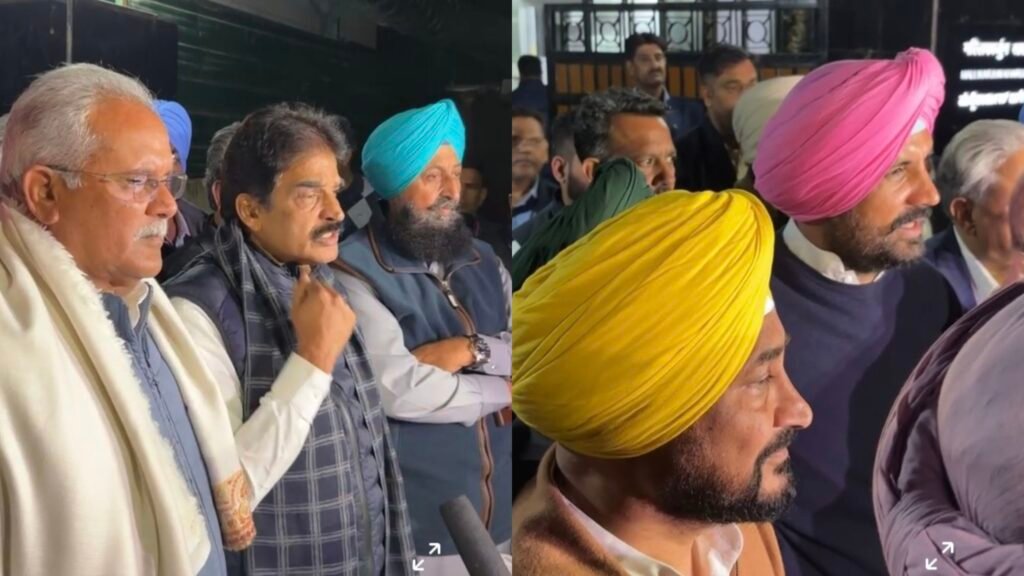
The high command’s warning came amid visible strains among senior Punjab Congress leaders, triggered largely by public statements and political positioning by former Chief Minister Charanjit Singh Channi. Channi’s remarks seeking greater representation for Dalits within the party’s organisational and political structure have sparked a fresh controversy, reopening fault lines that the party leadership has struggled to manage since its defeat in the 2022 Assembly elections.
The PAC meeting, chaired by Congress president Mallikarjun Kharge and attended by Rahul Gandhi, AICC general secretary KC Venugopal, Punjab in-charge Bhupesh Baghel, Ambika Soni and senior Punjab leaders, sent out an unambiguous message: public posturing, group mobilisation and indiscipline will not be tolerated. The leadership clarified that there would be no immediate change in the Punjab Congress leadership, but made it equally clear that concerns must be raised only through internal channels and not aired in public.
Punjab Congress president Amarinder Singh Raja Warring, Leader of Opposition Partap Singh Bajwa, former Chief Minister Charanjit Singh Channi, Rana KP Singh, Sukhjinder Singh Randhawa, Vijay Inder Singla and Dr Amar Singh were among those present. The very composition of the meeting reflected the complex factional balance within the state unit, where at least five distinct camps are believed to be operating, often at cross purposes.
At the heart of the latest unrest lies Channi’s push for what he describes as adequate Dalit representation. While the issue of social justice resonates deeply in Punjab’s political discourse, the timing and manner of Channi’s intervention have raised eyebrows within the party. His statements have been interpreted by rivals as an attempt to carve out a distinct political constituency ahead of 2027, rather than strengthening collective party strategy.
Raja Warring, in particular, has reportedly taken strong exception to Channi’s public remarks, cautioning that such debates, when played out in the media, damage the party’s image and distract from the core task of taking on the ruling Aam Aadmi Party. Senior leaders during the PAC meeting expressed displeasure over what they termed an “unwarranted controversy”, warning that repeated public disagreements could weaken the party’s organisational cohesion at a critical juncture.
The unease within the high command has been compounded by a recent episode in which around 30 to 40 Punjab Congress leaders reportedly came together to seek a collective meeting with the central leadership. While KC Venugopal later clarified that there was nothing wrong in individual leaders seeking time with the leadership, he made it clear that letters or representations signed as a group would not be acceptable. The message was unmistakable: factional pressure tactics will only deepen mistrust, not resolve internal issues.
This episode highlights the Congress party’s central dilemma in Punjab. Despite having a broad social base and a history of governance, the party continues to struggle with internal unity. Multiple power centres — ranging from former chief ministers and state presidents to prominent legislators and organisational leaders — are vying for influence. Instead of converging around a common political narrative, these leaders often appear more focused on consolidating their individual standing.
For the Congress high command, the stakes are high. The Aam Aadmi Party government, despite facing criticism on issues such as law and order and drugs, has rolled out major welfare initiatives that are reshaping political narratives in the state. In contrast, the Congress risks being perceived as inward-looking and divided, a perception that could severely undermine its electoral prospects if not addressed swiftly.
Punjab’s political history shows that unity within the party has often been the decisive factor in electoral success. The current phase, however, is marked by a leadership vacuum in terms of a single, widely accepted face who can galvanise cadres and voters alike. While Raja Warring is tasked with organisational revival, leaders like Channi, Bajwa and others command their own followings, making consensus-building a delicate exercise.
The high command’s intervention should therefore be seen as both a warning and an opportunity. By drawing a firm line against indiscipline, the central leadership is attempting to reassert control and push the Punjab unit towards a more disciplined, election-focused mode. At the same time, it recognises the need to balance competing social and political aspirations, particularly on sensitive issues like representation and inclusion.
As the 2027 elections approach, the Congress party’s chances in Punjab will largely depend on its ability to convert internal diversity into collective strength. If factionalism continues unchecked, it could further fragment the party’s vote base and organisational machinery. However, if the leadership succeeds in forging unity, aligning state leaders behind a common programme and credible alternative vision, Congress could still position itself as a serious challenger.
For now, the infighting within the Punjab Congress remains one of the biggest concerns for the high command. The coming months will test whether the party can move beyond internal power struggles and focus on reconnecting with voters, or whether divisions will continue to erode its political standing at a time when electoral revival is both urgent and uncertain.