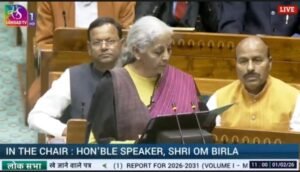
On February 1, 2026, Finance Minister Nirmala Sitharaman presented India’s Union Budget for 2026–27, outlining a forward-looking economic blueprint focused on growth, infrastructure, manufacturing, fiscal discipline, and global competitiveness. This budget is being positioned by the government as a strategic step toward a “Viksit Bharat” (Developed India), with clear priorities that aim to balance immediate economic needs with long-term resilience and self-reliance.

Below is a detailed, holistic assessment of every major aspect of the budget, its implications for different sectors, its people-centric elements, and its political and economic impact.
Growth and Macroeconomic Outlook
The Union Budget 2026 maintains a strong growth-oriented stance amid global uncertainties and domestic economic challenges. The government projects a robust growth trajectory, with nominal GDP growth estimated around 10 percent and the overall economy expected to expand between 6.8 percent and 7.4 percent in the coming fiscal year.
Fiscal discipline remains central, with the fiscal deficit targeted at 4.3 percent of GDP, slightly lower than the previous year, signaling a commitment to responsible public finances while still enabling expansionary investment.
This balance aims to reassure investors, international partners, and rating agencies that India can pursue development without compromising macroeconomic stability.
Infrastructure Development: A Core Engine of Growth
Infrastructure expenditure is clearly at the heart of the budget’s strategy. The total capital expenditure (capex) has been raised to ₹12.2 lakh crore, an increase of nearly 9 percent, reinforcing the government’s belief that public investment in infrastructure is critical for jobs, logistics, and broader economic growth.
Key infrastructure priorities include:
* Seven high-speed rail corridors connecting major cities across regions to boost connectivity and sustainable transport.
* Development of freight corridors and enhanced logistics networks, reducing transport costs and improving supply chain efficiency.
* Expansion of national waterways and inland shipping, cutting logistics costs and creating new economic hubs.
* City Economic Regions (CERs) with dedicated funding to transform tier-2 and tier-3 cities into growth engines.
These steps reflect a clear intention to decentralize growth and link economic prosperity to infrastructure that supports industry, agriculture, tourism, and urbanization.
Manufacturing and Self-Reliance
Boosting domestic manufacturing is a central theme of Budget 2026:
* India Semiconductor Mission 2.0 with ₹40,000 crore outlay: This program is designed to build a full semiconductor ecosystem, decrease import dependence, and position India as a global technology hub.
* Revival of industrial clusters: A plan to modernize 200 legacy clusters focused on technology, competitiveness, and job creation.
* Support for high-value manufacturing sectors including biopharma, electronics, chemical parks, container manufacturing, and rare earth processing, encouraging import substitution and export competitiveness.
This push supports Prime Minister Narendra Modi’s broader ‘self-reliant India’ vision while creating globally competitive supply chains.
Small and Medium Enterprises (SMEs / MSMEs)
Recognizing the MSME sector as a backbone of employment and entrepreneurship, the budget announced several notable measures:
* A dedicated ₹10,000 crore SME Growth Fund to help promising firms scale up.
* A ₹2,000 crore top-up to the Self-Reliant India Fund to support micro enterprises.
* Expansion of the TReDS platform and mandatory participation by central enterprises to improve liquidity and working capital.
* Introduction of “Corporate Mitras” to help small businesses navigate compliance and regulatory processes.
These initiatives, if effectively implemented, are expected to reduce financial stress for small businesses, generate jobs, and broaden economic participation beyond large urban centers.
Taxation and Market Reforms
The budget made several structural tax and regulatory changes:
* Increase in Securities Transaction Tax (STT) on derivatives, which has already caused market volatility as investors reacted to higher trading costs.
* Simplification of income tax rules, with plans to implement a new Income Tax Act from April 1, 2026 to further ease compliance and documentation.
* Tax holiday until 2047 for foreign companies offering cloud services through India-based data centers, to attract global investment and strengthen the digital economy. ([The Sunday Guardian][5])
* Reduced TCS (tax collected at source) on overseas education and travel remittances, easing financial burden on middle-class families.
These changes reflect a mix of market reform, investor confidence building, and targeted relief for specific sectors.
Agriculture and Rural Economy
While not the headline, the budget includes tech-driven support for agriculture:
* Use of AI tools to assist farmers with pest control, weather forecasting, and crop planning.
* Schemes to promote high-value crops such as cashew, cocoa, and walnuts, aiming to increase farm incomes.
However, some analysts note that major direct subsidies for farmers or significant increases in MSP (minimum support price) are absent, suggesting limited short-term relief for agricultural communities.
Social and Quality-of-Life Measures
The budget also highlighted people-centric provisions, including:
* Incentives for tourism and hospitality, including training programs and hospitality institutes.
* Major tourism infrastructure development to boost local economies and employment.
However, critics argue that many of these benefits will be long-term and may not immediately translate into relief for low-income households.
Sectoral and Regional Impacts
Industries likely to benefit:
* Infrastructure and construction (roads, rail, shipping)
* High-technology manufacturing (semiconductors, electronics)
* Biopharma and healthcare products
* SMEs and cluster-based manufacturing
Markets have reacted unevenly: financial markets have shown anxiety over the STT hike, but capital goods and infrastructure stocks gained on higher capex expectations.
States and regions: The budget reinforces the 41 percent share of states in the common tax pool for 2026–31, a positive for fiscal federalism. However, some states with disaster vulnerability, high service delivery costs, or special category status have voiced concerns about insufficient targeted support.
Political and Public Perception Impact
The 2026 budget’s focus on structural reforms and investment is likely to resonate with business communities and global investors, but its lack of direct subsidies or immediate tax cuts for the middle class and farmers may lead to debate over whether it is truly a “people’s budget.” Its timing—amid global economic uncertainty and geopolitical tensions—suggests a strategic emphasis on long-term competitiveness over short-term populist measures.
Prime Minister Narendra Modi has lauded the budget as “historic” and a key step toward achieving India’s developmental vision by 2047.
At the same time, critics and opposition voices may highlight areas where relief was minimal, such as direct tax cuts, immediate rural support, or enhanced social sector spending.
Overall Evaluation
Budget 2026–27 is a strategic, investment-driven blueprint focused on infrastructure, manufacturing, technology, and fiscal discipline. It’s aimed at positioning India for resilient and sustainable growth, enhancing global competitiveness, and catalyzing large-scale economic transformation.
Its strengths lie in capital expenditure focus, manufacturing push, SME support and regulatory reforms.
Its limitations may be seen in immediate relief for farmers, direct tax benefits for the middle class, and targeted support for economically weaker regions.
In essence, this budget signals a long-term vision more than short-term populism, balancing ambition with fiscal prudence as India charts its path toward becoming a developed economy.