
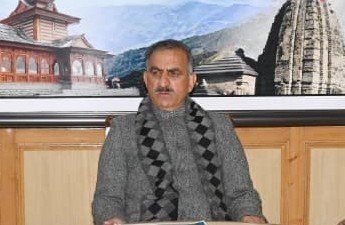
Shimla: Emphasising the growing importance of environmental conservation in the face of climate change, Himachal Pradesh Chief Minister Thakur Sukhvinder Singh Sukhu has directed the Forest Department to prepare a comprehensive and time-bound roadmap to increase the State’s forest cover to 31 percent by the year 2030. The directive was issued while presiding over a high-level review meeting of the Forest Department in Shimla on Monday.
The Chief Minister noted that Himachal Pradesh currently has a forest cover of around 29.5 percent, which must be enhanced through a well-planned, scientific and sustainable approach. He underlined that global warming has emerged as a serious worldwide challenge and its impacts are increasingly visible in fragile hill ecosystems such as Himachal Pradesh. Protecting and expanding forest cover, he said, is critical not only for environmental balance but also for safeguarding water sources, biodiversity and the livelihoods of people dependent on forest resources.
Chief Minister Sukhu pointed out that nearly 16,376 square kilometres of the State’s geographical area is either snow-covered, barren or highly mountainous, where plantation is not feasible. In view of this limitation, he directed the Forest Department to identify district-wise potential areas suitable for plantation and to prepare a phased and realistic plantation plan. He stressed that afforestation efforts should prioritise native tree species, fruit-bearing plants and species with medicinal value to strengthen ecological sustainability while also supporting local livelihoods.
Highlighting a balanced approach, the Chief Minister said that the focus should not be limited to creating new forest areas alone. Equal attention must be paid to the protection and rejuvenation of existing forests, which are under pressure due to climate stress, human activity and natural degradation. He emphasised that meaningful and lasting conservation is possible only when local communities are actively involved in forest management and protection.
Referring to community-based initiatives, Sukhu said that the State Government has launched the Rajiv Gandhi Van Samvardhan Yojana to promote people’s participation in plantation and conservation activities. Under the scheme, plantation was carried out over 924.9 hectares during the previous year with the active involvement of grassroots institutions. A total of 285 Mahila Mandals, 70 Yuvak Mandals, 59 Self Help Groups and 13 community-based organisations contributed to the programme, reflecting strong public engagement.
The Chief Minister said that under the scheme, the State Government is providing financial assistance of Rs 2.40 lakh for plantation over two hectares to participating groups. In addition, annual incentives linked to the survival rate of plantations are being offered to encourage long-term care and protection of saplings. He noted that the scheme has received an encouraging response from local communities and has emerged as a key pillar of Himachal’s forest conservation strategy.
Looking ahead, Sukhu informed that a target has been set to undertake plantation over 5,000 hectares in the next financial year under the Rajiv Gandhi Van Samvardhan Yojana. Of this, 3,376 hectares have already been identified, while the process of identifying the remaining 1,624 hectares is currently underway. He reviewed the progress of other forestry and conservation schemes being implemented across the State and called for improved coordination, monitoring and outcome-based planning.
Senior officers, including Additional Chief Secretary K.K. Pant, Principal Chief Conservator of Forests and Head of Forest Force Sanjay Sood, along with other senior officials of the Forest Department, were present during the meeting.
The State Government’s renewed push to enhance forest cover reflects Himachal Pradesh’s growing recognition of forests as a vital shield against climate change, natural disasters and ecological imbalance, while reinforcing the role of communities as partners in conservation.