
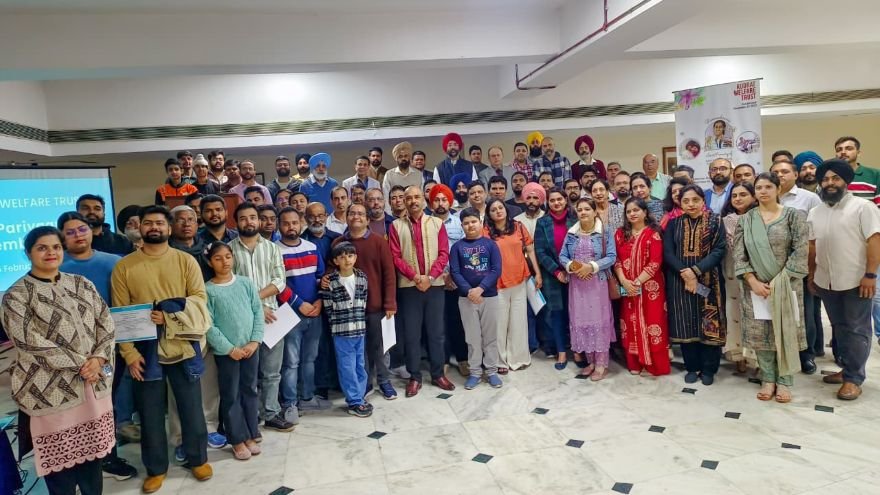
Chandigarh Tricity witnessed a deeply moving and socially significant gathering as Kudrat Welfare Trust organized a commemorative programme on the 20th birth anniversary of Late Kudrat Kaur, who tragically lost her life in a road accident in Mohali in December 2019. What began as a personal remembrance evolved into a collective reaffirmation of humanitarian service, bringing together voluntary blood donors, medical professionals, advocates, social workers and members of the Kudrat Parivaar.
The event was not merely ceremonial; it reflected a conscious effort to transform grief into purposeful public service. Chairperson G.S. Ahluwalia shared how the unbearable silence following the family’s loss gradually turned into a commitment to serve society. During the COVID-19 crisis, the family began assisting patients in arranging oxygen cylinders, medicines and urgent medical support, laying the foundation for an organized social initiative.
On July 7, 2021, a WhatsApp-based donor coordination group was created to connect voluntary blood donors with patients in need. As participation increased and more compassionate individuals joined hands, the initiative expanded in scale and structure. It was formally registered as a public charitable trust on December 22, 2022. Today, Kudrat Welfare Trust operates as a responsive network of voluntary blood donors, referred to as “Raktveers,” alongside sevadars and professionals who provide emergency medical support across Chandigarh, Mohali and Panchkula. The Trust also extends assistance to families arriving from other states who often face medical crises without local support systems.

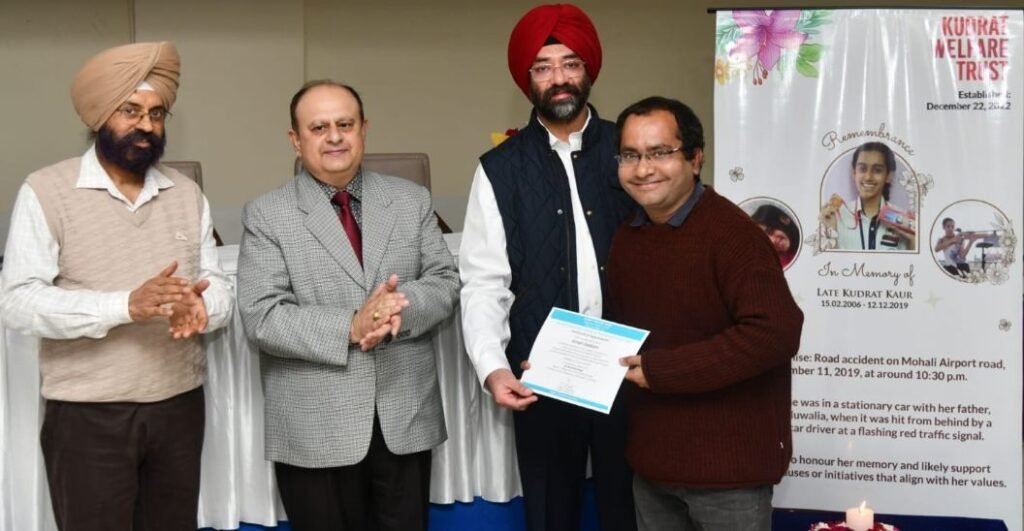
During the programme, Volunteer Sourabh Rana highlighted the Trust’s measurable impact. In 2025 alone, 565 blood and platelet donations were coordinated across the Tricity region. Many beneficiaries were families from distant regions who had no attendants in the city but received timely support through the Trust’s network. Rana also revealed that the organization intervened in an extortion attempt in which money was demanded in the name of arranging a blood donor. Two police complaints were filed in 2025 against fraudulent operators exploiting emergency situations. The Trust has since strengthened its verification protocols to safeguard both patients and donors from exploitation.
Medical professionals attending the event underscored the importance of voluntary blood donation. Dr. Suchet Sachdev emphasized that blood cannot be manufactured and that society must take collective responsibility for ensuring adequate supply through voluntary contribution. He noted that while forming a trust is administratively simple, earning public trust requires sustained credibility, transparency and ethical functioning. He described the Trust’s journey as an example of how responsibility belongs not to an individual but to the community at large.
Dr. Sumit Rajpal recalled his personal memories of Kudrat Kaur and shared that he had rushed to the hospital upon hearing about the accident in 2019. He appreciated the humanitarian transformation that followed and informed attendees that he, along with a group of twelve friends, is currently supporting 18 thalassemia patients who require regular blood transfusions. He reiterated that consistent voluntary donation remains essential for such patients whose survival depends on timely blood availability.
The programme also addressed the growing concern of fraud and intimidation in the blood donation ecosystem. Social worker Lakhvir Singh Choudhary cautioned citizens against emotional manipulation and monetary exploitation carried out under the pretext of urgent blood requirements. He stressed that genuine help does not demand forced payment and urged families to verify requests carefully before acting. He further appealed to hospitals to establish clear verification help desks and transparent communication channels to prevent distress and confusion during medical emergencies.
Beyond emergency medical assistance, the Trust outlined its expanding vision in social welfare. Advocate Puneet Sharma spoke about the psychological impact of parental alienation on children and emphasized the need for counselling-oriented mediation approaches to reconnect children with parents and grandparents wherever possible. He advocated for child-centric social reforms that prioritize emotional well-being and family cohesion rather than prolonged conflict.
An education support initiative was also formally presented during the gathering. Ms. Rachna Jhamb explained that the programme aims to assist deserving students who discontinue their studies after middle school due to financial hardship. The initiative intends to provide not only financial aid but also mentorship and guidance so that students can complete their education and pursue professional or skill-based careers with dignity. She stressed that education should be viewed as empowerment rather than charity, noting that strengthening one child ultimately strengthens an entire family and society.
The Chief Guest, Dr. Harsimran Singh, addressed the issue of road safety, linking the tragedy that claimed Kudrat Kaur’s life to broader concerns about traffic mismanagement and weak enforcement. He emphasized the urgent need for stricter traffic laws and responsible public behaviour to prevent avoidable loss of life. Describing the Trust’s journey from grief to public service as a meaningful social contribution, he appreciated the family’s constructive response to personal tragedy.
The Trust also announced that “Kudrat Parivaar Sewa & Remembrance Day” will now be observed annually on February 15, institutionalizing the spirit of service and reflection. Donors were felicitated during the event in recognition of their selfless participation and to inspire continued voluntary engagement.
Members of Kudrat Parivaar expressed appreciation for the opportunity to gather beyond routine emergency responses, reinforcing the shared belief that sewa must remain ethical, transparent and compassionate. The event concluded with a collective resolve that remembrance should translate into responsibility — saving lives through voluntary blood donation, promoting education, strengthening families and working toward a safer, more humane society.
What began as a tribute to a young life lost has grown into a structured social movement within Chandigarh Tricity — one that demonstrates how personal grief, when channelled with purpose, can evolve into sustained public service benefiting hundreds of families each year.